Does any red light work for red light therapy? Short answer: no. Long answer: color is the least important thing on the label. A red party bulb and a purpose-built therapy device can glow the same shade and behave nothing alike once the light touches skin.
Shoppers get tangled here all the time. One person grabs a $12 LED strip and feels nothing. Another spends a few hundred dollars on a panel and feels a real difference. Same color. Different physics.
Three things decide the outcome for light therapy: the exact wavelength, how much power reaches the tissue and how long the session lasts. Miss one. You may own a very expensive night light. Below you will see what therapeutic light actually needs, which household lights fall short and which five specs to check before paying. Kneeflow builds its knee massager around that kind of transparency so you will also see where it matters most for joints.
Does Any Red Light Work for Red Light Therapy? The Quick Version
Visible red light sits between 620 and 750 nanometers. Photobiomodulation, the name for what red light therapy does works with red and near-infrared light usually between 600 and 1,100 nanometers. A red bulb overlaps that range on paper. In practice it rarely delivers enough of the light for red light therapy to matter.
Picture a garden hose and a fire hose. Both move water. Only one knocks over a fence.
So does any red light work for light therapy? Only light with a known wavelength, enough power and a sensible dose can do the job, for light therapy. The word red is not a specification. It is a color.
What Makes Light Therapeutic
Wavelength Comes First
Inside your cells, mitochondria contain an enzyme called cytochrome c oxidase. Researchers have identified it as a primary light absorber behind photobiomodulation, and its absorption pattern matches the red and near-infrared bands that therapy devices target. Other wavelengths mostly pass through or get soaked up by tissue components that do nothing useful for recovery. That is why a random red source can miss the target completely. It is also the first reason the answer to does any red light work for red light therapy leans toward no.
Red light around 630 to 670 nm works closer to the surface. Near-infrared light around 800 to 850 nm travels deeper, which matters for a joint as layered as the knee. Kneeflow breaks the split down in its guide to what wavelength is red light therapy, including how 660 nm and 850 nm differ and why a label that says only red tells you very little.
Power and Dose Decide the Result
Wavelength gets the headlines. Power gets ignored. Irradiance, measured in milliwatts per square centimeter, tells you how much light lands on your skin every second. Multiply it by time and you get dose.
Quick math. A device delivering 50 mW/cm² for 10 minutes gives about 30 J/cm². A weak lamp putting out 5 mW/cm² gives roughly 3 J/cm² over those same ten minutes. Ten times less, from the same red glow.
More is not always better, either. Photobiomodulation follows a biphasic dose response, so lower doses are often more beneficial than very high ones, as a widely cited review in the Annals of Biomedical Engineering explains. A well-designed device sits in the middle on purpose. Dose is the second reason does any red light work for red light therapy never gets a simple yes. If these terms feel new, Kneeflow’s pillar article on how red light therapy works walks through the basics before you ever open a spec sheet.
Does Any Red Light Work for Red Light Therapy When It Comes From a Household Bulb?
Red Party Bulbs and Tinted Incandescents
A red-coated bulb is basically a white bulb wearing a filter. Most of its output is heat plus visible light nobody measured. The packaging never lists a wavelength or an irradiance, because nobody tested for either.
Cheap LED Strips
Strip lights are designed for mood. Their LEDs are small, spaced far apart and run at low power. One can glow a convincing red and still deliver far too little energy to your knee to matter.
LED itself is not the problem, by the way. Reviews of the field note that LEDs perform much like lasers when wavelength and power density match. The problem is the missing numbers. A strip that cannot answer does any red light work for red light therapy with a spec sheet is decoration.
Heat Lamps and Infrared Saunas
Heat lamps feel wonderful, and that feeling is warmth. Warmth helps stiff joints, no question. But it works through a different mechanism than photobiomodulation, which is sometimes called cold laser therapy precisely because its power stays below the level that heats tissue. Kneeflow’s explainer on whether red light therapy is the same as infrared untangles that overlap.
The pattern is simple. Household lights were built to brighten a room or warm a body. Therapy was never in the design brief. So when a friend asks does any red light work for red light therapy, point at the hardware aisle and say: those bulbs were made to light a room.
Five Specs That Separate a Real Device From a Red Lamp
A real device earns trust with numbers. Before you buy, look for these:
-
Wavelengths in nanometers, ideally one band around 630 to 670 nm and another around 800 to 850 nm, not just red or infrared.
-
Irradiance in mW/cm², stated at a specific distance from the skin.
-
Session guidance tied to a dose, not “use it as long as you like.”
-
Real coverage, meaning multiple LEDs positioned across the joint rather than a single bulb.
-
Safety details, including eye guidance, plus a return policy you can find without hunting.
A seller that hides these numbers is asking you to take its word for it. Skip it. Anyone still wondering does any red light work for red light therapy at home can use this list as a filter: if a product cannot answer all five, the answer is probably no.
Does Any Red Light Work for Red Light Therapy on Knee Pain? What Research Shows
Let us stay honest. A meta‑analysis from 2019 published in BMJ Open gathered data from 22 placebo‑controlled studies that included 1,063 people who had knee osteoarthritis. The analysis found that light therapy lowered pain by 14 millimetres on a 100‑millimetre scale when compared with placebo in general and by almost 19 millimetres when the treatment used doses that were within the recommended range. The recommended range was 4 to 8 joules per spot at wavelengths between 785 and 860 nanometres or 1 to 3 joules at 904 nanometres. No adverse events were reported.
Notice what the finding did not say. The study did not mention light. It specified a wavelength and a particular dose. I think it is important to note that there is also a caveat. The same paper states that major osteoarthritis guidelines still do not recommend this type of therapy and that results across studies differ. Treat light therapy as a support tool, not a cure and speak with a clinician if knee pain is severe, sudden or accompanied by swelling. A detailed analysis of the trials can be found in the post about whether red light therapy works for knee pain.
The answer to the question "does any red light work for red light therapy, on a sore knee" is specific not general.
How to Choose a Device Built for Your Knee
Knees are tricky. The joint is bony, curved and covered by thin tissue so light has to sit close to the skin and reach the right depth. That is one reason a floor lamp across the room rarely helps. Asking does any red light work for red light therapy is a start but for a knee the better question is whether the device was built for that joint.
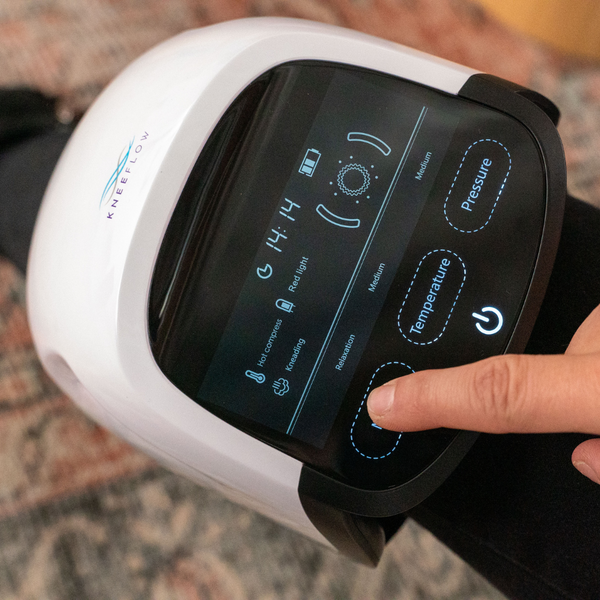
Kneeflow combines heat, red light therapy and air compression in one wearable so you are not juggling three gadgets. Browse the page for the knee massager with red light therapy to see the listed specifications and decide whether it fits your routine.
Price matters too. Cheap is not automatically bad, and expensive is not automatically good. Transparent is what you want.
Three Mistakes That Waste a Good Light
-
Sitting too far away. Intensity drops fast with distance, so follow the distance printed on the spec sheet.
-
Letting clothes get in the way. Thick fabric blocks light. Place the device on bare skin.
-
Overdoing sessions. Remember the biphasic curve. Longer sessions are not stronger sessions.
Once the does any red light work for red light therapy question is settled, a good device can still underperform when it is used badly. Technique counts.
Does Any Red Light Work for Red Light Therapy? Pick the One That Shows Its Work
The question was never really about color. It was about proof. Does any red light work for red light therapy? Only the kind that can show its wavelength, its power and its dose. Everything else is decoration.
Your knee deserves more than a glow. At Kneeflow, we would rather answer questions than oversell, so if you are ready to buy or want help choosing, contact the team and we will point you in the right direction.