Is red light therapy the same as infrared? Short answer: No, but it’s a little more complicated than that. The near-infrared is part of the infrared spectrum, and therefore many red light therapy devices contain components of near-infrared light as well. However, when speaking clinically, near-infrared and red light are two separate categories, and the only distinction is not about wavelength categorization on a spectrum chart. It is about mechanisms. What is the light doing inside the tissue, and what biological changes does that produce?
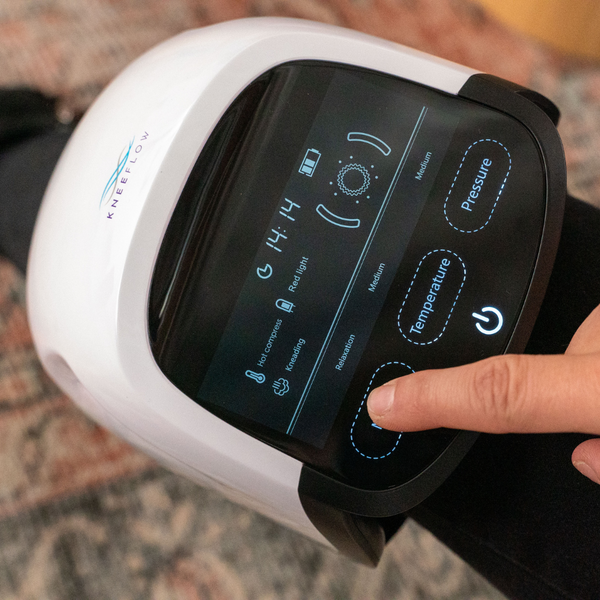
This question has a very specific answer, depending on which part of the label you are talking about for “infrared” or “red light”. Both heat and near-infrared photobiomodulation are incorporated into the Kneeflow design to serve two separate functions in joint recovery. If you want to see how that works in practice, the Kneeflow heated knee massager combines the two mechanisms alongside compression in a single wearable device.
The Electromagnetic Spectrum: A Quick Map
Is red light therapy the same as infrared? Context first.
The part of the light spectrum that we can see with the naked eye has a wavelength of about 380 to 700 nm. Below 380 nm we have the ultraviolet light, above 700 nm we have the infrared light. Infrared light is divided into near-infrared (700-1100nm), mid-infrared (1100-100000nm) and far-infrared (100000-1m).
Red light as used in therapeutic devices sits at the upper edge of visible light, typically 630 to 700nm. It is visible as a red glow when the device is active.
Near-infrared radiation covers the range of approximately 700nm to 1100nm and is not visible to the human eye. Devices that emit near-infrared typically appear dark and do not emit any light, even at maximum power, but may emit a faint red glow towards the lower end of this range.
The far-infrared region is approximately 3000nm and above. This region is utilized by most far-infrared heating devices including most so-called infrared saunas and produces its effects by surface absorption followed by action within the surface tissues primarily as heat.
Is red light therapy the same as infrared in terms of wavelength position? Near-infrared overlaps with both categories. Far-infrared does not. The mechanisms each produces are where the meaningful differences live.
Is red light therapy the same as infrared: Two Mechanisms, Not One
Here is the core of the distinction.
Red light therapy and near-infrared photobiomodulation use photochemical effects to increase activity within cells. When cells absorb light of the proper wavelengths, it causes a photochemical reaction. The increased activity in the cells causes a number of positive effects including increased production of ATP, release of nitric oxide into the surrounding vasculature, inflammatory cytokine expression decreases, and collagen synthesis accelerates. These are cellular-level changes that require specific wavelengths to be absorbed by specific molecular targets. The effect is not thermal. The tissue does not need to warm for the mechanism to operate.
Infrared heat therapy (conventional as well as far-infrared) uses light which is absorbed by the tissue as heat. This heat is then distributed to the surrounding water molecules and proteins in the tissue causing a local rise in temperature. As the temperature of the tissue is raised, several secondary effects can occur. First, the increased temperature produces secondary effects: vasodilation from the warmth, relaxation of tight musculature, increased local circulation driven by the thermal stimulus. These are real and clinically useful effects. They are not the same as photobiomodulation. They are temperature-mediated tissue responses.
Is red light therapy the same as infrared in terms of mechanism? No. One works photochemically at the cellular level. The other works thermally at the tissue level. Both produce beneficial effects. They produce them through entirely different pathways.
Where Photobiomodulation Lives on the Spectrum
The wavelength range where photobiomodulation operates is specific: roughly 630 to 1100nm, covering visible red and near-infrared. Within this range, the primary target is cytochrome c oxidase, which has absorption peaks at several wavelengths including around 660nm, 810nm, and 830nm.
There is a specific wavelength range where photobiomodulation takes place (between 630 nm and 1100 nm), namely the red part of the visible spectrum and the near-infrared part of it. The major effect on cells is exerted by means of activation of cytochrome c oxidase. The absorption peaks of this enzyme are at several wavelengths including approximately 1100nm, where water absorption in tissue becomes the dominant interaction again, and thermal effects begin to predominate over photochemical ones.
Research into the optical penetration of tissue by light has found that the wavelength selection for therapeutic devices is not random. Thus devices operating at 810nm or 850nm near-infrared and others operating at 660nm visible red are targeting the same photobiomodulation mechanism. Thus, in functional terms, they are offering ‘red light therapy” in the functional sense even though only one emits visible red light. Both are technically infrared or near-infrared in terms of wavelength position.
The Far-Infrared Distinction
Far-infrared is where is red light therapy the same as infrared becomes most clearly a no.
Far-infrared radiation, which is used in many saunas and heating pads, is completely absorbed in the upper millimeter or so of human tissue. Thus, it does not penetrate to the muscle, tendons and joints that are affected by musculoskeletal problems. Their therapeutic effect is the heat they generate at the tissue surface, which then conducts inward over time and produces the circulatory and musculature-relaxing effects associated with heat therapy.
When you are looking for penetration to reach the mitochondria of cells in the tissues you want to treat with photobiomodulation, wavelengths of 660nm to 850nm are relevant as they penetrate several centimeters into biological tissues. Near-infrared wavelengths thus reach joint tissues that are distant from the surface. Far-infrared does not produce wavelengths, which are too long to be absorbed by cytochrome c oxidase, and they do not penetrate far enough to reach joint structures even if they could trigger the mechanism.
An infrared sauna and a near-infrared LED or laser device are both “infrared therapy” in a broad sense. They produce their effects through completely different physical processes and target completely different tissue depths.
Near-Infrared: The Bridge Between Both
Near-infrared is the part of the spectrum where is red light therapy the same as infrared becomes genuinely complicated.
Near-infrared wavelengths, particularly 800 to 1100nm, trigger photobiomodulation through the same cytochrome c oxidase pathway as visible red. They are not visible to the eye. They penetrate deeper than visible red into biological tissue because the chromophores in tissue absorb them less strongly at longer wavelengths, allowing more photons to reach deeper structures. For joint applications, near-infrared is typically considered more therapeutically relevant than visible red specifically because of this penetration depth advantage.
Near-infrared is also technically part of the infrared spectrum. So when a device is marketed as “infrared therapy” and uses wavelengths between 800 and 1000nm, it is both infrared therapy and red light therapy in the functional sense. The mechanism is photobiomodulation. The wavelengths are technically infrared. The label depends on which classification system the manufacturer is using, not on any difference in mechanism.
The practical implication: a device claiming “infrared therapy” may or may not be producing photobiomodulation depending entirely on what wavelengths it emits. Near-infrared around 850nm produces photobiomodulation. Far-infrared around 10,000nm produces heat. The word infrared alone does not tell you which one you are getting.
Why This Matters When Choosing a Device
The distinction between photobiomodulation and thermal infrared is not academic for someone choosing a recovery device.
A device producing photobiomodulation at the correct wavelengths can reduce pro-inflammatory cytokine expression at the synovial tissue level, support collagen synthesis in damaged tendons, and accelerate the cellular conditions for tissue repair. These effects are documented in controlled clinical trials for conditions including knee osteoarthritis, patellar tendinopathy, and post-surgical recovery.
A device producing far-infrared heat warms the tissue and produces the circulatory and musculature-relaxing effects of heat therapy. These are also genuine and clinically useful. They are not the same outcomes as photobiomodulation.
When a product marketed as “infrared therapy” is being evaluated for clinical joint conditions, the wavelength matters more than the label. Is red light therapy the same as infrared in terms of outcome for joint disease? Only if the infrared device is operating in the near-infrared photobiomodulation range at therapeutic power density. Far-infrared heat devices do not produce the anti-inflammatory cellular effects that the photobiomodulation evidence base supports.
How Devices Often Combine Both
Many therapeutic devices, including well-designed wearable knee devices, intentionally combine both mechanisms.
A thermal component and NIR photobiomodulation emitters such as LEDs or lasers can be activated simultaneously to address different aspects of recovery. A thermal component increases local blood flow, loosens surrounding muscles and reduces stiffness through thermal vasodilation. The NIR photobiomodulation component reduces expression of inflammatory cytokine expression and supports cellular tissue repair through the photochemical mechanism. Neither mechanism duplicates the other. Used together, they produce a more complete tissue-level response than either alone.
This combination is different from a device using far-infrared heat and calling it infrared therapy. The photobiomodulation component requires specific near-infrared wavelengths at therapeutic power density, not just infrared warmth reaching the tissue surface.
Is Red Light Therapy The Same As Infrared and Closing Thoughts
Is red light therapy the same as infrared? Not when the terms are used precisely. Red light therapy and near-infrared photobiomodulation share a mechanism, differ from far-infrared heat therapy by mechanism, and overlap with infrared on the wavelength spectrum without being equivalent in clinical function. A device that delivers near-infrared photobiomodulation is doing something different from a device that delivers far-infrared heat, even if both are marketed under the “infrared therapy” label.
For joint conditions specifically, the distinction matters in terms of which biological processes are being addressed, at what tissue depth, and with what clinical evidence behind the claimed outcomes. If you want to talk through how this applies to your situation and what Kneeflow’s approach to these mechanisms looks like in practice, contact us now and the Kneeflow team will respond directly.