There was a window, not long ago, when bringing up red light therapy in a clinical setting earned a certain kind of look. The kind that says "we've seen wellness trends before." That window has closed. The controlled trials that skeptics demanded have accumulated, the mechanism has been traced to specific molecular targets inside cells, and the clinical picture that athletes and physical therapists were describing for years has turned out to be accurate. Red light therapy works. The more interesting question now is why, and what that means for how to use it.
The answer lives in the mitochondria, in enzyme activity, in nitric oxide release and cellular energy production. None of that is metaphor or marketing. It is photobiology, a branch of science that studies what specific wavelengths of light do when they are absorbed by living tissue. Understanding it changes how you evaluate devices, how you structure sessions, and what you can realistically expect from the treatment.
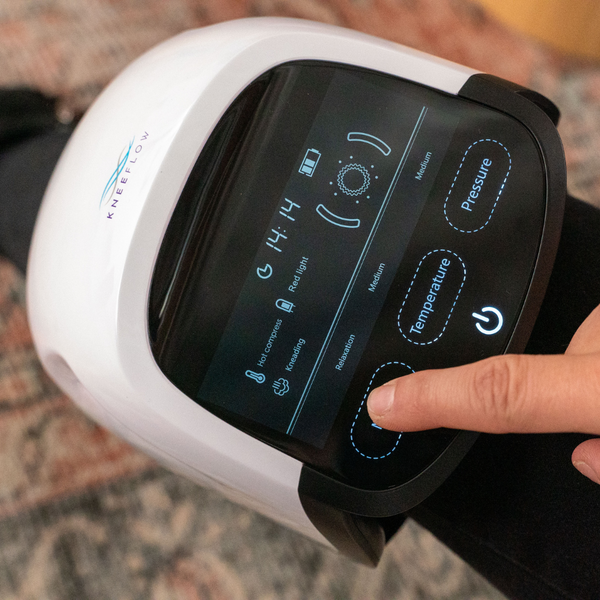
Kneeflow integrates red light therapy into joint recovery because this mechanism is directly relevant to what arthritic and overloaded joints need. If you want to see that in action, the Kneeflow heated knee massager with red light therapy combines it with heat and compression in one wearable device.
What Light Does Inside a Cell
Photobiomodulation. The word is a mouthful, and it describes something precise: specific wavelengths of light, absorbed by specific molecules inside cells, triggering specific biological responses. Not all light does this. Ultraviolet damages genetic material. Visible light in the green and blue ranges largely passes through tissue without being absorbed by anything that matters here. Red and near-infrared wavelengths, roughly 630 to 1100 nanometers, hit a target that sits at the center of cellular energy production.
That target is an enzyme called cytochrome c oxidase.
It sits inside the mitochondrial membrane. It drives the final step of ATP synthesis. And it has a documented photosensitivity to red and near-infrared wavelengths that produces a measurable change in its activity when the right light reaches it.
Here is what happens when it does. ATP production goes up, because the enzyme is running more efficiently. Nitric oxide that had been blocking the enzyme, a normal cellular stress response that essentially throttles energy output, gets displaced and released into the surrounding tissue. That nitric oxide dilates local blood vessels.
More blood flow. Better oxygen delivery. Faster clearance of metabolic waste. And the reactive oxygen species produced by the newly activated metabolic activity trigger downstream signals that modulate inflammation, stimulate fibroblast activity, and accelerate the repair processes in damaged tissue.
What peer-reviewed research on photobiomodulation consistently shows is that these cellular events produce measurable outcomes at the tissue level. Wound healing accelerates. Collagen production increases. Inflammatory markers decrease. Pain signals reduce. These findings hold across independent research groups and multiple study designs.
Why the Tissue Type Changes Everything
Muscle. Tendon. Joint capsule. Synovial membrane. Each responds to red light therapy, and each responds for slightly different reasons.
In muscle, the ATP upregulation and improved circulation reduce the cellular damage that heavy training produces. Creatine kinase, a blood marker of muscle breakdown, is lower in athletes who receive photobiomodulation after exercise than in those who do not. Next-day soreness scores drop. The time between hard sessions and the ability to perform at full capacity again shortens. These are not small effects, which is part of why professional sports teams have integrated this technology into their recovery protocols without waiting for every detail of the dosing science to be settled.
Tendon tissue is a different story. Tendons heal slowly because they are poorly vascularized. They depend on the circulatory environment of the surrounding tissue for their nutrient supply, and they respond to chronic overloading not with classic inflammation but with structural disorganization of their collagen architecture. Red light therapy supports fibroblast activity and collagen synthesis, two processes directly relevant to tendon recovery, through the same cellular mechanism that benefits muscle, applied to tissue that has fewer of its own repair resources to draw on.
In the joint itself, the anti-inflammatory dimension matters most. What clinical trials on red light therapy for musculoskeletal conditions document is a reduction in the expression of cytokines including IL-1β and TNF-α. These molecules drive the chronic joint inflammation that characterizes osteoarthritis. Reducing their expression does not rebuild cartilage. It changes the chemical environment the cartilage is sitting in, which is a different thing and still a meaningful one.
Red Light Versus Near-Infrared: Depth Is the Deciding Factor
Red light, which is in the visible portion of the light spectrum and ranges from 630nm to 680nm, is very easily absorbed by the chromophores in the surface layers of the skin. It is suitable for dermatological treatments, for wound healing and for surface tissues. It does not penetrate deeply enough to reliably deliver therapeutic doses to muscle bellies, tendons, or joint structures sitting several centimeters beneath the surface.
Near-infrared, in the 800 to 850 nanometer range, scatters differently through tissue. Less absorption at the surface means more photons reach depth. Muscle tissue at three centimeters. The joint capsule. The synovial membrane. The patellar tendon. These are the structures that near-infrared is actually reaching in a therapeutic session, and they are also the structures most relevant to knee and joint conditions.
Most devices designed for musculoskeletal applications combine both ranges. Visible red handles the superficial layers while near-infrared carries the treatment into the tissue below. A device that emits only visible red light and claims to treat joint pain is making a claim that the physics of tissue penetration does not support at typical power densities.
Where the Evidence Is Solid and Where It Is Still Developing
Honesty about this matters if the goal is making an informed decision rather than simply believing the marketing.
The strongest evidence sits in wound healing and dermatological applications. The outcomes are measurable, the tissue is accessible, and the findings have been replicated consistently across independent research groups for decades. This is not contested territory.
Although the evidence is positive for the use of red light therapy for musculoskeletal and joint conditions, it is still evolving. Systematic reviews that include studies using red light therapy for the treatment of knee osteoarthritis, tendinopathy and muscle recovery report that in comparison to sham treatment, there is benefit from treatment.
The effect sizes are meaningful. What is still being optimized is the precise combination of wavelength, power density, session duration, and frequency that maximizes outcomes for specific conditions. The therapeutic window exists. Its exact coordinates continue to be mapped.
This does not make the evidence weak. It makes it honest. The research base for red light therapy in musculoskeletal conditions is stronger today than it has ever been, and it is still accumulating.
Using It in a Way That Actually Works
Parameters matter. Applying the wrong wavelength to the wrong tissue depth, or delivering a dose that falls outside the therapeutic window, produces results that range from minimal to nonexistent.
Wavelength first. For joint and musculoskeletal applications, near-infrared around 810 to 850 nanometers is the range doing the relevant work at depth. Visible red at 630 to 680 nanometers addresses superficial tissue. Combination devices cover both.
Power density determines how quickly energy accumulates at the target tissue. Higher power density means shorter sessions can deliver equivalent doses. Lower power density requires longer sessions. Most clinical protocols for joint conditions target a total energy dose of two to six joules per square centimeter per session.
Frequency matters as much as individual session quality. Daily sessions during an active recovery period maintain the cellular conditions photobiomodulation creates continuously enough to produce cumulative tissue-level change. For ongoing joint health maintenance, three to five sessions per week sustains the benefit without demanding daily commitment.
The people who get the least from this treatment are those who use it inconsistently. The cellular effects require regularity to compound into the tissue-level changes that produce noticeable improvement. Kneeflow provides a red light therapy system for support, which can help to the recovery process of the knee.
Closing Thoughts on Red Light Therapy
Used correctly, with appropriate wavelengths reaching the right tissue at therapeutic doses delivered consistently, red light therapy is one of the more versatile and well-supported recovery tools available without clinical supervision. It does not replace load management, strength training, or anti-inflammatory habits.
It adds a cellular dimension none of those address directly, and it does so through a mechanism that is well-characterized, non-invasive, and compatible with everything else in a comprehensive joint care routine. If you want to talk through how it fits into your specific situation, contact Kneeflow and have options that can help to the whole process of your recovery.