Hiking is great for your body, but your knees may not always agree. Long climbs, steep descents, uneven trails, and carrying a backpack can put quite a bit of stress on the knee joint. Sometimes you finish the hike feeling fine, only to wake up the next morning with stiffness, soreness, or that annoying feeling that your knees just do not want to bend properly.
That does not always mean something is seriously wrong. Your knees have simply done a lot of work.
The good news is that a little recovery care can make a big difference. From gentle movement and heat therapy to using knee pain relief equipment, there are several simple ways to help your knees feel more comfortable after a long hike.
1. Give Your Knees Time to Recover
The first thing to do after a demanding hike is pretty simple: slow down.
You do not need to spend the entire day in bed, but jumping straight into another hard workout is probably not the smartest move. Give your knees some time to settle, especially if you notice soreness, knee stiffness, or mild swelling.
Gentle walking around the house can actually be better than sitting completely still for hours. Keep your movements easy and avoid activities that make the discomfort worse.
If pain is sharp, severe, keeps getting worse, or does not improve with rest, it is worth speaking with a healthcare professional instead of trying to push through it.
2. Try Gentle Stretching
Hiking works more than just your knees. Your quadriceps, hamstrings, calves, and hips all help keep your legs stable while you walk over uneven ground.
When these muscles become tight, your knees can feel the difference.
After your hike, try gentle stretches for your quads, hamstrings, and calves. Do not force the movement or bounce into a stretch. You should feel a mild pull, not pain.
A few minutes of easy stretching can help your legs loosen up and may make the next day feel a little less rough.
3. Use Heat Therapy for Stiff, Tired Knees
Heat therapy can be useful when your knees feel stiff, or your surrounding muscles feel tight after hiking. Warmth can help relax muscles and make the area feel more comfortable.
This is especially useful when your main problem is that stiff, tight feeling rather than fresh swelling from an injury.
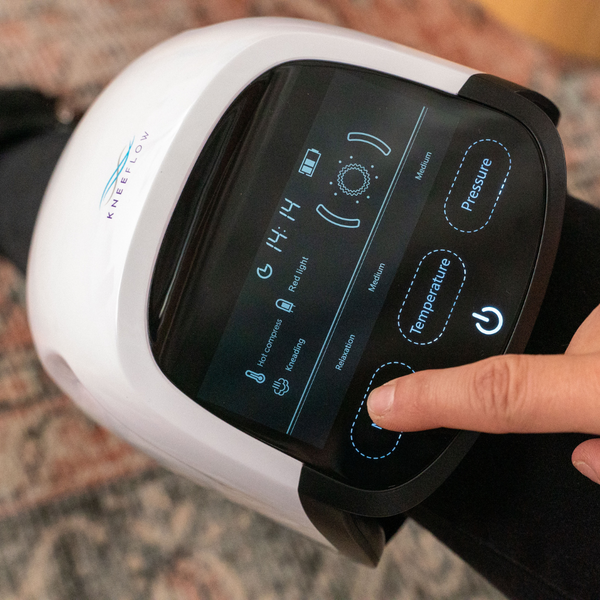
A wearable knee massager can make this easier because you do not have to sit beside a heating pad and keep adjusting it. For example, Kneeflow combines heat, infrared light, and soft airbag massage in one portable device.
Its heating settings can be adjusted between 45°C, 50°C, and up to 55°C, allowing you to choose a level that feels comfortable for you.
4. Consider a Wearable Knee Massager
Sometimes you just want something that helps you relax after several hours on a trail.
That is where a wearable knee massager can fit into a recovery routine. Instead of manually massaging your knee, the device wraps around the joint and provides targeted therapy while you sit and recover.
Kneeflow combines three features: infrared light, heat therapy, and soft airbag massage. The airbag system provides gentle compression around the knee, while the heat and infrared functions are designed to support comfort and circulation.
It also runs a customizable 15-minute therapy cycle, so you do not need to spend a huge amount of time on recovery.
If you want to understand more about how knee massagers may support mobility and everyday joint care, check out our guide on 10 Surprising Benefits of Using a Knee Massager for Joint Health and Mobility.

5. Keep Moving, But Keep It Easy
Complete inactivity is not always the answer after hiking. Once your knees feel ready, gentle movement can help you get back into your normal routine.
Try an easy walk on flat ground instead of another steep trail. Light cycling may also be comfortable for some people, depending on their condition.
The key is to pay attention to how your knees respond. If an activity causes increasing pain, stop and give yourself more recovery time.
There is no prize for turning recovery into another workout.
6. Pay Attention to Hydration and Nutrition
Recovery is not only about what you do to your knees. Your entire body needs enough fluids and nutrients after a long hike.
Drink enough water, particularly if you were sweating heavily during the hike. A balanced meal containing protein, carbohydrates, healthy fats, and plenty of nutrient-rich foods can also support your body's normal recovery processes.
You do not need a complicated recovery diet. A proper meal and enough fluids will usually do more for you than a cabinet full of trendy recovery products.
7. Check Your Hiking Gear
If your knees regularly hurt after hiking, look beyond recovery and consider what happened during the hike.
Poorly fitting footwear, carrying too much weight, sudden increases in hiking distance, and spending hours on steep terrain can all increase the workload on your legs.
Your shoes should provide a comfortable fit and suitable support for the terrain. Your backpack should also be adjusted properly and not overloaded.
And if you suddenly went from short weekend walks to a six-hour mountain hike, your knees may simply need more time to adapt.
8. Build Recovery Into Your Hiking Routine
Do not wait until your knees hurt badly before thinking about recovery.
If hiking is a regular part of your lifestyle, create a simple routine around it. After longer hikes, give yourself time to cool down, stretch gently, hydrate, and use whatever recovery method works comfortably for you.
For people who regularly deal with knee stiffness or post-hike discomfort, knee pain relief equipment can become part of that routine.
Kneeflow is designed for convenient home use and can also be taken with you because it is cordless and weighs around 790g. Its adjustable strap can also be used around other joints, such as the elbow or shoulder.
When Should You Be Concerned About Knee Pain After Hiking?
Normal post-hike soreness should generally improve with rest and time. However, significant swelling, instability, locking, a sudden injury, severe pain, or difficulty putting weight on your leg deserves more attention.
Do not assume every knee problem is just muscle soreness.
If you have an existing knee condition, recent surgery, or a significant injury, talk with your healthcare provider before adding heat, massage, or other recovery equipment to your routine.
Give Your Knees Some Attention Before the Next Trail
Hiking puts your knees through plenty, especially on steep downhill sections and uneven terrain. A little recovery work afterward can help you stay comfortable and ready for your next adventure.
Gentle stretching, adequate rest, hydration, sensible activity, heat therapy, and a wearable knee massager can all be useful parts of a personal recovery routine.
If you want a convenient way to combine heat, infrared light, and gentle massage in one device, explore Kneeflow and see whether it fits your recovery routine.
Ready to give your knees a little more care after the trail? Explore Kneeflow here.
FAQs
1. Why do my knees hurt after hiking?
Knee discomfort after hiking can happen because your knees are handling more load than they normally do, especially during steep climbs and descents. Walking downhill can be particularly demanding because your leg muscles work to control your body as you move down the trail. Uneven surfaces, long distances, heavy backpacks, and suddenly increasing your hiking activity can also contribute to soreness or knee stiffness. If pain is severe, persistent, or accompanied by significant swelling or instability, consider getting professional medical advice.
2. How can I reduce knee stiffness after hiking?
Start by giving your knees some recovery time without keeping them completely still all day. Gentle walking and light stretching can help you stay mobile while avoiding activities that increase your discomfort. Heat therapy may also feel soothing when stiffness is related to tight muscles or general post-activity discomfort. A wearable knee massager can combine warmth and gentle massage in a convenient format, making it an option for people who want a simple recovery routine at home.
3. Is heat therapy good for knee pain after hiking?
Heat therapy can be helpful for temporary stiffness and tight muscles following physical activity. Warmth can make muscles around the knee feel more relaxed and may provide a soothing sensation after a long hike. However, heat is not appropriate for every situation, particularly when there is fresh swelling or an acute injury. If you are unsure whether heat therapy is suitable for your knee problem, especially if you have an existing condition, speak with a healthcare professional first.
4. Can a knee massager help after a long hike?
A knee massager can be a convenient addition to a post-hiking recovery routine when your knees feel tired, stiff, or generally uncomfortable. Devices such as Kneeflow combine soft airbag massage with heat and infrared light, allowing you to receive several forms of comfort-focused therapy in one session. Its customizable settings let you adjust the heat and massage according to your comfort level. A knee massager should be considered a supportive wellness tool, not a replacement for medical treatment when an injury is involved.
5. What is the best knee pain relief equipment after hiking?
There is no single piece of knee pain relief equipment that works the same way for everyone. Some hikers prefer stretching, others use heat packs, compression products, or massage devices as part of their recovery routine. A wearable knee massager can be convenient because it provides targeted massage and heat without requiring you to manually massage the area. Kneeflow also adds infrared light and offers a 15-minute customizable therapy session for people looking for a portable option.
6. Can hiking cause joint inflammation?
Hiking can temporarily increase irritation around a joint, particularly when the activity is much harder or longer than your body is used to. Steep terrain, repeated downhill walking, uneven ground, and carrying additional weight can all increase the physical demands placed on the knees. However, not every episode of post-hike soreness means you have joint inflammation or an injury. If swelling, warmth, pain, or reduced movement continues or becomes significant, getting an appropriate medical evaluation is a sensible step.
7. Should I use a knee massager before or after hiking?
A knee massager can be used as part of a recovery routine after hiking, particularly when your knees feel tired or stiff following activity. Some people may also prefer gentle heat or massage before physical activity because it feels relaxing and helps them prepare. The right timing depends on your comfort, the device instructions, and your individual knee condition. Kneeflow is designed around customizable 15-minute sessions, so it can be incorporated into a routine without requiring a large time commitment.
8. How does a wearable knee massager work?
A wearable knee massager wraps around the knee and delivers therapy directly to the area while you sit or relax. Kneeflow combines soft airbag massage, heat therapy, and infrared light, giving users several customizable options in one device. The soft airbags provide gentle compression around the knee, while the heating function provides warmth. The device also includes 19 infrared lights and an automatic 15-minute shutoff as part of its design.
9. Can heat therapy help with knee stiffness after hiking?
Heat therapy can provide soothing warmth when your knees feel stiff, and the surrounding muscles feel tight after physical activity. The warmth may help you feel more comfortable and relaxed, particularly when stiffness is the main complaint. A device such as Kneeflow allows users to select different heating levels and combine heat with massage. However, if your knee is newly injured, significantly swollen, or unusually painful, avoid assuming heat is the right option and seek appropriate medical guidance.
10. How long should I rest my knees after hiking?
There is no fixed recovery period that applies to every hiker because it depends on the length and difficulty of the hike and how your knees feel afterward. Mild soreness may settle with normal daily movement and a lighter activity day, while a harder hike may require more recovery time. Instead of focusing only on a specific number of hours, pay attention to whether your symptoms are improving. Persistent or worsening pain, major swelling, instability, or difficulty bearing weight should be assessed by a healthcare professional.
11. Can a knee massager help with knee stiffness and mobility?
A knee massager may help you feel more comfortable when stiffness makes normal movement feel difficult. Gentle massage and heat can help relax the tissues around the knee, which may make movement feel easier for some people. Kneeflow combines these features with infrared light and soft airbag compression in a portable design. It is best viewed as a supportive tool for comfort and recovery rather than a guaranteed treatment for an underlying knee condition.
12. Is Kneeflow suitable for people who hike, run, or cycle?
Kneeflow is designed for people who want convenient knee care as part of an active lifestyle, including those who hike, cycle, run, or participate in other sports. Its portable cordless design makes it practical to use at home or after physical activity, and its 790g weight makes it easier to carry than many larger recovery devices. The device provides heat, infrared light, and soft airbag massage in customizable 15-minute sessions. Anyone with a significant injury or medical condition should check with their healthcare provider before using a therapeutic device.
13. How often can I use a knee massager after hiking?
How often you use a knee massager depends on the device instructions, your comfort, and your individual circumstances. Kneeflow is designed around a 15-minute therapy cycle and includes an automatic shutoff to help prevent overheating. You should follow the manufacturer's instructions rather than assuming that longer or more frequent sessions will provide better results. If you experience unusual pain, increased swelling, skin irritation, or other concerning symptoms during use, stop using the device and seek professional advice.