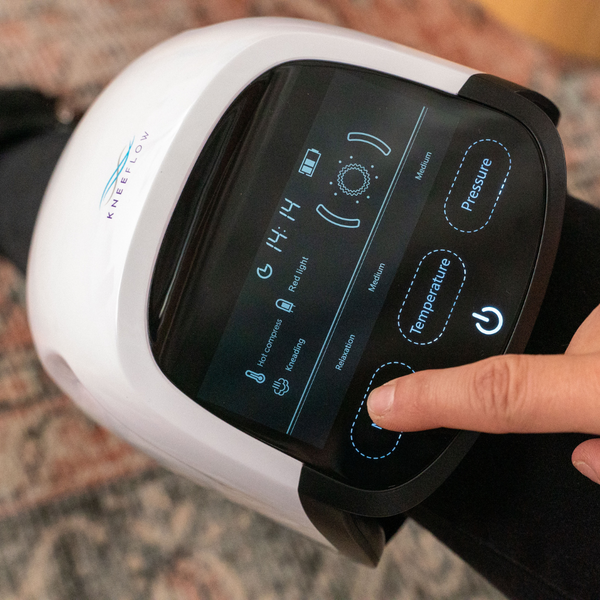
Do heated knee massagers work? For everyday knee stiffness and soreness, the answer is a confident yes with a catch. Heat and gentle compression can loosen a tight joint and take real discomfort down a notch. What they can't do is fix whatever's actually causing pain underneath the surface, and any page telling you otherwise is peddling a promise the research just doesn't back up.
This piece breaks down why heat, compression, and vibration are supposed to help in the first place, what the science shows, the situations where people actually reach for a device like this, and exactly where the line sits between easing discomfort and needing a doctor instead.
We shaped the Kneeflow Massager around this same blunt honesty, mostly because plenty of the people writing in already burned money on a cheaper device that overpromised and left them wary of the whole category.
This isn't marketing dressed up as research. It's a clear-eyed walk through where heated knee massagers earn their keep, and where they simply don't.
How Heat, Compression, and Vibration Are Supposed to Help
Heat widens blood vessels near the skin's surface, which cranks up circulation and loosens the muscles wrapped around a stiff joint. Picture the way a warm bath melts tight shoulders, then point that same effect squarely at the knee. Grasping this mechanism is step one in answering do heated knee massagers work without just trusting a product page's word for it.
Gentle compression stacks a second layer on top of that. Alternating pressure nudges fluid around the joint, which explains why so many people describe compression as feeling like it physically moves stiffness rather than just muffling it. Vibration, on devices that include it, throws in a mild massage-like buzz that can melt tension around the kneecap and along the sides of the joint.
None of this rebuilds cartilage, stitches a torn ligament back together, or reverses arthritis. It works on comfort, blood flow, and muscle tension, a legitimate payoff on its own, just a completely different one from fixing whatever's structurally happening inside the joint. Anyone asking whether heated knee massagers work as a cure is chasing the wrong question. The one worth asking is whether they ease discomfort, and there the answer tilts firmly toward yes.
What the Research Actually Says
Do heated knee massagers work according to hard clinical evidence, or mostly according to clever copywriting? The truth splits the difference. A Cochrane review on thermotherapy for knee osteoarthritis found that heat and cold packs, sometimes paired with massage, delivered some benefit for pain and range of motion compared with no treatment at all, though the reviewers didn't hide that the underlying studies were small and shaky on quality.
That review calls this the best evidence available right now, not proof of some dramatic transformation. Other research digging into heat therapy for knee osteoarthritis turns up nearly the same story when it comes to whether do heated knee massagers work in a clinical setting: modest, real improvement in pain and stiffness, powered by better circulation and looser muscles rather than any actual shift in the joint itself.
Compression and vibration carry far less research pinned specifically to the knee, and most of what exists traces back to general muscle recovery studies instead of trials built around heated knee devices themselves. That gap deserves a straight answer instead of getting buried under confident marketing copy, and it's exactly why a fair verdict on do heated knee massagers work has to separate the well-studied piece, heat, from the extras layered on top that haven't been tested nearly as thoroughly.
Situations Where People Commonly Reach for One
A handful of recurring situations tend to push people toward a heated knee massager, and spotting which one fits your own experience helps set expectations before any money changes hands. None of this doubles as a self-diagnosis checklist. It's simply where the question "do heated knee massagers work for this?" shows up most often.
Knee Pain That Lingers Past a Few Days
Pain that refuses to quit after basic rest, ice, or an over-the-counter pill often signals inflammation or muscle tension that heat paired with better circulation can genuinely calm, even though the underlying cause still deserves an actual explanation from a doctor if things don't turn around. This is one of the more common jumping-off points for anyone researching heated massagers, since lingering discomfort is exactly the kind of everyday complaint heat therapy handles well.
Morning Stiffness or Stiffness After Sitting
A knee that feels rusted shut first thing in the morning, or after a long stretch parked in a chair, follows a pattern heat handles particularly well, since warmth loosens tissue that's tightened up from sitting still too long. A short session before climbing out of bed or right after standing up from a desk can make the first several steps noticeably easier, which is a small, everyday example of do heated knee massagers work in action rather than in theory.
Achiness That Worsens in Cold Weather
Cold squeezes blood vessels shut and stiffens connective tissue, which is exactly why people with sensitive joints notice more discomfort once winter rolls around. Warmth flips that mechanism in reverse, part of why heat therapy has such a long history tied to this specific complaint, decades before heated wearable devices ever existed.
Muscle Tightness Around the Knee
Pain doesn't always start inside the joint itself. Tight quadriceps, hamstrings, or calves can tug on the knee and create discomfort that stretching alone hasn't cracked, and heat paired with gentle massage goes straight after that surrounding muscle tissue, often exactly where these devices prove most useful.
Soreness After Standing, Walking, or Activity
Aching after a long stretch on your feet ranks among the top reasons people fold a heat and compression session into their evening wind-down, treating it the way an athlete might treat a cooldown after training. It's also one of the simplest situations to test firsthand, since the comfort payoff usually shows up that same evening.
What a Heated Knee Massager Can't Do
Time to be blunt about the limits, since this is exactly where marketing tends to quietly overreach. A heated knee massager doesn't treat arthritis, tendonitis, bursitis, or any other diagnosed condition. It doesn't stand in for physical therapy, medication a doctor prescribed, or a structured rehab plan. If you're wondering whether do heated knee massagers work for an actual diagnosed structural problem, the flat answer is no, not by themselves.
If a doctor has already put a name to your knee condition, a device like this can slot in as a smart comfort add-on layered into care you're already receiving, not a stand-in for it. Leaning on heat and compression as your entire response to a diagnosed condition, instead of sticking with whatever plan a doctor actually laid out, tends to leave the real issue untouched no matter how good each session feels in the moment. This is where the do heated knee massagers work question gets a firm no, at least on its own.
How It Compares to Simply Resting
Rest carries real weight, especially right after an acute flare-up or fresh injury, since it gives angry tissue room to settle without piling on more stress. Where rest falls flat is stimulating circulation, since a joint sitting perfectly still isn't getting the improved blood flow that clears inflammation and ferries nutrients to healing tissue. This is really the crux of the do heated knee massagers work question: they add something rest can't touch, not something rest was botching.
A heated knee massager stacks that circulation piece on top of rest instead of replacing it outright. The two play well together: pulling back from whatever's specifically aggravating the knee, while slotting in short sessions of heat and gentle compression to support comfort and movement in the gaps between.
Neither approach wins outright across the board. Rest carries more weight in the first day or two after a flare, while heat and compression earn their spot once the acute phase cools off and lingering stiffness becomes the main complaint, which is usually the exact moment someone starts googling do heated knee massagers work in the first place.
Choosing One That Actually Fits Your Routine
Adjustable heat and compression settings matter far more than any single number on a spec sheet, since a device you can dial down to something comfortable is one you'll actually stick with. A fixed, one-size setting tends to get shelved within a few weeks.
Portability decides how often a device actually gets picked up. A wearable option that straps on and lets you sit, read, or half-watch a show while it runs beats anything demanding you lie still in one spot, and sticking with it consistently is really what decides whether do heated knee massagers work for any given person.
We built the Kneeflow Massager around adjustable heat, gentle air compression, and a portable, rechargeable shape specifically because those details separate a device that becomes part of an actual routine from one gathering dust in a drawer.
Battery life and how fast it charges round out the practical side. A device demanding a charge every single day gets skipped far more than one that holds its charge across several sessions, another small detail that quietly shapes real-world results well beyond anything printed on a box.
Common Mistakes People Make
Expecting one session to erase pain that's been building for months tops the list of mistakes. Heat and compression work gradually, chipping away at discomfort session by session rather than delivering some dramatic overnight fix. Anyone judging do heated knee massagers work after a single try just isn't giving it a fair shot.
Cranking the heat to its highest setting, assuming more intensity equals faster results, comes in a close second. A moderate, comfortable setting held for a full session usually does more for circulation and muscle relaxation than a short blast of high heat that gets cut off because it's uncomfortable to sit through.
Leaning on a device instead of tackling an actual diagnosed condition rounds out the list. Comfort support and medical treatment solve two different problems, and skipping the second because the first feels good is a habit worth catching before it hardens into routine.
When Rest and Heat Aren't Enough
A heated knee massager, no matter how well built, was never designed to handle every kind of knee pain, and a few situations call for a doctor's exam instead of a home routine. Pain following a fall, a twisting injury, or a direct hit needs a proper look rather than a wait-and-see shrug, no matter how well do heated knee massagers work for garden-variety stiffness.
Swelling that balloons up fast, a knee that locks or feels wobbly, an inability to bear weight, visible deformity, or fever alongside knee pain all point toward something well beyond ordinary stiffness. Same goes for pain that keeps climbing instead of easing over a couple of weeks of sensible home care.
If you've already got a diagnosis, arthritis or tendonitis among them, checking with your doctor or physical therapist about how heat and compression fit into your actual treatment plan beats assuming a device handles that on its own.
The Bottom Line
Do heated knee massagers work? For everyday stiffness, muscle tension, and the ache that piles up from being on your feet all day, heat and gentle compression can make a genuine difference, backed by solid, if modest, research. What they won't do is diagnose, cure, or replace medical care for an actual joint condition, and drawing that line clearly is what separates a useful comfort tool from an overhyped one.
If you're still asking do heated knee massagers work for a situation like yours, the Kneeflow knee compression massager with red light page has the specifics, and you're welcome to reach out to our team with questions about settings, sessions, or what's realistic to expect.
Frequently Asked Questions
Do Heated Knee Massagers Actually Work?
For everyday stiffness, muscle tension, and soreness after activity, yes, heat and gentle compression genuinely support comfort and circulation. A Cochrane review on thermotherapy for knee osteoarthritis found real but modest benefit for pain and movement, based on the best evidence currently available, a fair result rather than a dramatic one. What these devices don't do is treat, cure, or reverse an underlying condition like arthritis. They work on comfort and circulation, not the structural cause of joint pain, so keeping expectations grounded matters more than chasing a miracle fix.
Can a Heated Knee Massager Help With Arthritis?
It can support comfort alongside arthritis care, but it doesn't touch the condition itself. Heat improves circulation and loosens muscles around a stiff joint, something plenty of people with arthritis genuinely appreciate day to day, but the underlying joint changes behind arthritis stay unaffected by heat or compression. Anyone diagnosed with arthritis should treat a device like this as a sidekick to whatever their doctor or physical therapist already recommended, not a replacement for it, and mentioning it during appointments helps it fit sensibly into an existing plan.
How Long Before You Notice a Difference?
Most people feel short-term relaxation within a single session, since heat and compression start working on circulation and muscle tension almost right away. The longer-term comfort people describe, less morning stiffness, easier movement, tends to build over one to a few weeks of fairly steady use rather than showing up after one try. Expecting instant, dramatic relief from a single session sets up disappointment even when the device is doing exactly what it's supposed to.
Is Heat or Ice Better for Knee Pain?
It hinges on the situation rather than one option winning outright. Ice earns its place right after an acute flare or injury, when knocking down swelling is the priority, while heat suits ongoing stiffness and muscle tension without active swelling. Some people bounce between the two depending on how a knee feels that day. A combination device offering heat alongside gentle compression handles the ongoing-stiffness half of that equation well, though it isn't meant to sub in for ice during an acute swelling episode.
Are Heated Knee Massagers Safe for Daily Use?
For most people, yes, at a moderate heat setting for a reasonable session length. Daily use generally counts as low risk, though anyone managing diabetes, neuropathy, or a circulation issue should check with a doctor first, since reduced sensation can hide a setting that's running too hot. Stopping and checking in with a healthcare provider is the right call if a session ever brings on burning, numbness, or unusual irritation instead of comfort.
Can a Heated Knee Massager Replace Physical Therapy?
No. Physical therapy tackles strength, mobility, and the specific mechanics behind a knee issue, none of which heat or compression can replicate on their own. A heated massager can be a smart comfort addition alongside a physical therapy program, easing tension before or after exercises, but it isn't a substitute for the guided, progressive work a physical therapist provides. Anyone recovering from an injury or surgery should follow their physical therapist's plan first and treat a massager as a supporting player rather than the main strategy.
What Should I Look for When Choosing One?
Adjustable heat and compression settings matter most, since a device you can dial to a comfortable level is one you'll actually keep using. Portability and battery life come next, since a wearable, rechargeable option fits daily life far more easily than something requiring you to sit still in one spot for a session. Beyond that, a snug but adjustable fit and a fair return or warranty policy are worth checking before buying, since comfort and fit vary enough from person to person that trying a device without much risk actually matters.
When Should I See a Doctor Instead of Using One at Home?
See a doctor if knee pain follows a fall, a twisting injury, or a direct impact, or if there's significant swelling, instability, locking, an inability to bear weight, or fever alongside the pain. Pain that keeps climbing instead of improving over a couple of weeks of sensible home care also deserves a proper look rather than more home treatment. Ordinary stiffness and muscle tension without these signs is generally fine to manage with rest, heat, and gentle movement, but anything outside that pattern is worth getting checked properly.