660nm. 850nm. Sometimes 630nm or 830nm. These are not interchangeable. They determine whether the light that goes through the skin reaches the cell machinery that causes the known effects of red light therapy or if it spreads in the layer of tissue before it reaches that cell machinery.
Most people who look at red light therapy devices focus on session time, brand reputation or LED count. The question about wavelength usually comes later when results are disappointing or when two devices that claim the same benefits look different enough to need inspection. What wavelength is red light therapy, and why does the specific nanometer value decide whether a device can actually do its stated job?
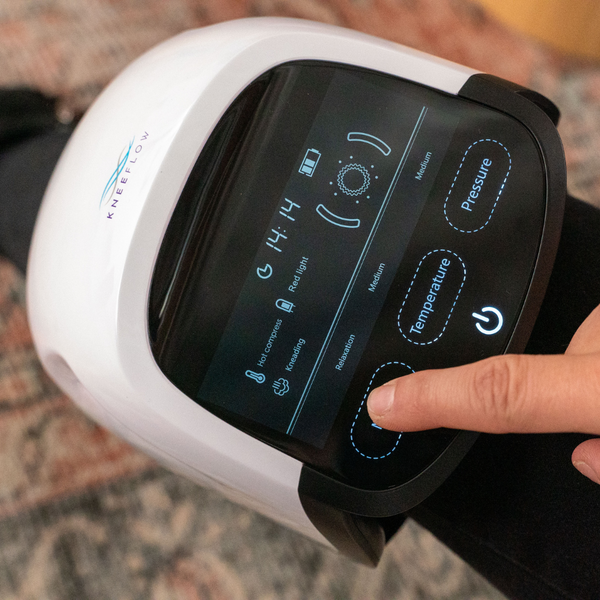
The answer lies at the meeting of physics and cell biology. Understanding what wavelength is red light therapy changes how you judge each red light therapy device. Kneeflow uses near-infrared wavelengths in its joint recovery design because that specificity is not optional for joint-level applications. If you want to see how that works in practice, the Kneeflow heated knee massager mixes calibrated near-infrared photobiomodulation with heat and compression in one device made for the knee. For the science behind how the mechanism works at the cell level, the complete guide to how red light therapy works and how to use it gives the full picture.
Why the Number Matters at All
Light behaves in a non-uniform way inside tissue. Different wavelengths meet chromophores, molecules that absorb light at specific frequencies. These encounters decide whether incoming photons go into tissue or deposit energy near the surface. Melanin absorbs strongly across the spectrum. Hemoglobin shows peaks in the range. Water absorbs broadly in the infrared above, about 1000 nm. Between 600 nm and 1100 nm all three absorbers are less efficient letting light reach centimeters into tissue instead of being caught at the surface. Researchers call this range the window of biological tissue.
Within that window sits cytochrome c oxidase. Cytochrome c oxidase is an enzyme complex that lives in the mitochondrial membrane and catalyzes the final step of electron transport producing adenosine triphosphate. Cytochrome c oxidase is the photoreceptor responsible for photobiomodulation. When light at the wavelength is absorbed by cytochrome c oxidase, cytochrome c oxidase activity increases. ATP production goes up. Nitric oxide that had been suppressing cytochrome c oxidase releases into surrounding tissue. Local circulation improves. Downstream cellular signals reduce cytokine expression and stimulate repair processes in damaged tissue.
Cytochrome c oxidase has four documented absorption peaks within the window: 620 nm, 680 nm 760 nm and 820 nm to 830 nm. Devices that emit light at or near these peaks increase the chance that incoming photons will reach and activate cytochrome c oxidase, of being absorbed by other chromophores or scattered before they reach the mitochondria of the target cells.
What wavelength is red light therapy? Any wavelength in the window that activates cytochrome c oxidase can be used. In practice the two wavelengths that most devices use are 660 nm and 850 nm. They are close to absorption peaks can be produced by LEDs and together they reach all tissue depths; from the skin surface, to joint structures where most musculoskeletal problems occur.
660nm: The Visible Red Wavelength
660nm is visible.
A device emitting at this wavelength produces the characteristic deep red glow that most people picture when they think about red light therapy. That visibility provides useful confirmation that the device is active. It also reflects something important about the wavelength’s behavior in tissue.
Visible red light at 660nm is absorbed easily by the top layers of living tissue than light that is closer to infrared. Melanin, the protein structure of the epidermis and the hemoglobin in the capillary network all interact with 660nm light more strongly than they do with 850nm. The practical result is that 660nm delivers most of its photon energy within one to two centimeters of the skin surface depending on tissue type and pigmentation.
For anyone asking what wavelength is red light therapy for superficial applications, 660nm is well matched to:
Skin rejuvenation and collagen stimulation in the dermis, where fibroblasts and keratinocytesre the primary cellular targets. Wound healing at the surface and subcutaneous layers, where the clinical evidence base for photobiomodulation's strongest. Post-inflammatory repair in the musculature and fascia immediately beneath the skin. Conditions affecting the connective tissue rather than the structures sitting deeper in the body.
For applications 660nm has a basic depth limitation. The synovial membrane, joint capsule, patellar tendon and the deep musculature surrounding the knee sit at depths that 660nm cannot reach at photon density, with most consumer devices. The photons arrive. Not enough of them do. This is the same physical constraint that prevents red light therapy from producing photobiomodulation through thick fabric, as explored in the breakdown of whether red light therapy works through clothes: any barrier that reduces photon density at the skin surface, whether fabric or tissue depth, pushes the arriving dose below the activation threshold.
850nm: The Near-Infrared Wavelength
850nm is invisible.
A device operating exclusively or primarily in near-infrared emits no visible glow. This causes confusion. People assume the device is not working because they cannot see the light. The light is there. The eye simply has no receptor cells sensitive to 850nm, so the signal does not register visually.
In tissue, 850nm behaves differently from 660nm. The chromophores that absorbed 660nm more aggressively are less active at longer wavelengths. More photons pass the surface layers intact, maintaining photon density at depth. Clinical measurements of light penetration in biological tissue put therapeutically useful photon density achievable at three to five centimeters of depth for near-infrared wavelengths, compared to one to two centimeters for visible red.
Three to five centimeters is the depth range where joints live.
The synovial membrane lining the knee joint capsule. The patellar tendon inserting below the kneecap. The deep quadriceps and the structures that most knee conditions affect. All of them sit at depths that 850nm can reach at therapeutic doses from a well-designed contact-delivery device. All of them sit at depths where 660nm alone cannot reliably deliver the dose required to trigger meaningful cytochrome c oxidase activation.
This is why what wavelength is red light therapy becomes a joint-specific question. For skin, either wavelength can work within its respective depth profile. For the knee joint, near-infrared is not a preference. It is the specification the physics requires.
Why Devices Combine Both Wavelengths
A device emitting only 660nm serves superficial tissue well and deeper tissue inadequately.
A device emitting only 850nm serves deep tissue well and may under-dose the superficial layers where surface-level photobiomodulation effects, including collagen stimulation and subcutaneous anti-inflammatory signaling, are relevant for complete recovery support.
The answer to what wavelength is red light therapy also explains why combining both wavelengths in a single device addresses the full tissue depth profile in every session. The 660nm component activates cytochrome c oxidase in the skin and upper subcutaneous layers. The 850nm component carries photobiomodulation to the deeper muscle, tendon, and joint structures simultaneously. The two mechanisms do not compete. They address different tissue columns through the same cellular pathway.
This is the reason why "660nm and 850nm" shows up on most good photobiomodulation devices meant for muscles, bones and joints. It’s not a marketing trick or a way to make the product seem more complete. Instead it’s because these two wavelengths work together. One goes deeper the other works better on the surface. They cover layers of tissue. That’s why using both makes sense.
The difference between light and infrared therapy helps explain how these wavelengths fit into the bigger picture of the infrared spectrum. It also shows why people get confused when shopping for devices. The names. Light, infrared, near-infrared. Sound similar but they mean different things. When brands don’t explain it clearly consumers end up unsure which one to pick. So when someone asks what wavelength is red light therapy, having both 660nm and 850nm isn’t random. It’s a combo based on how light travels through the body.
Power Density: The Variable Wavelength Cannot Fix Alone
Wavelength answers which tissue depth is accessible.
Power density answers whether adequate energy arrives at that depth to trigger the cellular response once photons reach it.
A device emitting at 850nm at insufficient power density may deliver 850nm photons to joint depth without accumulating enough total energy to drive meaningful cytochrome c oxidase activation. The wavelength is right. The dose is not. A device emitting at 660nm at extremely high power density still cannot overcome the tissue absorption profile that limits visible red to superficial depths, regardless of how many photons are emitted.
Both variables are necessary. Neither substitutes for the other. How long each session should run at given power density parameters is the practical completion of the wavelength question: knowing what wavelength is red light therapy answers which tissue you can reach. Knowing how long to use it at what power determines whether you actually get there at a therapeutic dose.
What Other Wavelengths You Might See
When comparing what wavelength is red light therapy across devices, 630nm and 670nm appear in some devices as alternatives to 660nm. Both sit near the 620nm and 680nm cytochrome c oxidase absorption peaks. Both produce photobiomodulation at similar tissue depths to 660nm. The practical clinical difference between 630nm and 660nm and 670nm is small enough that device choice on this basis alone is not meaningful.
810nm and 830nm appear as near-infrared alternatives to 850nm. 830nm lies closer to the 820nm–830nm cytochrome c oxidase absorption peak than 850nm does. This proximity gives 830nm advantages for enzyme activation efficiency. In practice the absorption peak is wide enough that 850nm also falls inside it and reaches activation rates. Devices that use 810nm or 830nm are not technically better than devices that use 850nm for joint applications. However the difference is enough that some clinical protocols choose 830nm.
Wavelengths above 1000nm leave the photobiomodulation window. They enter a range where water in tissue's the main absorber again. These wavelengths produce effects rather, than photochemistry. Consumer devices using wavelengths in this range are delivering heat, not photobiomodulation, regardless of how the technology is described.
Wavelengths below 600nm, in the green, yellow, and blue visible ranges, do not effectively activate cytochrome c oxidase at the enzyme’s relevant absorption peaks. Some beauty and wellness devices use these wavelengths for other cellular targets and different mechanisms, but they are outside the photobiomodulation category as it applies to joint and musculoskeletal conditions.
What to Look For When Choosing a Device
If what wavelength is red light therapy is the first question you are using to evaluate a device, the wavelength specification is the first filter. Not the only filter, but the first.
Devices specifying 660nm and 850nm together, or 630nm to 680nm plus 810nm to 850nm, are targeting photobiomodulation with wavelengths calibrated for the depth profile required by joint and musculoskeletal applications. These are the specifications that align with the research evidence.
Devices claiming “red light therapy” or “infrared therapy” without specifying nanometer values cannot be evaluated for photobiomodulation efficacy from marketing materials alone. The wavelength may be appropriate. It may not. The claim does not confirm the mechanism.
Devices marketing “far-infrared” or specifying wavelengths above 1000nm are using thermal technology, not photobiomodulation. Far-infrared heat is a legitimate therapeutic tool with a different mechanism and different appropriate applications. It is not red light therapy in the photobiomodulation sense.
If you want to talk through how wavelength specifications apply to Kneeflow’s design and what that means for a daily joint recovery routine, reach out through the contact page and someone will respond to you directly.