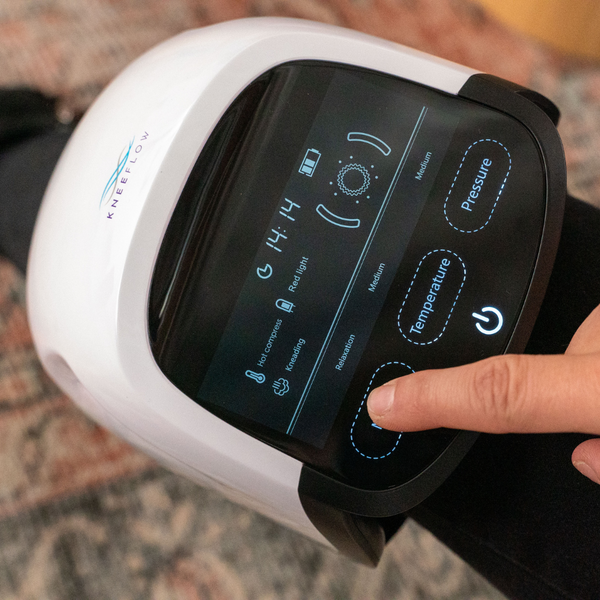
How long should you do red light therapy? Ten to twenty minutes per area is the clinical answer for most joint and musculoskeletal applications. Getting to the bottom of why that range exists, and what determines where within it you land, is what turns a vague guideline into something you can actually use.
Thirty minutes feels more committed than fifteen. It feels like you are taking it seriously. That instinct, reasonable in almost every other health context, is the wrong framework for red light therapy.
Past a certain point, more time does not produce more benefit. It can produce less. The mechanism behind this is not a marketing caveat or a liability disclaimer. It is the biology of photobiomodulation, documented across decades of controlled research, and it has a direct practical implication for how you structure every session.
The Kneeflow team works through these questions regularly. If you want to talk through what this means for your specific routine, reach out to the Kneeflow team and someone will respond to you directly.
The Window Nobody Tells You About
As with all photobiological responses, the dose-response relationship for red light therapy is biphasic; i.e. it is not a straight line up to infinity but rather curves off in some direction.
Low doses of light have minimal effects on cells. The target for red light, cytochrome c oxidase, gets activated by the light to produce more ATP but with low cumulative doses, there are few effects downstream. Moderate doses of light have the response at its strongest. The enzyme runs efficiently, nitric oxide releases into surrounding tissue, inflammatory signaling drops, and local circulation improves.
How long should you do red light therapy and you still down know; At high doses, the same oxidative species that act as beneficial signaling molecules at low doses can even switch off the same cellular responses they were intended to switch on. And so the curve rises, peaks and then falls.
Dose-response studies of photobiomodulation provide substantial evidence that the biphasic response is a consistent phenomenon in tissues of different types, irradiated at different wavelengths, and study designs.
Power Output Is the Variable Most People Ignore
Here is the part that invalidates most generic session length advice.
An 80 mW/cm² device delivers a 4 J/cm² dose in approximately 50 sec/cm². A 10 mW/cm² device delivers a 4 J/cm² dose in approximately 7 minutes/cm². Both can follow a “do 15 fifteen minutes" instruction. One will be well within the therapeutic window. The other will have been in the sub-therapeutic range the entire session.
How long should you do red light therapy in a mathematical way? The amount of energy that is delivered to the tissues in Joules/sq cm is a product of session length and power. Most clinical protocols for different joint conditions are designed to deliver between 2 and 6 Joules/sq cm per session.
Device documentation matters more than any article on red light therapy. That manufacturer-provided session time is the only guidance that has been calibrated to the specific device. Generic rules are averages across a product category that spans a ten-to-one power range.
Depth Changes Everything for Joint Applications
How long should you do red light therapy for depth changes?.
Red light, in the form of visible light between 630-680nm, is primarily absorbed in the superficial tissue layers making it suitable for treatments such as wound care, skin conditions and subcutaneous inflammation. However, red light does not penetrate to any significant degree to reach the synovial membrane, the patellar tendon insertion, or the deeper muscular structures surrounding the joint at meaningful photon density with most consumer devices.
Near-infrared at 800 to 900 nanometers travels further before the tissue absorbs it. These wavelengths reach three to five centimeters of depth in biological tissue, which is where joint conditions actually live. But reaching that depth at therapeutic doses requires more photons at the surface, which means either more power or more time.
For most LED-based wearable devices targeting knee and joint tissue, sessions at the lower end of the ten-to-twenty range are appropriate when the device's power density is high and the emitters press directly against the skin. Sessions at the upper end, fifteen to twenty minutes, are appropriate when targeting the deeper structures of a joint, when the device has moderate power output, or when working with conditions involving the connective tissue inside the joint itself.
What clinical protocols for musculoskeletal light therapy recommend is consistent with this: the deeper the target tissue, the more time is needed to accumulate adequate photon density at depth.
Distance Kills the Dose
Panel devices held at arm's length. Wraps that sit loosely against the knee. Panels positioned across the room.
Light follows the inverse square law: the irradiance at a surface is inversely proportional to the square of the distance from the light source. Thus, if the distance is doubled, the light’s intensity at the surface is reduced by 1/4. So, for example, a forty milliwatt/sq cm laser delivering light at contact will deliver only 10 milliwatts/sq cm at two centimeters of distance. The session length required to reach the same cumulative dose at two centimeters is four times longer than at contact.
Most manufacturers have set up session lengths for contact or near-contact use. A 15 minute session held 6 inches away from the knee does not deliver the same dose of tissue interaction as would holding the device six inches from their knee is not completing a fifteen-minute session in any meaningful dose sense. They may need sixty minutes to approximate the same tissue-level exposure.
Because wearable devices press emitters against your skin all of the variables that could affect the amount of light your skin is receiving are eliminated. Contact and dose are both constant. Session length is listed in the documentation as being constant for a number of reasons including the fact that the distance between the emitters and your skin is not changing. For people asking how long should you do red light therapy with a wearable format, the documentation's recommendation is genuinely reliable in a way that it is not for held panels used at variable distance.
When Longer Sessions Make Sense
How long should you do red light therapy in extreme situations?.
Early sessions with a new unit, prior to tissue adaptation to photobiomodulation are best started at the lower end. After two weeks of consistent use, moving toward the full recommended duration is appropriate.
Deeper tissue targets, including the joint capsule and the tendon insertions inside the knee, benefit from longer sessions at typical LED power densities. If the goal is reaching these structures rather than the surface musculature, fifteen to twenty minutes is more appropriate than ten.
Chronic conditions with long-standing structural changes, knee osteoarthritis that has been present for years, established tendinopathy that has not responded to shorter-duration protocols, are candidates for sessions at the upper end of the range. The established inflammatory and tissue changes require more sustained stimulus to modify than acute presentations.
None of these situations justify going significantly beyond twenty minutes with a standard LED device. The biphasic ceiling is real regardless of condition severity or chronic duration.
How long should you do red light therapy? The One Rule That Does Not Change
Consistency beats duration. Always.
A fifteen-minute session performed daily for six weeks produces better cumulative outcomes than a thirty-minute session performed twice per week across the same period. Not just because of frequency, though frequency matters, but because the cellular conditions photobiomodulation creates decay between sessions. Maintaining them more continuously produces more sustained tissue-level change.
The session length question matters. Getting it in the right range matters. But the larger variable in whether red light therapy produces meaningful results for most people is whether the sessions are actually happening regularly, not whether each individual session was seventeen minutes instead of thirteen.
Get into the range. Stay consistent. Kneeflow can help to adjust within the range based on how the tissue is responding over four to eight weeks. That is the complete answer to how long should you do red light therapy in practice.