Does red light therapy for knee pain work? Short version: for a lot of people, yes, though not in the dramatic way ads tend to suggest. Red light devices send specific wavelengths of light into the tissue under the skin, and a decent stack of clinical trials ties that exposure to lower pain scores and better daily function in people with knee osteoarthritis. The catch: improvement tends to be steady, not sudden.
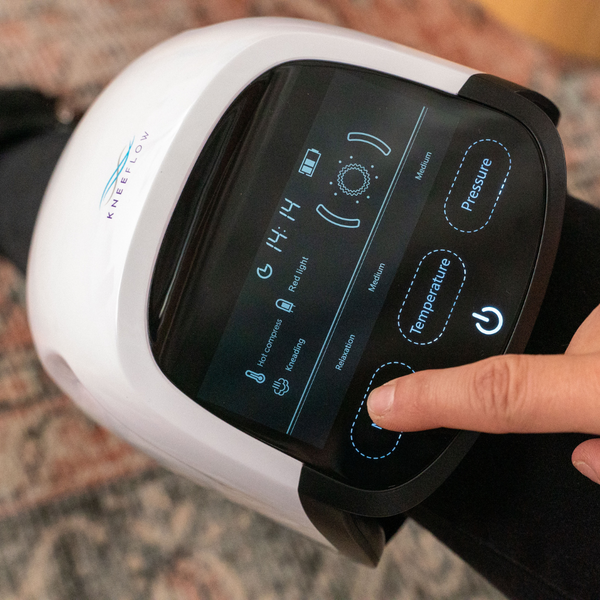
Red light happens to be one of three things layered into the Kneeflow Massager, alongside heat and gentle compression, so we end up watching this question play out in real households, not just in a lab printout. None of what follows is written to sell you on anything before you’ve had a chance to understand it. It’s a straightforward look at the evidence, a realistic timeline, and a few situations where this kind of therapy isn’t the right call.
Does Red Light Therapy for Knee Pain Work at the Cellular Level?
Researchers describe the mechanism behind this question as photobiomodulation: low-level red or near-infrared wavelengths that pass through skin and settle into the tissue just beneath it. Unlike a heating pad, the light isn’t generating surface warmth. It’s absorbed by small structures inside cells that help produce energy, and that absorption appears to shift cellular behavior over the following hours.
Inside a joint as compact and overworked as the knee, that shift matters. Cartilage, ligaments, and the thin synovial lining all heal slowly and respond poorly to overuse. Laboratory and animal studies point to improved local circulation and lower inflammatory markers in that same tissue, which is why researchers began testing the therapy in people with knee osteoarthritis specifically.
None of this means the light rebuilds cartilage or reverses structural wear. A home unit supports comfort and tissue response; it doesn’t reconstruct what’s already broken down, and keeping that line clear matters when deciding whether a wellness routine is enough or whether an actual diagnosis comes first.
Does Red Light Therapy for Knee Pain Work According to Clinical Research?
The honest answer sits somewhere between skepticism and hype. A systematic review and meta-analysis published in BMJ Open in 2019 pooled results from multiple randomized, placebo-controlled trials and found that low-level laser therapy eased pain and improved function in people with knee osteoarthritis compared with sham treatment, especially at particular light doses.
That same body of research flags something important: outcomes swing depending on wavelength, dose, and session count, which explains why some trials show a real benefit while others barely separate from placebo. Investigators call this a dose-response pattern, meaning the amount and type of light delivered carries as much weight as whether light was used at all.
Here’s the part that rarely makes it into marketing copy: most of the stronger trials rely on clinical-grade laser equipment under tightly controlled conditions, not consumer devices used at home. A wearable unit almost certainly isn’t matching a lab’s exact dose, so a milder, slower response at home is the reasonable expectation, not the disappointment.
Is Red Light Therapy More Effective for Knee Pain When Combined With Heat and Massage?
Is red light therapy more effective for knee pain when it’s paired with heat and massage, rather than used on its own? In most cases, yes, mainly because each input tackles a different piece of the discomfort. Heat loosens surface muscle tension and boosts local blood flow. Massage cuts the feeling of stiffness and nudges the joint toward movement. Light works deeper, at a cellular level neither heat nor pressure can reach alone.
Stack all three into one session and the knee gets support on multiple fronts at once, instead of leaning on a single mechanism to carry the whole load. That layered logic is the reason combination devices exist in the first place, rather than people just buying a basic heating pad or a bare light panel.
We leaned into that layering when we designed the Kneeflow Massager, a 3-in-1 knee massager with heat and red light that pairs adjustable heat and gentle airbag compression with the red light element so one short session covers circulation, tension, and tissue-level support in a single sitting.
Layering therapies doesn’t promise a bigger result for every knee or every cause of discomfort. Someone dealing with stiffness after long stretches of sitting is going to respond differently than someone managing a diagnosed joint condition, which is exactly why results get described in ranges instead of guarantees.
What a Realistic Timeline Looks Like
Does red light therapy for knee pain work fast, or does it take time to show up? For most people, it’s the second one. A single session can leave the knee feeling warmer and looser for a few hours, but the changes tied to actual tissue response tend to build across one to several weeks of fairly steady use.
In the trials mentioned earlier, meaningful shifts in pain scores generally appeared after several sessions a week over multiple weeks, not after one attempt. Home use tends to follow the same rhythm: early sessions bring short bursts of relaxation, while less morning stiffness or smoother movement usually shows up only once the habit has stuck around for a while.
This is where expectations go sideways most often. Anyone hoping for the instant effect of a pain reliever is going to feel let down after a try or two, then write the whole therapy off, when really the tissue just hasn’t had enough repeated exposure yet to respond.
A reasonable rule of thumb: commit to short, near-daily sessions for at least two to three weeks before deciding whether it’s actually doing anything for your particular knee.
Mistakes That Slow Down Results
People often ask whether red light therapy really helps with knee pain, then unknowingly get in their own way. The biggest habit that slows things down is treating one session like flipping a switch instead of treating consistency as the mechanism. A close second is cranking intensity higher than needed, assuming stronger settings mean faster results, when a lower setting held for the full session usually does more good than a brief blast on high.
Another common misstep: leaning on a red light alone and expecting it to cover every base. Light exposure doesn’t replace gentle stretching, sensible strengthening work, or rest on days when the knee is genuinely inflamed, and skipping those pieces shows up later as slower, shallower progress.
Running a session too long is a smaller but real problem too.
Extra minutes don’t speed up tissue response. Mostly they raise the odds of skin irritation or a session that stops feeling relaxing and starts feeling like an errand. Sidestepping these habits isn’t about following a rigid protocol. It’s closer to treating the therapy for what it is: a modest, repeatable input, not a single powerful event.
Who Tends to Notice the Difference
Does red light therapy for knee pain work the same way for everyone who tries it? Not quite. People with everyday soreness from standing, walking, or sitting too long tend to notice the steadiest comfort, mostly because their discomfort ties back to tension and circulation rather than a structural issue. Athletes managing overuse soreness and older adults with age-related stiffness show up often among the people who stick with it.
People with diagnosed knee osteoarthritis are actually the group studied most directly in the research cited earlier, and several of those trials reported real drops in pain scores for that population. That doesn’t mean every arthritis case responds identically, since joint damage severity and other health factors shape how much relief someone feels.
Someone recovering from a fresh injury, a surgical procedure, or an unexplained swelling episode is a different story. This kind of therapy isn’t built for acute injury management, and reaching for a home device before understanding what’s causing a sudden or severe symptom can delay the care that’s actually needed.
Age alone doesn’t decide who benefits most. What matters is whether the discomfort is the everyday, cumulative kind that builds up over a long day, or something sharper and newer that needs a closer look first.
When to Be Cautious and When to See a Professional
Anyone weighing whether red light therapy can relieve knee pain safely should know a few situations that call for extra caution. Combination devices with heat and massage are generally low risk, but if a session brings on increasing pain, burning, skin irritation, numbness, dizziness, or new swelling, that’s the cue to stop and get the knee looked at instead of continuing.
Some situations deserve a doctor’s input before starting at all: managing diabetes or neuropathy, since reduced sensation can hide an overly intense setting, or being pregnant, having an implanted device, or taking medication that affects circulation or skin sensitivity. None of this rules the therapy out automatically, it just means a quick check-in is the safer first step.
Separately, knee pain tied to a fall, a twisting injury, an inability to bear weight, visible deformity, fever, or symptoms that keep worsening instead of settling calls for prompt medical evaluation rather than home therapy. Those signs point toward something a wellness device was never meant to handle.
None of this is meant to sound alarming. It’s the honest line between what a home routine can reasonably support and what needs a clinician’s judgment, and that line is worth respecting even when a device feels gentle.
Does Red Light Therapy for Knee Pain Work Better at a Certain Time of Day?
Timing matters less than people expect, but it does shift the effect a little. For most users, a short daily session, somewhere around ten to twenty minutes on a low or moderate heat setting, is the safest and easiest habit to sustain. Using a session before activity can loosen a stiff knee and take the guard off those first few minutes of movement, which helps anyone who feels tight right before a walk or a workout.
Daily use isn’t mandatory for everyone, but skipping several days in a row tends to slow the gradual improvement mentioned earlier. Most people find a rhythm of short, near-daily sessions easier to keep up than long, occasional ones, partly because a short session slots into an existing routine, like winding down at night or right after a shower.
This is where a wearable option like the Kneeflow Massager tends to fit real life better than a stationary light panel, since nobody has to sit still in front of a machine or hold anything in place while it runs.
Choosing a Knee Massager Built Around Light, Heat, and Massage
The real difference between a bare red light panel and a combination knee massager comes down to how many angles of discomfort each one covers. A standalone panel only delivers wavelength exposure, while a combination device adds adjustable heat and gentle compression, which matters most for anyone whose knee pain involves both tension and stiffness.
When comparing options, adjustable heat and massage intensity matter more than raw light output, since a device you can dial down to something comfortable is one you’ll actually keep using. Portability matters almost as much. A corded or bulky unit tends to get used less often than something that straps on and works while you’re sitting or resting.
Heating pads still make sense as a low-cost source of plain warmth, and massage guns do their job on larger muscle groups, but neither is built specifically around the knee joint the way a combination device is, and neither includes any light element. The right pick comes down to what someone’s trying to solve: general muscle tension, joint-specific stiffness, or a routine broad enough to cover more than one of those.
So, does red light therapy for knee pain work? With KneeFlow you can start to use paired with heat and gentle compression, it can be a reasonable, low-risk piece of a broader knee care routine, alongside movement, rest, and medical guidance whenever something feels off. If you’re weighing whether a combination device belongs in your routine, feel free to reach out to our team with questions about setup, settings, or what to reasonably expect from regular use.
FAQ
Is Red Light Therapy Effective for Knee Pain?
For a good number of people, yes, though the impact tends to be gradual rather than dramatic. A 2019 systematic review published in BMJ Open pooled multiple randomized, placebo-controlled trials and found that low-level laser therapy reduced pain and improved function in people with knee osteoarthritis, particularly at certain doses. Still, no major osteoarthritis guideline currently names it a first-line treatment, and outcomes shift depending on wavelength, dose, and how consistently someone uses it. A home device is unlikely to match a lab’s exact conditions, so a gentler, slower benefit is the fair expectation. Most people who notice something different describe less stiffness and easier movement after weeks of fairly regular sessions, not after one try.
How Long Does It Take to Notice Results From Red Light Therapy?
Most people need one to several weeks of fairly steady sessions before anything meaningful shifts, rather than feeling different after a single use. One session can leave a knee warmer and looser for a few hours, but that’s mostly heat and massage doing quick work rather than the light itself. The deeper tissue changes tied to light exposure build slowly with repetition, similar to how stretching or strength training pays off over time instead of overnight. A fair benchmark is committing to short, near-daily sessions for two to three weeks before judging whether it’s actually helping a particular knee.
Can Red Light Therapy Be Used Every Day?
Daily sessions are generally safe for most people as long as they stay short, roughly ten to twenty minutes, in a comfortable heat setting. Several of the clinical trials behind this therapy used multiple sessions a week rather than one weekly dose, which backs up the idea that consistency counts more than occasional high-intensity use. Skin should return to its normal temperature between sessions, and daily use should pause if any redness, irritation, or discomfort shows up. Anyone managing diabetes, neuropathy, or a circulation issue should check with a healthcare provider before building a daily habit, since reduced sensation can hide an overly intense setting.
Is Heat or Red Light Better for a Stiff Knee?
Neither wins outright, since each handles a different piece of stiffness. Heat acts fast on surface muscle tension and blood flow, which is why warmth can bring near-instant relaxation around the joint. Red light works slower and deeper, building its effect over repeated sessions instead of showing up right away. For plain morning stiffness or tightness after sitting, heat alone often delivers quicker short-term comfort, while light contributes more to the gradual, cumulative side of things. Combination devices pair both because stiffness usually has more than one cause, and covering tension and tissue response together tends to go further than either input by itself.
Should Red Light Therapy Happen Before or After Exercise?
Either can work, depending on the goal. A short session before activity loosens a stiff knee and softens the guarded feeling in the first few minutes of movement, which suits anyone whose knee feels tightest right when they start. A session afterward serves a different purpose: easing tension that built up during exercise and supporting the wind-down the knee goes through once movement stops. Pre-activity sessions tend to stay brief, since the goal is preparation rather than deep recovery. Some people get the most out of using short sessions on both ends of a workout.
How Can You Tell if the Heat Setting Is Too High?
A setting is too high if it causes sharp discomfort, a burning feeling, or skin that turns visibly red and stays that way once the session ends. Comfortable warmth should feel soothing, not something you have to grit your teeth through, and a setting you’re tolerating rather than enjoying is usually set higher than it needs to be. Skin sensitivity differs from person to person, so what feels moderate to one person can feel too strong to another, which is why starting low and adjusting upward gradually beats starting at the top setting. If numbness, irritation, or unusual warmth shows up afterward, lower the setting or pause sessions until skin feels normal again.
Is This Type of Therapy Safe for Older Adults?
For most older adults managing ordinary, age-related knee stiffness, red light combined with gentle heat and massage counts as a low-risk addition to a wellness routine. Age by itself isn’t a barrier, since none of this involves strain, impact, or invasive contact with the joint. That said, older adults are more likely to be managing other conditions too, like diabetes, circulation issues, or thinner, more sensitive skin, all good reasons to start on a lower setting and pay closer attention during the first few sessions. Anyone with an implanted medical device, a recent injury, or reduced nerve sensitivity should check with a healthcare professional before starting, regardless of age.
Does This Help With Arthritis-Related Knee Pain?
Knee osteoarthritis is actually the condition studied most directly in the research behind red light and low-level laser therapy, and several trials reported real drops in pain scores for that specific group. It doesn’t reverse joint damage or rebuild worn cartilage, and it isn’t currently listed as a first-line treatment in major arthritis guidelines. What the evidence does support is a modest reduction in pain and stiffness for some people, especially with steady use over several weeks. Results shift depending on how advanced the joint changes are and what else, like exercise or medication, is already part of someone’s routine, so it works best as one piece of a bigger plan rather than a standalone fix.
Can This Replace Physical Therapy or Medical Treatment?
No. This is a complementary wellness tool, not a substitute for diagnosis, physical therapy, or medical care. It can support comfort and fit into a broader self-care routine, but it doesn’t get at the underlying cause of a knee condition the way a clinician’s evaluation or a structured rehab program does. Anyone with a diagnosed injury, ongoing joint instability, or symptoms that keep worsening needs professional guidance first, with a wellness routine added afterward if it makes sense. Pairing this therapy with physical therapy, rather than swapping one for the other, tends to produce better outcomes than relying on just one.
When Should You Avoid Using a Red Light Knee Device?
Skip it, or pause it, when knee pain follows a fall, a twisting injury, or an impact, or when there’s significant swelling, redness, warmth, joint locking, instability, or trouble bearing weight, since those symptoms call for medical evaluation rather than home therapy. Stop a session too if it brings on burning, numbness, dizziness, or worsening pain instead of relief. Anyone who’s pregnant, has an implanted medical device, or manages a condition affecting circulation or skin sensitivity should talk with a healthcare professional before starting, rather than assuming a gentle device is automatically fine for their situation.