iKeepFit has been making knee massagers since 2005. Two decades of iteration on a single product category has produced the MAXwarm 4.0, a 2026 upgrade that is genuinely impressive in its thermal engineering: a 16,800 square millimeter heating area that wraps 360 degrees around the knee, delivering even warmth across a surface area double what most competitors achieve. Five temperature settings from 113°F to 149°F. Three vibration modes. Sold as a pair. FSA and HSA eligible. This is a mature product from a brand that knows exactly what it is building.
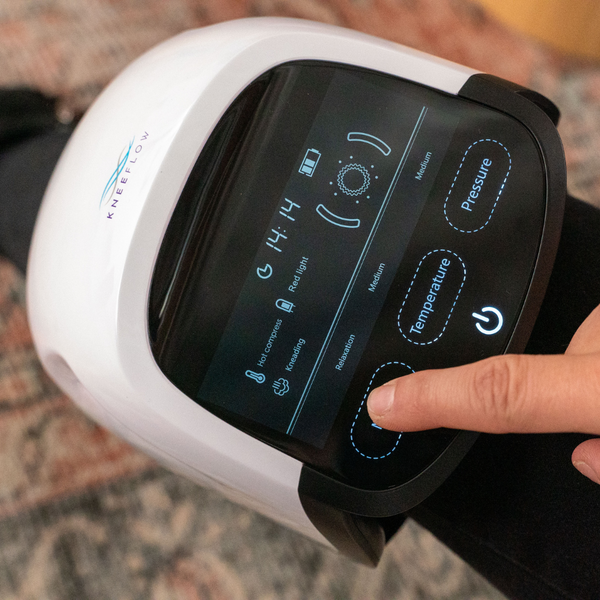
In the Kneeflow vs. iKeepFit comparison, Kneeflow is also a knee massager. It also applies heat. It is also FSA and HSA eligible. After those points, the two devices diverge completely. Kneeflow adds near-infrared red light therapy through photobiomodulation and therapeutic compression alongside the heat component. None of those additions are in the iKeepFit. For someone whose knee needs warmth, the iKeepFit is a credible choice at a competitive price per unit. For someone whose knee has an ongoing condition that requires anti-inflammatory intervention at the cellular level, it is not the right device regardless of how large the heating area is.
What iKeepFit Does Well
The heating story is real and worth acknowledging directly.
16,800 mm² of heating coverage is not a marketing number. It represents a meaningful increase over the typical 8,000 to 10,000 mm² found in most standard heated knee wraps. The full 360-degree coverage means the popliteal area behind the knee, the medial and lateral compartments, and the anterior surface all receive simultaneous warmth rather than only the front of the joint. For stiffness that lives in the back of the knee or the sides of the joint, this coverage advantage is clinically relevant in a modest way.
The three vibration modes are well-calibrated across the gentle, soothing, and intense range. The device is light enough and flexible enough to use while walking, which most competitors in the heated knee wrap category are not. The pair packaging means both knees are treated simultaneously, which matters for the significant population managing bilateral arthritis or bilateral post-exercise recovery.
The 20-year track record also has value. iKeepFit has refined the same product through four major versions. The construction quality and durability feedback across consumer reviews is consistently positive in ways that suggest a brand that has genuinely worked out the engineering challenges of a wearable heating device over time.
What iKeepFit Does Not Have in the Kneeflow vs iKeepFit Comparison
No red light therapy. No photobiomodulation. No near-infrared wavelengths. No active therapeutic compression.
For someone evaluating the Kneeflow vs iKeepFit comparison specifically because of a diagnosed knee condition, these absences are the comparison. The mechanism behind how red light therapy affects joint tissue at the cellular level is entirely outside what the iKeepFit delivers. Heat increases surface circulation and relaxes tight musculature. Near-infrared photobiomodulation does something different: it activates cytochrome c oxidase inside the mitochondria of cells in the joint tissue, increasing ATP production, releasing nitric oxide, and reducing the expression of pro-inflammatory cytokines including IL-1β and TNF-α. These are documented cellular changes with a clinical evidence base across multiple controlled trials for knee osteoarthritis and tendinopathy. They require near-infrared wavelengths to be delivered to the tissue at therapeutic photon density. Heat alone does not produce them.
The compression gap matters separately. Active therapeutic compression manages the post-activity joint swelling that most chronic knee conditions consistently produce. iKeepFit’s sleeve creates passive containment. Kneeflow’s compression is purposeful: it reduces fluid accumulation in the joint space and provides the proprioceptive input that improves how the joint moves under load. For someone whose knee swells visibly after activity, that mechanical difference is as clinically relevant as the photobiomodulation gap.
What Kneeflow Adds in the Kneeflow vs iKeepFit Comparison and Why It Matters
Three mechanisms in parallel. None optional for the user it was designed to serve.
Heat from a dedicated heating element warms the joint and surrounding tissue, improves synovial fluid distribution through the joint space, and reduces the morning stiffness that arthritic knees accumulate during inactivity. This component exists in both devices, and both do it well within their respective designs.
Near-infrared photobiomodulation is Kneeflow’s differentiator for clinical knee management. The research on whether red light therapy actually works for knee pain is consistent: near-infrared wavelengths at therapeutic doses reduce inflammatory markers in the joint and improve pain scores and functional outcomes in people with knee osteoarthritis across multiple randomized controlled trials. The effect is not immediate comfort. It is accumulated biological change over weeks of consistent daily sessions. That distinction matters for calibrating expectations and for understanding what the treatment is actually doing.
Compression at the joint addresses the swelling dimension that neither heat nor light therapy reaches mechanically. The MAXwarm 4.0 has excellent surface coverage but no compression mechanism. Kneeflow covers the full triad: stiffness, inflammation, and swelling.
The Price Comparison Is More Complex Than It Looks
The Kneeflow vs iKeepFit price comparison is more complex than it looks.
iKeepFit MAXwarm 4.0: ~$134 for a pair of two units. That is roughly $67 per knee.
Kneeflow: $119 for a single unit.
At the per-unit level, iKeepFit is less expensive. At the per-mechanism level, the comparison inverts. The iKeepFit delivers heat and vibration per knee at about $67. Kneeflow delivers heat, near-infrared photobiomodulation, and compression at $119.
For someone managing bilateral knee conditions who needs photobiomodulation and compression on both knees, two Kneeflow units would cost $238. Two iKeepFit units cost $134. The gap is real. The question is whether the $104 difference is meaningful when the more expensive option is the device addressing the condition’s biology and the less expensive option is not.
What to look for in a knee massager with red light therapy is worth reading before making this decision based primarily on price. The surface comparison of cost-per-unit does not reflect the difference in what each unit is capable of producing in the tissue it covers.
Who iKeepFit Serves Well
Someone managing bilateral knee discomfort who wants maximum heat coverage on both knees simultaneously at a reasonable combined price. Post-exercise soreness that responds to warmth and vibration without a diagnosed condition requiring clinical-grade anti-inflammatory support. General daily comfort for someone whose knees ache in the way that most active adults’ knees ache after a certain age, without the specific pathology of established osteoarthritis or tendinopathy.
The mobility advantage matters too. A device that can be worn while walking allows treatment during normal daily activity rather than requiring dedicated seated sessions. For someone managing mild-to-moderate discomfort who wants passive recovery support throughout their day rather than a dedicated treatment window, iKeepFit’s design philosophy is better matched to that use pattern.
Who Kneeflow Serves Better in the Kneeflow vs iKeepFit Comparison
Someone managing a specific knee condition that has crossed from general discomfort into documented pathology. Knee osteoarthritis with morning stiffness that has been present for more than six months. Patellar tendinopathy that responds to rest but returns with any increase in training load. Post-surgical recovery that needs anti-inflammatory support alongside the physical therapy exercises. The daily management of a knee that swells after activity and needs more than warmth to recover before the following day.
Understanding the difference between infrared heat and near-infrared photobiomodulation clarifies why iKeepFit’s superior heating does not substitute for the mechanism Kneeflow provides. The two technologies operate through different physical processes and produce different biological outcomes. A larger heating area does not close the gap. It just provides more of the same thing the iKeepFit has always provided.
The Honest Summary
Kneeflow vs iKeepFit is not a close comparison for someone with a clinical knee condition. It is a much closer comparison for someone without one.
iKeepFit is a premium thermal comfort device with industry-leading heating coverage, two decades of refinement, and a pair configuration that makes bilateral treatment practical and accessible. For the use case it was designed for, it is genuinely excellent.
Kneeflow is a clinical joint recovery tool that addresses three distinct dimensions of knee condition management simultaneously. For the use case it was designed for, the iKeepFit simply does not participate.
Choosing between them requires being honest about which category your knee is in. If you are ready to see what Kneeflow’s approach to daily joint recovery looks like in practice, explore the Kneeflow heated knee massager and decide whether the three-mechanism approach is what your situation needs.