Is red light therapy good for arthritis? People have genuine reasons for asking this question since arthritis is a chronic condition, the medications involve compromises, and anything that promises to reduce pain without the need for pills seems worth looking into. Although the science is real, it is in fact more detailed than the marketing indicates.
The extent to which red light therapy works depends a great deal on the kind of arthritis you have, the wavelength and dose of light the device provides, and how you incorporate light into your general routine. This guide looks at what the research indicates, the limitations of that research, and the practical steps that are sensible if you choose to give it a try.
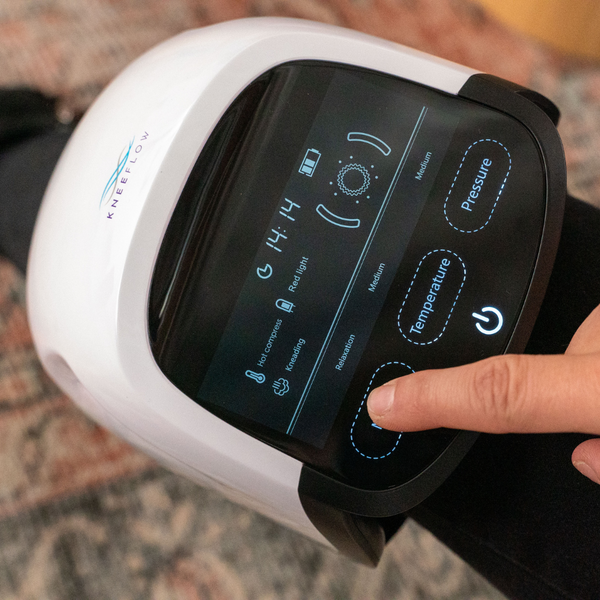
If you're deciding whether red light therapy is beneficial for your arthritis, it is the type of arthritis and the device specifications that matter more than the category name, a distinction that also shapes how Kneeflow approaches at-home knee support.
Is Red Light Therapy Good for Arthritis? Start With the Type You Have
To the question is red light therapy good for arthritis, you have to start with which type you have. Arthritis is not one condition. The two types which are most common act differently and react differently to treatment.
Osteoarthritis (OA) is a degenerative disease; the cartilage gradually wears away, the space between the joints becomes narrower and the surrounding tissue becomes inflamed as a result of the damage. Although the condition is of a mechanical origin, inflammation does play a significant role in the pain and stiffness you experience every day.
Rheumatoid arthritis (RA) is an autoimmune condition. The immune system directly attacks the lining of the joints, leading to swelling, a feeling of warmth, pain and, after a period of time, structural damage. It is mainly controlled using disease-modifying drugs which aim at the immune response.
Red light therapy acts at the cellular level, mainly on the mitochondria. As our guide to how red light therapy works explains, specific wavelengths stimulate energy production and modulate inflammation, which is why researchers have studied it for both types of arthritis. But the evidence is stronger for one than the other, and knowing the difference matters.
Is Red Light Therapy Good for Arthritis of the Knee? What the Evidence Shows on Osteoarthritis
For knee osteoarthritis in particular, the evidence is the most extensive. A meta-analysis from 2019, which appeared in BMJ Open, combined data from 22 placebo-controlled trials involving 1,063 people with knee OA. Compared to the placebo, light therapy resulted in a reduction of pain of about 14 mm on a 100 mm visual analog scale. When the doses were within the recommended range of 4 to 8 joules per spot and the wavelengths were between 785 and 860 nm, the effect increased to almost 19 mm. None of the trials reported any adverse events.
That is a meaningful result for a low-risk intervention. It is also not a dramatic one. Nineteen millimeters on a pain scale is noticeable but not transformative. The authors also noted that major OA guidelines have not yet formally recommended light therapy, partly because trial quality and reporting of device parameters have been inconsistent.
A 2023 randomized controlled trial published in the journal Life examined 830 nm low-level laser therapy together with exercise and compared it with high-intensity laser therapy also combined with exercise, in 34 adults who had mild to moderate knee osteoarthritis. Following the 12-week period, significant improvements were observed within each group. The group receiving the low-level laser therapy experienced a pain reduction of approximately 1.95 points on an 11-point scale and improved their KOOS (knee disability) score by 4.84 points; the high-intensity group showed greater improvement, yet the low-level laser group still achieved the minimal clinically important difference for pain.
A preclinical study carried out in 2023 and published in the Annals of Rehabilitation Medicine exposed rats that had been given induced knee osteoarthritis to dual-wavelength near-infrared (NIR) light. The rats that received the treatment exhibited better movement, had lower levels of inflammatory cytokines and maintained their cartilage when compared with the untreated control rats. Although the results from animals cannot be directly applied to humans, they do support the biological mechanism.
When put together, is red light therapy beneficial for arthritis of the degenerative OA type? The straightforward answer is that yes, it is, although realistic expectations should be maintained. It is helpful in reducing pain and in improving function, particularly when the wavelengths and doses are within the therapeutic range, and it has a favourable safety record; it serves as a supportive measure not a cure and works best when used as part of a more comprehensive routine which includes movement and clinical care.
Is red light therapy Good for arthritis of an autoimmune type? The evidence concerning rheumatoid arthritis
The case of rheumatoid arthritis is more complicated. A systematic review and meta-analysis which was published in PLoS One examined 18 randomized controlled trials involving 793 adults suffering from RA. The main finding was that infrared lasers (with wavelengths approximately between 780 and 1,060 nm) do not perform better than sham treatment when it comes to pain, morning stiffness, grip strength, functional capacity or inflammatory markers such as CRP. All of the results were rated as having low to very low certainty. Seventeen of the eighteen studies had a high risk of bias.
The review pointed out some positive findings from the studies that involved combining laser treatment with existing RA medications, but it still arrived at a cautious conclusion because the evidence is not strong enough to indicate that light therapy should be used on its own as a treatment for RA.
So what does this imply for a person with rheumatoid arthritis who is asking whether red light therapy is good for their arthritis? It means that light therapy is not likely to have a direct effect on the autoimmune process and therefore should not be used as a replacement for your disease-modifying drugs. If your rheumatologist agrees, it is reasonable to try it as a complementary measure to alleviate symptoms, but the body of evidence supporting its use in the case of RA is much weaker than that for osteoarthritis.
The Mechanism: Why Light Affects Inflamed Joints
Cytochrome c oxidase, which is found in the mitochondria of your cells, absorbs red and near-infrared light when the correct wavelengths are used. As a result, there is increased ATP production, less oxidative stress, and a change in the way inflammatory signals are transmitted. It seems that light helps to reduce the number of pro-inflammatory cytokines while increasing the number of anti-inflammatory ones; this is something that applies to joint tissue that is chronically inflamed.
In the case of OA, adjusting the inflammatory environment will not cause cartilage to regrow but may reduce the load which causes pain. With regard to RA, the inflammatory process is more widespread and immune in origin, which is one of the reasons why local light treatment has not produced the same consistent results.
The question “is red light therapy good for arthritis” assumes light is reaching the right tissue. What this entails for the knee is the use of wavelengths in the near-infrared range (800 to 850 nm) which penetrate more deeply, together with sufficient time and power so as to affect the joint and not just the surface of the skin.
What Wavelength and Dose Actually Matter
The dose is determined by the wavelength, the irradiance and the session duration, and it is the dose that decides whether any useful effect takes place. In the case of the trials which demonstrated a benefit in patients with knee osteoarthritis, the wavelengths used were in the range from 785 to 860 nm and the doses ranged from 4 to 8 joules per treatment spot. A device that states only 'red light' without also giving the wavelength or the irradiance figure fails to provide the information necessary for an assessment of the therapeutic dose.
Our full breakdown of how long you should do red light therapy covers how session time and dose interact. Short, consistent sessions beat occasional long ones. Consistency is what the research protocols have in common.
Is Red Light Therapy Good for Arthritis at Home?
Clinical trials use controlled settings and calibrated devices. Home use means more variables: device placement, contact quality and specs that have not always been independently verified. That does not make home use pointless. For the knee, a wearable device that sits against the joint and applies light consistently over 15 minutes is a practical and low-risk addition to a daily routine. The key is choosing a device with published specifications and not expecting it to replace clinical treatment or exercise.
A few questions worth asking before you buy: Does it publish a specific wavelength in nanometers? Does it list irradiance in mW/cm²? Does it cover the knee fully rather than applying light from one point? If the answer to any of those is no, you are working blind on dose. Our research review on whether red light therapy works for knee pain covers what specs to look for in a home device.
Is Red Light Therapy Good for Arthritis When Combined With Heat and Compression?
Many people managing arthritis use more than one modality. Heat opens blood vessels, reduces joint stiffness and prepares tissue for movement. Compression supports circulation and can help with the swelling that tends to build after a long day on your feet. Red light works at the cellular level on inflammation and energy production.
These three do not interfere with each other. Using them in sequence or simultaneously is a reasonable approach for someone managing chronic knee arthritis. Heat tends to work best before movement. Light and compression can be used before or after, depending on your symptoms and what your clinician recommends.
The question “is red light therapy good for arthritis” in a combined routine gets a more practical answer than the question about light alone: yes, combined modalities make it easier to build a consistent habit and address more than one aspect of the condition at once.
Is Red Light Therapy Good for Arthritis? What to Tell Your Clinician
If you are managing RA and wondering is red light therapy good for arthritis in your case, loop in your rheumatologist before starting. The evidence does not support light therapy as an RA treatment, and you do not want to introduce anything that could complicate how you monitor disease activity or medication effects.
If you are managing OA, particularly knee OA, the evidence is more supportive. Telling your orthopedist or physical therapist you are considering adding light therapy gives them the chance to offer guidance on timing, placement and how to integrate it with your existing exercises and other treatments. Most clinicians familiar with the research are not opposed to it as a low-risk addition. See the specs and order at the Kneeflow knee massager page.

Is Red Light Therapy Good for Arthritis? The Short Answer
For knee osteoarthritis: yes, with realistic expectations and the right device. The evidence supports modest but meaningful pain relief and functional improvement, the safety profile is good, and it fits well into a daily recovery routine.
For rheumatoid arthritis: the evidence is weak and inconclusive. It is not a replacement for your medications, and the current research does not support using it as a primary treatment for RA symptoms.
In both cases, wavelength, dose and consistency matter more than the brand name. If you are ready to add red light to your arthritis routine, Kneeflow combines heat, red light and air compression in one cordless wearable. Have questions first? Contact the Kneeflow team and we will help you choose.