How soon after surgery can you use red light therapy? The honest answer is that it depends on your procedure, your incision and your surgeon, not on a number printed on a device box. Some people get cleared early, under supervision. Others are told to wait until the wound has fully closed. Both can be right.
People often wonder why recovery feels so slow. The knee swells sleep is. Every physical therapy session leaves the knee sore. A device that promises faster healing sounds good. The science behind it is real. Timing can turn good intentions into problems. In this write‑up we explain what research says about light therapy after surgery why there is no best day for recovery and which questions you should ask at your next appointment.
Kneeflow makes a knee massager for recovery routines so we also cover how heat and compression fit together, with light once your surgeon says it is safe.
How Soon After Surgery Can You Use Red Light Therapy? The Honest Answer
Here is the plain version. There is no safe day that applies to everyone. Your surgeon knows how your incision looks, whether hardware was placed how swelling you have and what medications you take. Those details decide the answer.
So how soon, after surgery can you use red light therapy at home? You can use red light therapy at home after the person who operated on you says the area is ready. We understand how you feel. That sounds cautious because it is. A closed healing incision and a fresh surgical site are not the situation and a device cannot tell the difference.
Think of it like driving after an operation. Some people are cleared in days, some in weeks. Nobody sensible picks the date from a blog post.
Why There Is No Universal Date
Your incision sets the pace
Surgical wounds pass through stages: inflammation, tissue building and remodeling. Red. Near‑infrared light act on cells during each stage. Because researchers study these lights for wound repair a review of near‑infrared photobiomodulation for impaired skin wound healing found that near‑infrared light around 800 to 830 nm is the most effective and most studied range. Red light at 630 to 680 nm also shows benefit.
Studied is not the same as cleared for your couch at home. We know you want to use treatments at home but wound care is not the same. Dressings, stitches, staples, drainage and any redness or warmth, around the incision all change what your surgeon wants near the incision area.
Your Procedure Matters
A scope for a meniscus tear is a different recovery from a total knee replacement. One leaves small portal incisions. The other opens the joint and replaces surfaces. Kneeflow explains how light fits into that first scenario in its post on red light therapy for a meniscus tear, and the same logic applies: the procedure shapes the plan.
Your Whole Recovery Stack Counts
Pain medication, nerve blocks, blood thinners and compression stockings all change what is safe. Numb skin cannot warn you about heat. Reduced clotting can change how you respond to other devices. A good plan looks at everything at once. That is why how soon after surgery can you use red light therapy has a different answer for every patient.
How Soon After Surgery Can You Use Red Light Therapy? What Research Shows
Let’s look at the evidence, with honest limits. A 2023 randomized trial in Arthroplasty Today followed 45 patients after total knee replacement. One group received low-level laser therapy at 804 nm, one received a polarized light therapy, and one served as controls. At three months, range of motion was highest in the laser group, at 116.8 degrees, against 104.0 and 92.3 in the other two groups. The laser group also used less oxycodone in the first month, 48.3 mg versus 60.3 mg.
Those numbers are encouraging. They also come with context. The patients were treated by a clinical team, with clinic equipment, in a single center, and the sample was small. A home device is a different tool in different hands.
So when someone asks how soon after surgery can you use red light therapy because a study showed early benefit, the careful reading is this: early light therapy can be part of supervised care. That does not make every device safe to use on any incision on any day.
Wider research supports the mechanism. Photobiomodulation raises cellular energy production and modulates inflammation, as Michael Hamblin describes in his review of its anti-inflammatory effects. That is why surgeons and physical therapists take it seriously. For a broader look at the evidence in knee pain, our research review covers what trials show outside the operating room.
How Soon After Surgery Can You Use Red Light Therapy at Home? A Practical Timeline
No calendar here, because your surgeon owns the calendar. Instead, think in stages.
Stage One: The First Days
This is hospital and early home recovery. Swelling peaks, dressings stay on, and your care team manages pain and clot prevention. Unless your surgeon has arranged supervised light treatment, this is a stage for rest, elevation and following the discharge plan.
Stage Two: The Incision Is Closing
When the wound looks clean and your surgeon is happy with its progress, how soon after surgery can you use red light therapy becomes a practical question. Ask directly whether light is allowed near the area, over a dressing, or only around it. Some surgeons say yes early. Some say after suture removal. Your answer may differ from a friend’s, and that is normal.
Stage Three: Active Rehab
Once you are working with a physical therapist, red light therapy can become a steady habit instead of just an experiment. How you do each session and how often you do it makes a big difference. Our guide on how you should do red light therapy covers the right dose. Short sessions done regularly are better than ones done only once in a while.
Questions to Ask Before You Start
Bring these questions to your appointment so you can get clear answers about when you can start using red light therapy after surgery. It's important to know for your situation. Don't guess: get a yes or no.
-
Is the incision healed enough to use red light therapy near it? Should you stay away from the wound area completely?
-
Can you use the device over your dressing. Do you have to wait until the dressing is removed?
-
Do you have any hardware, a cast or a brace that might get in the way of placing the device correctly?
-
Are any of your medications or a past nerve block making your skin more sensitive to heat or light?
-
How minutes per session and how many days each week would be safe, for you?
-
What symptoms should make you stop away and call your doctor?
Write the answers down. Recovery takes time and details fade. Having the answers written helps you stay on track.
Heat, Compression and Red Light: Check Each One
Many recovery devices combine modalities. That is convenient, but each mode needs its own green light. Heat on numb skin can burn. Compression after a procedure that raises clot risk deserves a clinician’s opinion. Red light is the gentlest of the three on the skin, yet it still belongs on your list of questions.
Kneeflow’s comparison of infrared, heat and vibration therapy is a good primer on how those tools differ, so you can ask better questions about each.
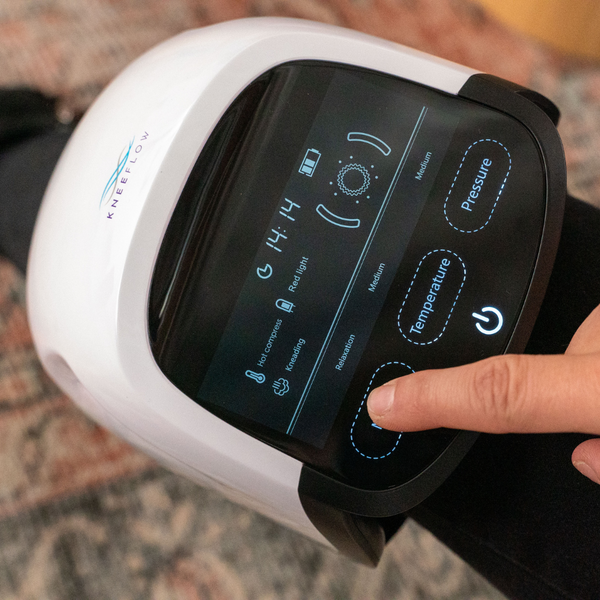
Once your surgeon has approved the combination, Kneeflow offers heat, red light therapy and air compression in one wearable. The knee massager with red light therapy page lists the specifications, so you can share them with your care team before buying. How soon after surgery can you use red light therapy with a combined device? Only as soon as every mode has been cleared.
Warning Signs That Mean Stop
Whenever your answer to how soon after surgery can you use red light therapy turns into a yes, know the warning signs. Stop and call your surgeon if you notice increasing redness, warmth, drainage, a fever, new or worsening pain, or sudden swelling and tightness in the calf. These are not side effects to push through. They are reasons to get checked.
The same goes for anything that feels wrong during a session. Skin should feel comfortable, never hot or stinging. Eyes should stay protected, since bright LEDs are not meant to be stared at.
How Soon After Surgery Can You Use Red Light Therapy? Start With a Yes From Your Surgeon
Recovery rewards patience and good questions. The answer to how soon after surgery can you use red light therapy is never just a day count. It is a conversation, a green light from the person who knows your knee, and then a routine you can keep.
When you have that clearance and want a device that combines heat, red light and compression, we are here to help. If you are ready to buy, or want help choosing before you do, contact the Kneeflow team and we will walk you through it.