What Clinic Red Light Therapy Actually Costs
Walk-in red light therapy sessions at spas, wellness centers and dedicated photobiomodulation clinics typically cost between twenty-five and seventy-five dollars per session for full-body panel sessions. Targeted clinical sessions using powered devices sometimes delivered by physical therapists or medical staff as part of a treatment protocol run from seventy-five to two hundred dollars, per session depending on the device quality the session duration and the provider’s overhead.
Package pricing exists across most clinics and typically offers 10 to 20 percent discount on per-session rates. A ten-session package that would cost $500 individually might be sold for $425. The discount is real; the total commitment is also real.
The problem is frequency. How much does red light therapy cost when you actually need it daily? The research on photobiomodulation frequency is consistent: for conditions like knee osteoarthritis or tendinopathy, daily or near-daily sessions during an active treatment phase produce meaningfully better outcomes than once or twice weekly use. At $40 per session and five sessions per week, that is $200 per week. Over a standard eight-week treatment phase, the cost reaches $1,600 before accounting for travel time, scheduling constraints, or the sessions missed when life intervenes.
Monthly maintenance sessions at clinic rates also add up. Two sessions per week at $50 each for long-term joint management: $400 per month, $4,800 per year. This is not a realistic cost for most people managing a chronic condition.
What At-Home Red Light Therapy Devices Actually Cost
The range is wide. Genuinely wide.
Entry-level LED panels for full-body or large-area use start around $100 to $200 and represent the most accessible entry point into at-home red light therapy. These devices typically emit at a single wavelength, often 660nm visible red, at lower power density than clinical devices. They are appropriate for skin-level applications and mild general wellness use. For joint conditions requiring deeper tissue penetration, they are often insufficient.
Mid-range panels and wearable devices priced between $200 and $400 represent the category where power density, dual wavelengths, and clinical-grade delivery start to appear. Many of the more credible at-home photobiomodulation devices sit in this price range.
Premium and medical-grade devices run from $400 to $500 and beyond. Devices using medical-grade laser diodes alongside LEDs, such as those in the Kineon Move+ Pro category at $499, occupy the high end of the at-home market. The premium reflects genuine hardware differences in optical precision and penetration depth.
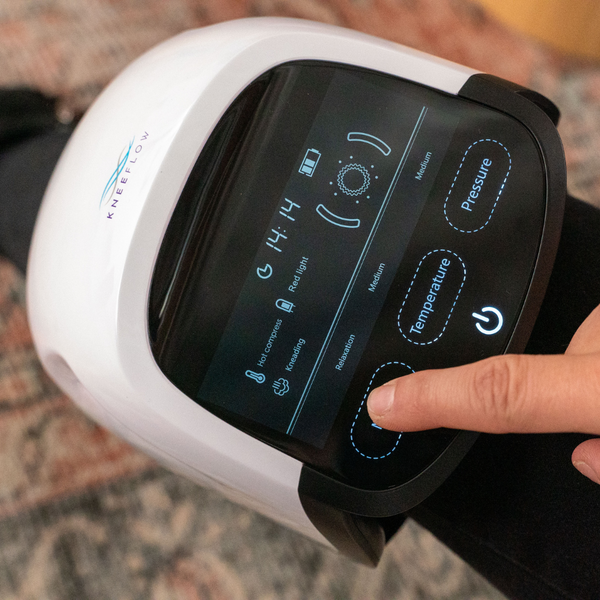
Targeted wearable devices designed for specific joints, including the knee, often sit in the $100 to $200 range for the mass market and $119 for Kneeflow, which integrates near-infrared photobiomodulation alongside heat and compression in a single wearable format. The comparison point is not just how much does red light therapy cost at purchase but what the device delivers for that cost over daily use.
The Per-Session Cost Math
This is where the comparison changes.
A clinic session at $50 costs $50. Every time.
A device purchased at $119 and used daily for one year costs $0.33 per session. At twice daily during an acute recovery phase, $0.16 per session. At three sessions per week for maintenance, $0.76 per session.
The crossover point, where a device’s upfront cost equals the cost of clinic sessions at the same frequency, happens faster than most people expect. A $119 device against $40 clinic sessions used five times per week crosses break-even in six sessions. Six sessions. After that, every session is effectively free.
The calculation shifts at higher device price points. A $499 device against $50 clinic sessions breaks even at ten sessions. Still less than two weeks of daily clinic use during an active treatment phase.
Understanding whether red light therapy actually produces the clinical outcomes that justify this investment is a separate question from the cost calculation, but both matter for making a rational decision. The per-session math only makes sense if the sessions are actually delivering the mechanism.
Hidden Costs on the Clinic Side
Scheduling time. Travel to and from the facility. The sessions you miss when you cannot get there. The progress that resets when a consistent protocol becomes inconsistent.
These are not trivial. The evidence for photobiomodulation outcomes consistently shows that consistency of sessions matters as much as individual session quality. Missing sessions during an active treatment phase, which is inevitable with clinic-dependent protocols, produces worse outcomes than slightly lower individual session quality at consistent daily frequency.
Membership models at wellness studios and photobiomodulation clinics try to address the consistency problem through monthly commitments. Memberships typically run $150 to $300 per month for unlimited or specified-frequency access. These are more cost-effective than pay-per-session for high-frequency users, but they still carry the access constraint: you can only use the device when the facility is open, when you can get there, and when the device is available.
Hidden Costs on the At-Home Side
The device price is not always the total cost.
Accessories for panel-style devices include stands, mounting systems, and protective eyewear. Quality eyewear rated for the specific wavelengths being used runs $20 to $50. A proper mounting stand for a floor-standing panel can add $50 to $150 to the total setup cost.
Device longevity matters for the per-session calculation. LEDs are rated for 50,000 hours of use in most quality devices, which at daily twenty-minute sessions translates to over 140 years. The device is not the limiting factor in most cases. The limiting factor is whether the user maintains the habit.
Replacement costs for consumable devices are worth flagging. Some devices in this category use non-rechargeable batteries, like the Firefly Recovery device at $49 per disposable pair. At daily use, the annual consumable cost exceeds several hundred dollars. Rechargeable devices like Kneeflow have no consumable cost beyond the initial purchase.
What HSA and FSA Eligibility Changes
Both clinic sessions and at-home devices can often be purchased with pre-tax health savings or flexible spending account funds, depending on the plan and the provider’s documentation of medical necessity.
FSA and HSA eligibility effectively reduces the out-of-pocket cost by the user’s marginal tax rate. At 25 percent marginal rate, a $119 device costs the equivalent of $89 in after-tax income. At 30 percent, it costs $83.
This applies to both clinic services and home devices when properly documented. For people with active FSA or HSA balances, the real cost of either option is lower than the sticker price suggests, and the at-home device’s permanent cost advantage over recurring clinic sessions becomes even more pronounced on an after-tax basis.
What Drives Device Price Within the At-Home Category
Not all of the price range reflects clinical capability. Some of it is brand positioning, aesthetics, and marketing overhead. Understanding what actually drives therapeutic value within the device price range helps distinguish investments that change outcomes from investments that change the box it comes in.
Power density is the most directly clinically relevant variable. A device delivering 80mW per square centimeter at contact can reach therapeutic dose in ten minutes. A device delivering 15mW per square centimeter needs over forty minutes for the same dose. Session time and power density are inversely related, and devices at the lower end of the price range are often lower-powered, meaning longer sessions for equivalent dose.
Wavelength specificity matters for targeted applications. What to look for in a knee massager with red light therapy covers this in detail, but the short version is that near-infrared wavelengths around 850nm are required to reach joint-depth tissue at therapeutic photon density, and not all devices marketed for joint applications use wavelengths calibrated for that depth.
Form factor determines whether consistent daily use is practical. A panel requires setup, positioning, and a dedicated space. A wearable device attaches directly to the treatment area and can be worn while sitting, working, or watching television. For joint applications requiring daily sessions over months, the friction difference between those two formats has a real effect on whether the protocol actually happens consistently.
The Total Value Calculation
How much does red light therapy cost? That question is really about the value over the time you use it not just the first price. Clinic visits cost $50 each. If you go five times a week for eight weeks of treatment and then go twice a week for maintenance for a year the total comes to about $4,800 in the first year. A $119 at‑home device used every day for the period costs only $119, plus whatever extra value you get from the convenience of daily sessions at home without travel or scheduling hassles. The value calculation is not money. It also includes whether the format helps you stay consistent which decides if the treatment will work. A clinic protocol that costs $400 a month but ends up being used twice a week because of scheduling problems will give worse results, than a $119 device used every day because it takes only thirty seconds to put on before bed. If you want to talk about how Kneeflow can fit into a joint recovery routine that relies on consistent at‑home sessions contact us through the contact page and someone will answer you directly.