Black Friday is one of the best times of year to buy a red light therapy device for knee pain, but it is also one of the easiest times to buy the wrong one. Red light therapy black Friday deals range from genuinely discounted, well-specified devices to deeply discounted products that have never published a wavelength and are unlikely to do much more than glow. The difference matters, because the therapeutic benefit of red light therapy depends almost entirely on specs that most promotional listings never mention.
This guide covers what to look for in a red light therapy black Friday deal, which specs separate a real device from a flashy one. Kneeflow is running a Black Friday deal this year, and we will cover exactly what that includes at the end.
Why Black Friday Is a Good Time to Buy a Red Light Therapy Device
Home red light therapy devices sit in a price range where timing genuinely matters. A quality wearable knee device that combines red light, heat and compression typically runs between $100 and $200. That range is wide enough that a 20 to 40 percent Black Friday discount represents real money, $25 to $80 off depending on the device.
The other reason this timing works is seasonal demand. Arthritis and joint pain tend to be worse in colder months when people move less and cold temperatures increase joint stiffness. Buying a device now and building a daily routine through winter is better timing than waiting for a spring sale when you have already spent months managing pain without it.
The risk of Black Friday shopping in this category is the same as any technology purchase: promotional listings emphasize price drops and downplay specs. A device marked from $299 to $99 may never have sold at $299, and the spec sheet may explain why.
What to Look For Before You Buy
There are four things worth confirming before any red light therapy black Friday purchase. These are not nice-to-haves. Without them, you are buying a light that may or may not reach the right tissue at the right dose.
Published wavelength in nanometers. Red light therapy works because specific wavelengths are absorbed by mitochondria in your cells, stimulating energy production and modulating inflammation. The therapeutic range studied for knee pain is 630 to 860 nm. A device that lists its wavelength as “red” or “infrared” without a nanometer value does not give you the information needed to evaluate whether it qualifies as therapeutic. Our explanation of how red light therapy works for the knee covers the cellular mechanism and why wavelength specificity matters.
Documented heat temperatures. Many red light knee devices also apply heat. If the device lists three heat levels but not the actual temperature in degrees, you have no way to know whether the heat is therapeutic, excessive, or appropriate for a post-surgical knee. Exact temperatures matter for safety and consistency.
Certifications. CE and RoHS are the most common certifications for medical-use wearable devices sold in the US and Europe. They are not a guarantee of therapeutic efficacy, but they indicate that the device has cleared a third-party review. No certifications listed means no independent review.
FSA and HSA eligibility. Not every device qualifies. If you plan to use pre-tax funds, confirm eligibility before buying, not after. Some devices claim eligibility without documentation.

The Red Light Specs That Actually Determine Results
Red light therapy black Friday marketing tends to emphasize light count, panel size or the number of LEDs in a device. These numbers are largely meaningless without irradiance data. What matters for a knee device is wavelength, power density and total dose per session.
Wavelength: For surface tissue, red light in the 630 to 680 nm range is most studied. For deeper joint tissue at the knee, near-infrared in the 800 to 860 nm range penetrates further and has stronger clinical evidence for joint pain applications. A device with both ranges is more versatile.
Session length and power: A 15-minute session at an adequate irradiance level delivers a therapeutic dose. A device with very low power output may require sessions of 30 to 60 minutes to achieve the same dose, which makes daily compliance harder. Most clinical protocols for knee OA used 15-minute sessions, which is what well-designed wearable devices are built around.
Heat and compression complement: Red light works at the cellular level. Heat improves local circulation and reduces stiffness, preparing the joint for the light. Compression supports swelling management and fluid movement. A device combining all three addresses the problem from more angles than a panel or pad that only delivers light.
When evaluating any deal in this space, ask whether the listing answers these questions. If it does not, search the brand name plus “wavelength” before buying.
Price vs Value in Red Light Therapy Black Friday Deals
Red light therapy black Friday price drops fall into three categories, and knowing which one you are looking at saves money.
Genuine discounts on well-specified devices. These are devices with published wavelengths, documented temperatures, certifications and confirmed FSA eligibility that are running a real promotion. They are worth buying if the specs match your condition.
Inflated original prices. Some devices appear to be heavily discounted because the original price was set high for the express purpose of showing a dramatic markdown. Check the device’s regular price outside of promotional windows to verify. If it has never sold at the listed original price, the discount is not real.
Entry-level devices marked down from an already-low price. There is nothing wrong with an inexpensive device if the specs support your use case. But a $29 device at 50 percent off is not a substitute for a $119 device with published specs. The Black Friday market includes both, and they are not interchangeable.
The KneeFlow guide to how much red light therapy costs covers the full pricing landscape from clinic sessions to home devices, which is useful context for evaluating whether a “sale” price is actually competitive.
FSA and HSA + Black Friday: Stack the Savings
One of the most useful red light therapy black Friday strategies is combining a promotional discount with FSA or HSA funds. The logic is straightforward. If your device qualifies as a medical expense, the out-of-pocket cost after pre-tax payment drops by roughly 20 to 35 percent depending on your tax bracket, and that saving stacks on top of any Black Friday discount.
For example: a $119 device at 15 percent off is $101. Paid with FSA or HSA funds at a 25 percent effective tax rate, the real out-of-pocket cost is closer to $76. A well-specified device at that effective price is a strong buy.
There is also a timing angle. FSA funds from calendar-year plans typically expire at the end of the year or in a short grace period after. Black Friday falls in late November, which makes it a natural window to spend down FSA balances on a planned medical device purchase before the December 31 deadline.
If Kneeflow is on your list, see the current Black Friday price and pick it up at the Kneeflow knee massager page.
What to Watch Out For in Black Friday Red Light Deals
A few patterns appear repeatedly in red light therapy black Friday promotions and are worth flagging.
Wavelength described as “near-infrared” with no number. Near-infrared is a range from roughly 780 to 1,100 nm. A device claiming near-infrared without specifying the nanometer value could be anywhere in that range. Some of it is therapeutic for knee pain. Some of it is not.
Bundle deals that dilute the main device value. A Black Friday bundle that includes carrying cases, gel packs and charging accessories at a “combined value” figure is usually padding. Evaluate the main device on its own specs and price, separately from the extras.
Limited-time countdown timers with no end date. These are a standard pressure tactic. A timer that resets every day is not a real deadline.
“Clinically proven” claims without citations. If a device claims clinical proof, the claim should come with a study reference. Red light therapy as a category has real clinical evidence; not every device in the category has been tested.

Kneeflow Black Friday 2026: What the Deal Includes
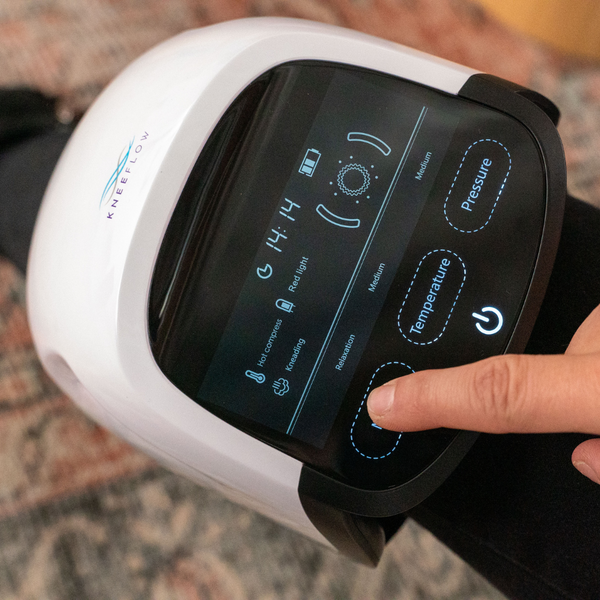
Kneeflow’s red light therapy black Friday offer for 2026 is a discount on the Kneeflow knee massager, available directly at checkout on the product page. The device combines 650 nm red light with 19 near-infrared lights, heat at three documented temperatures (45°C, 50°C and 55°C), and air compression through soft airbags. Battery life is rated at 210 minutes with a 60-minute recharge. The device weighs 790 grams and fits the knee, elbow or shoulder.
It carries CE and RoHS certifications and is confirmed FSA and HSA eligible with a dedicated checkout option. For FSA buyers with a December 31 deadline on their account balance, the Black Friday window lands at the right time.
The case for buying during the sale is straightforward. If you have been managing knee pain from osteoarthritis, post-surgical recovery or general overuse, adding a device that combines three evidence-based modalities into a 15-minute daily session is a lower barrier at a discounted price than at full retail. Our review of what red light therapy does for knee pain covers the clinical evidence if you want to evaluate the mechanism before buying.
Get the Kneeflow Black Friday Deal Before It Closes
Red light therapy black Friday deals on well-specified devices sell through. The combination of a real promotional window, end-of-year FSA deadlines and increased winter demand for joint pain relief makes late November the highest-traffic period for this category.
Have questions about whether it is the right device for your condition before the sale closes? Contact the Kneeflow team and we will help you decide quickly.