Knee arthritis does not come with a warning. It creeps slowly, built over years of small choices and repeated stress. Before you know it, the joint that carried you through life starts to resist. By the time most people wonder how to prevent arthritis in the knees, they are already dealing with mornings or a familiar pain after sitting too long. Some are still far from that moment. The habits that keep the knee healthy work the same for everyone, no matter where you are on the journey.
This is not about changes. It is about noticing what really affects cartilage, joint strength, and how to prevent arthritis in the knees over time. Most people have more power than they think. The Kneeflow team created this guide to help you see those opportunities. If you are ready to take steps to protect your knee health, keep reading.
What the Knee Is Actually Up Against
The knee bears more load per square inch than almost any other joint in the body. Every step transfers force upward through the foot, concentrates at the knee, and disperses into the hip. Cartilage handles the compression. Muscles handle the stability. Synovial fluid handles the lubrication. When any one of those systems gets chronically overtaxed or neglected, the others compensate, and over time that compensation has a cost.
Cartilage is the variable with the least margin for error. It has no direct blood supply and cannot regenerate in any meaningful way once it is significantly damaged. The window for protecting it is wide open in your thirties and forties, narrower in your fifties, and still worth taking seriously at any age after that.
Habit 1 on How to Prevent Arthritis in the Knees: Manage Your Weight Before It Manages Your Knees
For every pound you carry beyond a healthy weight, the knee takes an extra four pounds of force. This is true on the ground. On stairs or hills, the force grows more. With thousands of steps each day over years, the math is hard to ignore.
Weight also changes the inflammation inside the joint. Fat tissue releases chemicals that keep low‑grade inflammation going. Long‑term inflammation eats away at cartilage. Keeping weight down tackles both the mechanical pressure and the biological damage at the same time. That is why staying at a weight is one of the best ways to how to prevent arthritis in the knees.
Habit 2: Strengthen the Muscles That Actually Support the Joint
The knee does not stabilize itself. When the hamstrings, quadriceps, hip abductors, and calves work well, they absorb and redirect force during movement. The cartilage surfaces feel much less direct stress. When those muscles are weak, the cartilage takes the hit instead. The knee depends on those muscles to stay steady.
Building that strength does not require a barbell. Step‑ups, clamshells, wall. Straight‑leg raises performed three or four times a week provide measurable improvements in joint stability over months. The principle is consistency over intensity. Strength gains come from effort, not from a single heavy lift.
A moderate effort performed reliably over time does more for the knee than high‑effort sessions spaced by weeks of inactivity. The knee benefits from repeated work rather than erratic bursts of effort.
Habit 3: Move Often and Vary the Way You Do It
How to prevent arthritis in the knees: Cartilage needs movement. Movement keeps cartilage alive. The key move is the push. Pull happens when weight moves across the joint. That. Pull pushes nutrients into cartilage through the fluid that surrounds the joint. If you stay still for long, that nutrient flow slows. If you always move the same way, the same spots get all the work.
For how to prevent arthritis in the knees, walking is good. Add swimming, cycling, and a little hiking. This is not because more is always better. Because different moves spread the work over many parts of the joint and let each part rest. For people who want to avoid knee arthritis for a time, low‑impact movement that changes often is the best tip that appears again and again in studies.
Habit 4: Treat Every Knee Injury Like It Matters
A meniscus tear in your twenties that you walked off without rehabilitation can show up as knee arthritis in your forties. That is not speculation. Post‑traumatic knee arthritis is a documented outcome of injuries that heal structurally but leave behind mechanics, residual inflammation, or muscular imbalances that quietly accelerate cartilage wear over the following years.
Finishing a rehabilitation program rather than stopping when the acute pain fades is one of the highest‑return investments in long‑term joint health available to anyone who has had a significant knee injury. Stability, strength, and movement patterns need to be restored, not just functional enough to get through the day without limping and key on how to prevent arthritis in the knees.
Habit 5: Rethink How Your Job Loads Your Knees
People who work in construction, farming, installing floors, or doing other jobs that require a lot of effort get knee arthritis more often than people who work in offices. This happens because their work involves repeated stress on the knees that doesn't give them time to heal. Kneeling for a time, staying in a squatting position, and carrying heavy things on hard surfaces all put pressure in the same areas of the knee cartilage.
The changes that can help how to prevent arthritis in the knees are not big or complicated. Switching tasks to avoid the movements over and over, using padding for the knees, changing positions often during the day, and building stronger muscles to take some of the weight are all possible and easy to do. None of these changes mean quitting a job. They mean paying attention to something that many people, in jobs, have stopped noticing.
Habit 6: Eat in a Way That Keeps Inflammation Low
Food does not rebuild cartilage directly. What it does is shape the inflammatory environment the joint lives in, and that environment matters enormously for how cartilage holds up over time. Diets built around processed foods, refined carbohydrates, and industrial fats tend to push systemic inflammation upward. Diets built around vegetables, oily fish, olive oil, legumes, and whole grains tend to keep it in check.
Omega-3 fatty acids from salmon, sardines, and walnuts have the strongest evidence for anti-inflammatory effects in joint tissue. Vitamin D supports bone density and immune regulation. Adequate protein supports the muscular structure that protects the joint mechanically. These are not exotic interventions. They are the downstream effects of eating in a way that has been associated with better health across virtually every system in the body, including how to prevent arthritis in the knees.
Habit 7: Choose Footwear With the Joint in Mind
The foot is the foundation. How it contacts the ground determines the angle and distribution of force traveling up into the knee, and that relationship plays out across every step of every day. Footwear that allows excessive inward rolling of the foot, or that provides inadequate cushioning on hard surfaces, alters knee mechanics in subtle but cumulative ways.
This does not mean buying the most expensive shoes or defaulting to maximum motion control. It means paying attention to whether the footwear you spend the most time in actually suits the surfaces you walk on and the mechanics of your specific foot. People who have noticed that certain shoes consistently leave their knees feeling worse are already receiving useful information that is worth acting on.
Habit 8: Build Recovery Into Your Routine, Not Just Activity
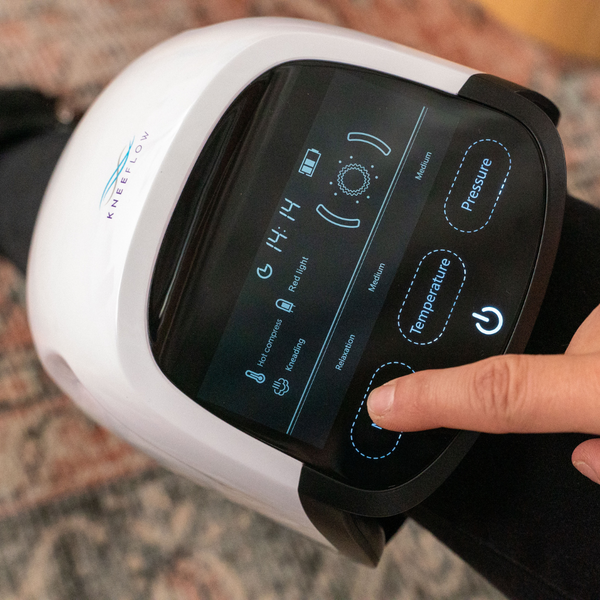
Movement helps how to prevent arthritis in the knees. Recovery, from that movement, decides whether the protection grows stronger or fades away over time. Heat helps blood flow. Keeps the nearby tissue soft. Compression stops swelling and sharpens the knee’s sense of position. Targeted massage tackles tight muscles that pull the knee out of its shape when it builds up and are not released.
For people who want a tool that uses these three ideas, the KneeFlow heated knee massager brings heat, compression, and massage together in a wearable device that can be used daily at home. It fits into an evening routine without creating friction. The steady use of it is exactly the kind of low‑effort habit that adds up to real joint health over months and years.
The Honest Picture of Long-Term Joint Protection
No single habit on this list works in isolation, and none of them offer a guarantee. Genetics, past injuries, and age all shape the terrain in ways that habits can influence but not erase. What habits do is shift the odds, close the gap between what the joint is being asked to handle and what it has the resources to absorb, and buy time in the most literal sense.
Learning how to prevent arthritis in the knees is really about learning to treat the joint as something worth maintaining before it demands your attention. The people who do that tend to move better, for longer, than the people who wait for a diagnosis to start paying attention.
If you are dealing with ongoing stiffness or discomfort and want to talk through what makes sense for your situation, the Kneeflow team is available. Reach out through the contact page, and someone will respond to you directly.