What are the real numbers for everyone else to reference from Knee Arthritis? The numbers in 2021 for instance showed that 374.7 million people worldwide suffer from knee osteoarthritis of some sort. Each year for instance around 31 million new cases of knee osteoarthritis are diagnosed. By 2035, the projections put the total prevalence on track to climb nearly 44%.
Arthritis of the knee is one of the most common musculoskeletal conditions worldwide and there are many people with the condition who are lacking in information about the changes going on in their joint, why they are happening and most importantly what can be done about it. Many misconceptions exist about the condition. Knee arthritis gets collapsed into a single thing when it's actually several. It gets framed as a consequence of aging when genetics, weight, and injury history matter just as much.
And it gets accepted as a slow march toward surgery when the evidence points clearly toward years of effective non-surgical management for the majority of people. At Kneeflow, we work at the intersection of daily joint comfort and longer-term knee health. We think people managing this condition deserve an accurate picture.
What Knee Arthritis Actually Is
Arthritis is a general term used to describe more than 100 different diseases and conditions. Although each disease affects the joints, the causes of arthritis, the mechanism by which the disease causes joint damage, and the treatment for each form of arthritis can be quite different. In the knee specifically, the four most clinically relevant types of knee arthritis are osteoarthritis, rheumatoid arthritis, post-traumatic arthritis, and psoriatic arthritis.
All four affect joint function through different pathways and arrive at a similar cluster of symptoms: pain, stiffness, swelling to varying degrees, and progressively limited range of motion. The knee is the most commonly affected large joint across both degenerative and inflammatory arthritis types, which has to do with load distribution.
The knee carries most of your body weight through every step, with cartilage, synovial fluid, menisci, ligaments, and the surrounding musculature all involved in managing that load. When any part of that system degrades or becomes inflamed, the whole mechanism shifts.
The Four Main Types
-
Osteoarthritis
Osteoarthritis or “knee arthritis” is commonly thought of when referring to the degenerative process where cartilage between bone ends in joints deteriorates, allowing bones to ultimately contact each other. As joint degeneration proceeds, synovial fluid within the joint will undergo changes. The process is gradual, and for years it can advance on imaging before symptoms make themselves known.
Two types of OA exist: primary and secondary. Primary types of OA do not occur as a result of any specific incident and are linked to normal aging, genetics, and body weight. Secondary types of OA, on the other hand, occur as a result of an incident and could be as a result of a previous injury to a joint, a previous operation, or another condition that altered joint mechanics. The knee is the most commonly affected OA site globally, with women showing higher prevalence than men in the decades past fifty.
Subchondral bone changes, shifts in synovial chemistry, and low-grade local inflammation all drive the cycle forward, which is why rest doesn't work as a long-term strategy the way it might after an acute injury. The structural changes don't pause when you sit down.
-
Rheumatoid Arthritis
RA behaves differently from the start. The immune system misidentifies the synovial membrane lining the joint as a threat and attacks it. That inflammatory process, sustained over time, damages cartilage and bone in ways that look similar to OA on an X-ray but originate from an entirely different mechanism.
RA tends to affect joints symmetrically (both knees, both wrists, multiple small joints simultaneously) and comes with systemic features that OA doesn't: fatigue, morning stiffness lasting well past the thirty-minute mark, and sometimes low-grade fever.
The management of RA diverges substantially from OA management at the pharmacological level. Disease-modifying antirheumatic drugs and biologics target the immune process itself rather than managing symptoms downstream of it. Physical therapy and exercise remain important, but they work alongside medical treatment rather than in its place.
-
Post-Traumatic Arthritis
Post-traumatic arthritis (PTA) is a late form of knee arthritis with the longest delay between cause and consequence. A tibial plateau fracture, an ACL rupture or years of repetitive occupational loading can accelerate cartilage degradation in ways that don't become symptomatic until ten or twenty years after the original event.
Post-traumatic knee arthritis tends to affect individuals in their 40s and 50s, who had believed they had fully recovered from an earlier injury to the knee. The appearance on imaging looks like OA, but the timeline is faster and the history is the diagnostic key. Missing this distinction means missing the broader context of how the joint got here.
-
Psoriatic Arthritis
People with psoriasis are at risk of developing psoriatic arthritis. In fact, around 30% of people with psoriasis develop psoriatic arthritis at some stage. The condition most commonly affects the knees. As with RA, psoriatic arthritis is an immune mediated disease. However, it is often asymmetric. The skin changes of psoriasis precede joint symptoms by months or years.
Enthesitis (inflammation at the points where tendons and ligaments attach to bone) is characteristic and often overlooked. Treatment shares significant overlap with RA management, including biologics targeting specific inflammatory pathways.
How Symptoms Actually Present
Symptom patterns vary enough between types of knee arthritis that getting the diagnosis right is a prerequisite for getting the treatment right. The experience of living with OA is genuinely different from living with RA, and those differences show up in the daily symptom picture before they show up in a lab result.
Osteoarthritis tends to announce itself gradually. The morning knee that takes a few minutes to cooperate before you can walk normally. Pain that builds through a long day on your feet and eases when you finally sit down, until sitting for too long produces its own stiffness.
Crepitus, the grinding or crunching that accompanies certain movements, is common and tends not to be painful early on. Over time, the joint line becomes tender to pressure, range of motion decreases, and in some presentations, visible malalignment develops as the joint space narrows unevenly.
Rheumatoid arthritis looks different in several key ways. Morning stiffness extends well past thirty minutes, often an hour or more, and the joint swelling has a softer, more fluid quality than the bony changes of OA. Warmth at the joint is more pronounced. Fatigue that isn't explained by activity level is a consistent feature.
Several presentations require same-day evaluation regardless of which type of knee arthritis is suspected. Sudden severe swelling following minimal or no activity. A knee that locks in position or buckles unpredictably. New severe pain following years of stable, manageable discomfort. Fever alongside joint symptoms.
Diagnosis: What the Process Actually Involves
There is no single test that produces a knee arthritis diagnosis. It's built from the intersection of several information sources.
Patient history comes first, and it carries more diagnostic weight than most people expect. The pattern of symptoms, how they started, whether they're symmetric, what makes them better or worse, what previous injuries or procedures the joint has been through, what other conditions are present, and whether anyone else in the family has inflammatory arthritis.
Physical examination follows. Alignment, range of motion, the character of any swelling (fluid versus bony thickening), tenderness distribution, gait observation, and crepitus assessment together provide a functional picture that imaging alone can't supply.
Plain radiography is the standard starting investigation for suspected degenerative knee arthritis. The classic OA findings are joint space narrowing, subchondral sclerosis, osteophyte formation, and cysts beneath the bone surface. MRI adds detail when meniscal, ligamentous, or early cartilage pathology needs characterization. Ultrasound is particularly useful for assessing synovial inflammation in real time and can guide procedures like joint aspiration.
Blood tests don't diagnose OA, but when inflammatory arthritis is part of the differential, rheumatoid factor, anti-CCP antibodies, ESR, CRP, and a full blood count provide critical information. Uric acid is added when gout needs to be assessed.
One thing worth knowing: imaging severity and symptom severity correlate poorly in knee arthritis. Some people with minimal structural changes experience significant pain and limitation. Others with advanced radiographic findings manage well with appropriate care. The image describes the structure; the clinical picture describes the person. Management follows the person.
What Actually Works: The Management Evidence
Exercise is the single most consistently recommended intervention for knee arthritis across every major clinical guideline: ACR, NICE, OARSI, and the AAOS. For any type of knee arthritis, the case for regular movement is stronger than the case for any other single intervention. The mechanism for its effectiveness in OA is direct: quadriceps muscles absorb compressive load before it reaches the joint surface. Stronger muscles mean less cartilage stress with every step.
Aerobic conditioning adds a second layer: systemic health improvements, weight management support, and effects on pain that appear to operate independently of the strength benefit. Both land-based and aquatic programs have produced consistent improvements in pain and function across multiple randomized controlled trials.
Physical therapy brings something general exercise programs can't: an assessment of how the individual actually moves. Gait compensations that developed over years of protecting a painful joint, hip weakness that shifts load medially onto the knee, foot alignment issues that change stress distribution up the kinetic chain. A physiotherapist identifies and addresses these specifically. The combination of supervised PT and a home program consistently outperforms either approach alone.
Weight Management
High BMI contributed to 20.4% of the global osteoarthritis burden according to GBD 2021 data, making it the largest single modifiable risk factor for knee arthritis in the study. The mechanical explanation is blunt: each pound of body weight generates roughly four pounds of compressive force through the knee during normal walking.
A five to ten percent reduction in body weight among overweight individuals produces measurable decreases in pain, joint load, and functional limitation. This is among the most impactful interventions available for knee arthritis in people for whom it applies, and its benefits compound with those of exercise in ways neither achieves independently.
Medications
Topical NSAIDs are the first pharmacological treatment for mild to moderate symptomatic knee OA (as per NICE Guidelines). They provide local relief of pain with very little systemic exposure compared to oral NSAIDs (more potent but with risk of gastrointestinal, cardiovascular and renal damage with extended use). Corticosteroid injection provide short-term relief in resistant cases and carries a strong recommendation from the ACR when first-line approaches haven't been sufficient.
RA and psoriatic arthritis require a different pharmacological approach entirely: disease-modifying antirheumatic drugs and increasingly, biologics that target specific inflammatory pathways. These require rheumatological oversight and monitoring that goes well beyond what OA management involves.
Complementary Daily Support
The stiffness that builds between appointments (the morning reluctance, the tightness that accumulates during a long afternoon at a desk) is a daily management problem, not a clinical one. Heat around the joint supports local circulation and eases the surrounding musculature, making the first movements of the day considerably more accessible.
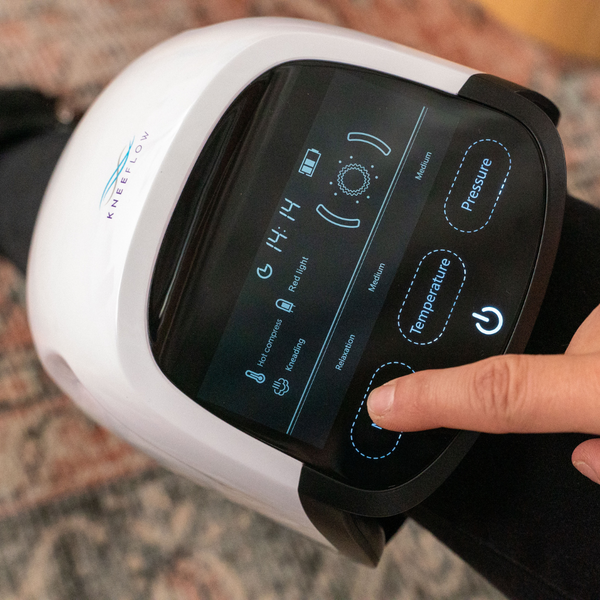
Compression adds proprioceptive input and reduces the sense of joint looseness. At Kneeflow, our device combines heat, compression, and massage specifically for this layer of daily comfort. It doesn't treat knee arthritis. It doesn't build muscle or slow progression. What it does is make the part of the day between clinical appointments more manageable for people already doing the more consequential work.
When Surgery Becomes the Conversation
Surgery is not the default endpoint. Most people who pursue consistent conservative management do not reach a point where it's necessary. For those who do (typically when structural damage is severe, pain control through non-surgical means has genuinely been exhausted, and function is significantly limited), total or partial knee arthroplasty has a strong evidence base and reliably produces meaningful improvements in pain and mobility in well-selected candidates.
Arthroscopic procedures like joint washout and debridement, once standard for knee OA, have been removed from most major clinical guidelines after randomized trials showed no benefit over sham surgery in OA populations. The evidence moved, and the recommendations followed.
Living With This Day to Day
Managing knee arthritis over years comes down to one variable more than any other: consistency. A modest exercise program maintained for three years outperforms an intensive one that runs for six weeks. That's not a management insight unique to knee arthritis; it applies to most chronic conditions, and it's the one most relevant to daily decision-making.
Activity modification is not the same as avoidance. High-impact loading during symptomatic flares adds unnecessary mechanical stress. But rest as a default strategy weakens the very muscles that protect the joint. Low-impact movement (walking on even terrain, cycling, swimming, targeted strength work at appropriate intensity) maintains the system that supports the joint without the load that stresses it.
Footwear and assistive devices get overlooked more than they should. A well-cushioned, stable shoe reduces impact transmission through the lower limb with every step. A cane used in the hand opposite the affected knee redistributes body weight and reduces joint load in a way that's been documented in clinical studies.
Knee braces serve different functions depending on type (some provide proprioceptive feedback, others offload specific joint compartments), and their benefit varies enough by individual that a clinical assessment should precede the purchase.
People who believe the condition is simply advancing regardless of what they do often stop doing the things that would slow that advance. Education is not a soft supplement to treatment; in chronic musculoskeletal conditions, it's one of the better predictors of adherence to the interventions that actually work.
What Comes Next
A knee arthritis diagnosis is not a sentence. The diagnosis describes the current state of the joint; it doesn't determine where things go from here. People who engage early with appropriate exercise, professional guidance, and consistent daily management generally do much better over years than those who wait for things to worsen or accept limitation as fixed.
The structural changes accumulate, but the functional impact of those changes is substantially shaped by what happens around them. If you're trying to figure out where at-home tools fit into a plan you're already building, reach out to the Kneeflow team, and we'll give you a direct answer.
FAQ
What is the most common type of knee arthritis?
Osteoarthritis, by a wide margin, is the most prevalent form of knee arthritis globally. It develops through cartilage degradation over time rather than immune system activity and accounts for the majority of knee arthritis cases globally. OA is the leading source of chronic joint pain in adults over 50, affecting women at higher rates than men in later decades. Rheumatoid arthritis is the next most clinically significant type: autoimmune, symmetrically distributed, and requiring substantially different management than OA. Post-traumatic arthritis, associated with prior joint injury, and psoriatic arthritis, linked to psoriasis, round out the common categories. The type determines the treatment; conflating them leads to approaches that don't work.
Is knee arthritis curable?
No existing treatment reverses the structural changes already present. What treatment produces is genuinely meaningful even without reversal: reduced pain, slower functional decline, and for many people, years or decades of maintained quality of life. For RA and psoriatic arthritis specifically, disease-modifying medications can suppress the immune process driving joint damage and produce clinical remission in a significant proportion of patients. For OA, the focus is symptom management and preservation of function over time. The consistent finding in the research is that people who actively engage with management strategies (exercise, weight management, professional guidance) do measurably better over time than those who don't.
What does knee arthritis feel like?
It depends on the type. Knee arthritis pain varies enough between types to make the description matter. OA characteristically produces a dull, variable ache centered on the joint, worse after activity and better after rest in early stages, though the pattern often reverses in advanced disease when rest pain and night pain appear. Morning stiffness is nearly universal but resolves within thirty minutes or so of movement. Crepitus (the grinding or crunching that accompanies certain movements) is common and usually painless early on. Rheumatoid arthritis feels different: more swelling, more warmth, more pronounced morning stiffness that extends well past that thirty-minute threshold, and fatigue that isn't proportional to activity. Post-traumatic arthritis feels similar to OA but appears at a younger age and in someone whose joint history explains the timing.
Can I exercise with knee arthritis?
Yes, and not exercising is generally worse. The muscles around the knee carry load so the cartilage doesn't have to. When those muscles weaken through disuse, that load transfers directly onto joint structures not designed to absorb it alone. The goal isn't unlimited activity but calibrated activity: low-impact movement, targeted strength work, and sufficient variety to keep the joint mobile. Swimming, cycling, walking, and water-based exercise programs all have strong evidence for pain and function improvements in OA populations. A physiotherapist is the most useful starting point for someone with significant damage or uncertain which movements are helping and which are adding stress.
What's the difference between OA and rheumatoid arthritis of the knee?
Mechanism, primarily. OA is degenerative: cartilage breaks down under cumulative load, aging, and individual risk factors. RA is autoimmune: the immune system attacks synovial tissue, producing inflammation that secondarily damages cartilage and bone. OA often affects one or both knees with asymmetric severity, alongside other load-bearing joints. RA typically presents symmetrically across multiple joints and includes systemic features: fatigue, longer morning stiffness, sometimes fever. Blood tests distinguish them definitively when the clinical picture is unclear.
When should I see a doctor about knee arthritis?
Earlier than most people go, which is the honest answer. Knee pain that has been present for more than a few weeks, is limiting daily activity, or is changing in character should be assessed rather than managed at home indefinitely. Several features move the timeline to same-day attention: sudden severe swelling, inability to bear full weight, a knee that locks or gives way, fever accompanying joint symptoms, or pain worsening actively over consecutive days. For inflammatory types like RA and psoriatic arthritis, early diagnosis and early treatment substantially change the long-term disease course.
Does a knee massager help with arthritis?
As a tool for the daily stiffness that comes with knee arthritis, heat and compression around the joint provide practical comfort that many people find meaningful. Warmth supports local circulation and relaxes surrounding musculature; compression offers proprioceptive feedback and a sense of joint stability that stiff joints often lack. What a massager doesn't accomplish is treating the underlying condition, building strength, slowing structural progression, or replacing the exercise and professional care that produce long-term outcomes.