When someone is diagnosed with arthritis, therapist options are typically searching for a ‘cure’ within the first few weeks. They might look at various supplements, browse through ads for devices, read through old forum posts and get bombarded with conflicting advice before landing on a question that's actually useful: what does the clinical evidence recommend, in what order, and who should be guiding the process?
Arthritis therapist options for OA are far more varied than most people would anticipate and the underlying logic behind how they're sequenced changes the way you approach every appointment and every decision along the way. At KneeFlow, we think people manage this condition better when they go into those conversations with a clear picture of the territory.
Why the Order of Treatment Matters
Osteoarthritis breaks down cartilage over time. Nothing currently available reverses that. What treatment accomplishes is managing symptoms, preserving function, and slowing the progression of disability. For most people, those goals are genuinely reachable.
The sequence matters because the options carry different levels of risk, invasiveness, and evidence. Moving straight to injections without trying exercise first, or assuming medication will do what physical therapy can't, tends to produce worse outcomes and more frustration than following the clinical pathway.
A 2023 systematic review published in Osteoarthritis and Cartilage synthesized six major international clinical guidelines on arthritis therapist options and found that all six positioned exercise as first-line care for both hip and knee OA.
Four of them specified this recommendation applied regardless of age, pain level, or disease stage. That kind of consistency across independent bodies of evidence is harder to dismiss than any single study. Among arthritis therapist options, exercise isn't the thing patients try while waiting for real care to begin.
Exercise: What the Evidence Actually Supports
Strength training, aerobic conditioning, and low-impact movement appear across every major OA guideline, endorsed by the American College of Rheumatology, the OARSI, and the UK's NICE. The reasoning isn't abstract: stronger muscles reduce the mechanical load on damaged cartilage, improve joint stability, and restore proprioceptive feedback that degrades when a joint has been painful and guarded for years.
The specific modality is less critical than the consistency and progression. Walking, swimming, resistance work, cycling, and water-based programs have each produced meaningful improvements in pain and functional scores in randomized controlled trials. A 2024 systematic review on aquatic exercise in older adults with OA, published through PubMed, documented improvements in walking ability, muscle strength and disease symptoms across twelve included studies.
Narrowing down arthritis therapist options through the lens of exercise comes down to who's going to design the program. General movement is beneficial. But when mapping out arthritis therapist options seriously, a program built around that person's specific joint involvement, baseline fitness, and pain behavior is what the evidence actually supports. That requires a physical therapist, not a brochure.
Physical Therapy: More Than Exercise Prescription
There's a tendency to treat physical therapy and exercise as the same thing with different price tags. They're not. A physiotherapist evaluates how a person actually moves: the compensatory patterns that developed over years of protecting a painful joint, the asymmetries in gait that increase load on one side, the strength deficits that aren't visible until someone watches you walk and get up from a chair.
The AAOS identifies physical therapy as one of the most clinically supported arthritis therapist options for mild to moderate symptomatic OA. OARSI core treatment recommendations for all OA presentations include structured land-based exercise under professional supervision. For knee OA, the focus almost always includes quadriceps strengthening.
Among all arthritis therapist options in the clinical literature, this is one of the most consistently documented non-surgical interventions for meaningful functional gain. A physiotherapist can also advise on bracing, taping approaches, and the kinds of daily activity modifications that reduce stress on the joint between sessions.
Medications and What the Guidelines Say About Them
Pharmacological management is a real part of arthritis therapist options, but clinical guidelines spend considerable attention on sequence and selection, not just whether to use them. The starting point for most patients is topical rather than oral. NICE explicitly recommends topical NSAIDs (diclofenac gel, for instance) as the first pharmacological move for knee OA, where the evidence is strongest, before introducing anything systemic.
Oral NSAIDs do have a place. They're effective for pain and function, and multiple guidelines include them. The caution is around duration and population. Long-term use carries compounding risk, particularly in older adults managing multiple conditions.
The clinical principle is the lowest effective dose for the shortest necessary period. Acetaminophen, despite its prevalence in OA self-management, has lost ground in recent guidance: NICE states explicitly that there is no evidence of its effectiveness for OA pain, and it shouldn't be routinely recommended.
Strong opioids don't belong in OA management. The risk-benefit calculation doesn't support them here. For patients whose symptoms haven't responded adequately to topical or oral agents, intra-articular corticosteroid injections are strongly recommended by the ACR for knee and hip OA. The relief is typically measured in weeks to a few months, not indefinitely, and the frequency of injections is limited by concerns about cumulative effects on joint tissues.
Complementary Approaches: Honest Assessment
Acupuncture has accumulated a meaningful body of research in OA, particularly knee OA. A 2024 systematic review and network meta-analysis in BMJ Evidence-Based Medicine drew on 80 randomized trials and nearly 10,000 participants to compare acupuncture against sham procedures, NSAIDs, usual care, and corticosteroid injections.
The analysis found acupuncture may reduce pain and improve physical function across several comparisons. The researchers were also direct about the certainty of the evidence: very low. The AAOS offers what it describes as a limited recommendation: possible benefit, acknowledged without strong endorsement. Arthritis therapist options in the complementary category tend to work this way: suggestive, low-risk, not a substitute for the core interventions.
Tai chi and yoga occupy similar territory among arthritis therapist options in the complementary tier. The OARSI conditionally recommends mind-body exercise for hip and knee OA, drawing on the favorable safety and efficacy profile these practices show in the knee OA evidence base.
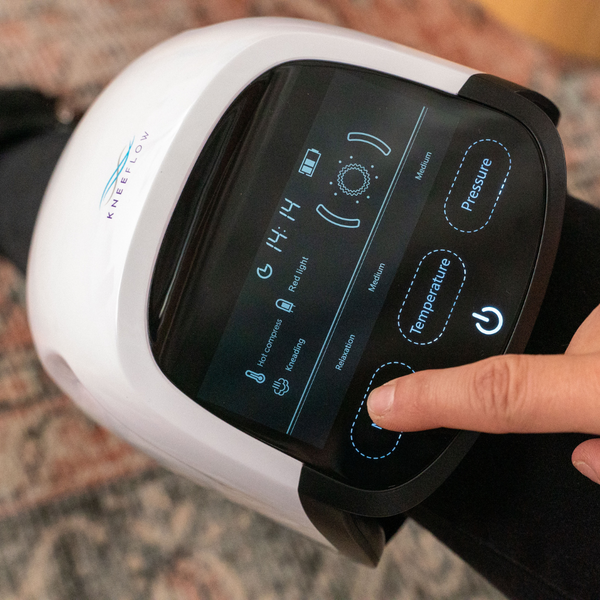
These aren't trivial benefits for someone whose daily life is constrained by joint pain and fear of movement. Heat and compression around the joint is another layer people reach for, often between clinical appointments. Controlled warmth relaxes the surrounding musculature and supports local circulation, both of which help with the tightness and stiffness that accompany OA daily.
This is the space our device at KneeFlow is designed for: not a treatment for osteoarthritis, not a substitute for any of the clinical work described above, but a complementary comfort tool for people already engaged with their care team.
Weight Management: Mechanical Impact Most People Underestimate
For knee OA specifically, body weight has an outsized mechanical effect. Each pound of body weight generates roughly four pounds of compressive force through the knee during normal walking. That ratio means modest weight reduction (even five to ten percent of body weight) can produce measurable reductions in joint load, meaningful decreases in pain, and improvements in function that sometimes exceed what medications achieve alone.
Weight management is also the one category among arthritis therapist options that asks the most of the patient over the longest period. It doesn't happen through a single appointment or a short course of treatment. For that reason, the most effective support usually involves a primary care physician overseeing overall health, a dietitian addressing nutrition, and a physiotherapist maintaining safe physical activity during the process.
Behavioral support and realistic goal-framing matter here as much as clinical guidance, because the results take time and the process requires consistency that's hard to sustain in isolation.
Surgery: What It Is and When It Becomes Relevant
Joint replacement surgery doesn't enter the clinical conversation until conservative arthritis therapist options have been pursued and found insufficient. Most pathways require documented failure of non-operative management before a surgical referral is appropriate. Total knee arthroplasty has strong, consistent evidence for advanced OA: pain reduction is reliable, and functional improvement is well-documented in appropriately selected patients.
Joint fusion and cartilage transplantation exist as alternatives for specific presentations and specific joints, though their use cases are narrower.
The decision to operate isn't a concession. For patients whose structural damage is significant and whose quality of life is severely limited despite sustained effort with non-surgical care, surgery is the right intervention. What goes into that decision includes the imaging, the symptom picture, the patient's age and overall health, their response to prior treatment, and their own priorities.
Navigating Arthritis Therapist Options as a Patient
Start with a primary care physician. A confirmed diagnosis, a severity assessment, and initial guidance on first-line management are what that first conversation should produce. From there, the two most common referral paths are physical therapy for supervised programming and rheumatology for more complex cases or nuanced medication management. Orthopedic surgery becomes relevant when structural damage warrants evaluation.
The practical problem with arthritis therapist options isn't that they're hard to find. It's that patients cycle through them without realistic expectations and conclude that none of them work. Exercise takes weeks to produce noticeable change. Physical therapy requires consistent engagement over months. Medications control symptoms without addressing the structural situation. Complementary approaches add something at the edges.
At every stage, at-home comfort measures can support the work you're doing clinically. They don't replace it, and no credible list of arthritis therapist options would suggest otherwise. For questions about where our device fits into a care plan that already has clinical oversight, or if you're still mapping out arthritis therapist options and want to understand where at-home tools belong in that picture, write KneeFlow and we'll help you think it through.
FAQ
What are the main arthritis therapist options for osteoarthritis?
The full range of arthritis therapist options for OA moves from low-risk lifestyle interventions to surgical procedures, and the major international guidelines sequence them in that order. Exercise and supervised physical therapy sit at the top because they carry the strongest evidence and the lowest risk. Pharmacological management comes next, starting with topical NSAIDs, moving to oral anti-inflammatory drugs if needed, then corticosteroid injections for resistant cases. Complementary approaches like acupuncture, tai chi, and heat therapy add value for some people alongside the primary interventions. Surgery is appropriate when conservative care has been consistently pursued and found insufficient.
Is exercise actually the most effective option for managing OA?
For most people, yes, and the evidence base is unusually consistent. A 2023 systematic review covering six major international OA guidelines found all six positioned exercise as first-line care for hip and knee OA, with four specifying it should be offered regardless of age, pain severity, or stage of disease. Strengthening and aerobic exercise have moderate to high quality evidence ratings across multiple Cochrane reviews. Exercise doesn't repair structural damage, but it reliably reduces pain, slows functional decline, and improves daily capability.
What does a physical therapist actually contribute beyond exercise?
Considerably more than exercise prescription. A physiotherapist watches how a person moves and identifies the compensatory patterns that have developed around a painful joint, patterns that often increase rather than reduce load on the affected area. From there, they design programming that addresses specific strength deficits and mobility limitations rather than offering generic activity guidance. The AAOS and OARSI both include supervised physical therapy in their treatment pathways. For knee OA specifically, professionally supervised quadriceps strengthening has some of the clearest non-surgical outcome data in the literature.
How safe are NSAIDs for ongoing OA management?
NSAIDs are part of the recommended pharmacological arthritis therapist options and are effective for pain and function. The concern with sustained use is systemic exposure. Oral NSAIDs carry gastrointestinal, cardiovascular, and renal risk that compounds with time and is more pronounced in older adults or those with comorbidities. Guidelines respond to this by recommending topical formulations first, where the evidence supports local delivery without systemic burden, and specifying the lowest effective oral dose for the shortest necessary period when pills are needed. These are calibrated clinical decisions, not one-size prescriptions.
Does acupuncture have a real role in OA treatment?
It has a plausible one, with honest limitations. A 2024 network meta-analysis published in BMJ Evidence-Based Medicine pooled 80 randomized trials and nearly 10,000 participants with knee OA and found acupuncture may improve pain and physical function across several comparisons. The researchers rated the overall certainty of evidence as very low and called for cautious interpretation. The AAOS offers a limited endorsement for acupuncture in knee OA. Among arthritis therapist options, it belongs in the complementary category: low-risk, potentially beneficial for some patients, and best thought of as a supplement to the core interventions rather than a substitute for them.
When does joint replacement surgery become appropriate?
When conservative arthritis therapist options have been tried with adequate consistency and haven't produced sufficient relief, and when the structural damage visible on imaging is significant. Most clinical pathways require documented failure of non-operative management before a surgical referral is made. Total knee arthroplasty has reliable evidence for advanced OA: pain reduction is consistent and functional gains are well-documented in appropriate candidates. The decision to proceed weighs structural findings, symptom severity, age, general health, treatment history, and patient preferences.
Can heat or compression help with OA pain day-to-day?
Heat and gentle compression around the joint serve a specific and limited role: comfort support for the muscle tension and stiffness that OA generates daily. Controlled warmth relaxes surrounding musculature and promotes local circulation, which helps with the morning lock and post-activity tightness many people experience. Among arthritis therapist options, this category doesn't modify the disease or build the joint strength that PT does. What it does is make daily life more manageable for some people between clinical appointments.
Which type of doctor should someone with OA see first?
Start with a primary care physician. They can confirm the diagnosis, stage the condition, and manage first-line treatment. For cases that are more complex or where medications need careful oversight, a rheumatologist is the appropriate next step. An orthopedic surgeon becomes relevant when the structural picture warrants evaluation or when surgical assessment is being considered. Physical therapists, occupational therapists, dietitians, and pain management specialists each contribute to different parts of a comprehensive OA plan.