You probably already know that red light therapy has research behind it. What's harder to find is someone who'll tell you plainly what the device does at a tissue level, which numbers in the studies actually matter, and what a realistic home protocol looks like. Most content in this category either oversells the modality or hedges so hard it becomes useless. Learning how to use red light therapy for knee pain doesn't require either extreme.
The mechanism is specific, the protocol is practical, and where the evidence runs out is worth knowing just as much as where it holds up. At KneeFlow, we think that kind of straightforwardness matters more than any claim we could make about our products.
What the Light Is Actually Doing
Red light therapy and near-infrared therapy belong to a clinical category called photobiomodulation, or PBM. Sometimes labeled low-level laser therapy, sometimes sold as LLLT. Whatever the branding, the underlying question for anyone asking how to use red light therapy for knee pain is the same: what is the light physically doing? The devices emit light at wavelengths the skin can absorb (typically 630 to 700 nm for red light, 800 to 1000 nm for near-infrared), and those wavelengths penetrate into the cells beneath the surface, where they're absorbed by structures inside the mitochondria.
What follows is cellular rather than thermal. The absorbed light drives an increase in ATP production, which is what cells use for energy. Higher cellular energy availability supports tissue repair and reduces oxidative stress. Downstream from that, local circulation shifts, inflammatory signaling changes, and the way nociceptors register pain in the area is modulated. These are plausible, documented effects, not invented ones, and they're entirely different from what heat therapy does.
Heat warms the tissue and relaxes surrounding muscle through thermal pathways. Red light triggers a photochemical response inside the cells themselves. Knowing that distinction is where understanding how to use red light therapy for knee pain actually starts, and it's the difference between having reasonable expectations and being disappointed by a device that's doing exactly what it's designed to do.
What the Research Supports and Where It Gets Honest
The clinical picture has sharpened considerably over the past several years, and the honest summary is more useful than the usual enthusiast take.
A 2024 systematic review and network meta-analysis published in Aging Clinical and Experimental Research examined thirteen randomized controlled trials with 673 participants who had knee osteoarthritis. Compared to sham treatment, LLLT produced a statistically significant reduction in pain (SMD = 0.96, 95% CI 0.31 to 1.61). That's a meaningful signal. The same analysis found no significant effects on function or stiffness, only pain, and the authors rated the quality of the evidence as low, flagging the need for larger, better-designed trials.
A second 2024 systematic review in the Journal of Lasers in Medical Sciences, focused on how to use red light therapy for knee pain in combination with exercise, found that both high-intensity and low-level laser therapy consistently outperformed laser therapy alone when paired with supervised exercise. The effect sizes were more convincing in the combined approach.
The takeaway isn't complicated: red light therapy beats placebo for knee OA pain in well-conducted trials, the effect is modest to moderate rather than dramatic, and the device performs meaningfully better when it's part of a broader care plan rather than used in isolation. Anyone who tells you more than that about how to use red light therapy for knee pain is extrapolating past what the evidence currently supports.
The Four Variables That Determine Whether It Works
Getting how to use red light therapy for knee pain right at home comes down to four things: wavelength, distance, session length, and frequency. These are the four variables that determine whether learning how to use red light therapy for knee pain at home produces results or frustration. Get them wrong, and you're either underdosing or wasting time. Get them right, and you give the mechanism a realistic chance to accumulate.
Wavelength is where the specificity matters most. Near-infrared at 850 to 905 nm shows the strongest evidence for joint depth penetration. The 2024 Fan et al. meta-analysis found that 904 to 905 nm produced the most consistent KOA pain reduction, and 785 to 850 nm also showed significant benefits over sham. Red light at 630 to 670 nm reaches less deeply but contributes to surface-level effects. Most consumer devices that combine red and near-infrared cover both ranges, which is why combined devices tend to produce steadier outcomes than single-wavelength panels.
Distance determines irradiance, the power actually reaching the tissue. Wearable knee wraps solve this by placing the LEDs directly against the skin, which maximizes delivery and removes the guesswork. Panel-style devices require following the manufacturer's distance specifications closely; even a few extra inches significantly reduces what arrives at the joint.
Ten to fifteen minutes per knee per session is the sweet spot most consistently supported for home use. Starting at the low end of that range and adding time once you've assessed how the knee responds is the sensible approach, particularly for anyone new to the modality.
How to use red light therapy for knee pain: The Practical Setup
The actual steps for how to use red light therapy for knee pain at home are less technical than the protocol variables suggest. Put the device on a clean, dry knee. Lotion, sunscreen, and topical medications all interfere with light absorption, so bare skin is the starting point. For wearable wraps, make sure the LEDs are flush against the joint rather than floating above it; the contact makes a measurable difference in what the tissue actually receives.
Where you position the device matters more than most product guides acknowledge. The joint line on both sides of the patella is where the research-backed dosimetry focuses coverage: front and sides of the knee, particularly at the joint margins. If posterior knee pain is part of the picture, targeting the back of the joint separately requires repositioning most wearable devices, but doing so is better than assuming the front coverage handles it.
Once the session starts, stay still. Near-infrared light is invisible and produces little to no warmth in most consumer devices, so there's nothing to feel in the way there is with heat therapy. That doesn't mean it isn't working. After the session ends, there's no rest period required the way there is with ice. Normal activity can resume immediately.
The most common mistake when working out how to use red light therapy for knee pain in practice is evaluating results after a handful of sessions. Track morning stiffness, how the knee feels after sitting for an hour, how it behaves during a walk. Those metrics capture the changes that the mechanism produces better than asking whether it hurts less at any given moment. Four to six weeks of consistent use, three to five times per week, is the appropriate window before deciding whether the approach is working.
Where KneeFlow Fits Into This
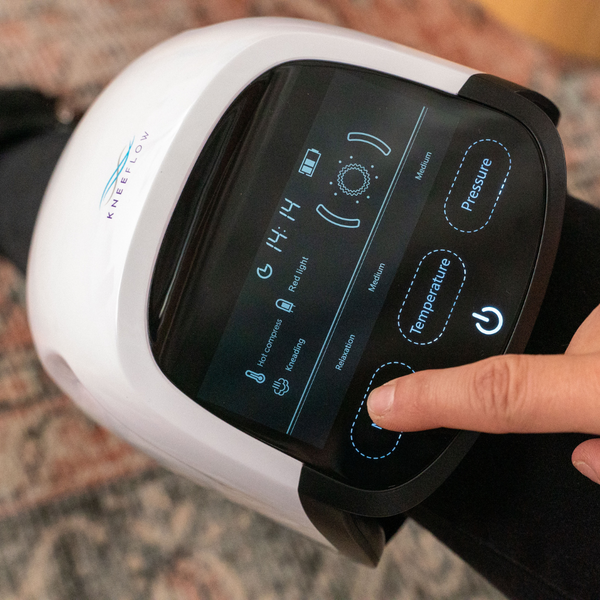
People sometimes arrive at KneeFlow mid-research on how to use red light therapy for knee pain and wonder whether our device uses photobiomodulation. It isn't, in the clinical sense. KneeFlow uses heat, compression, and massage. The infrared component in our device is far-infrared, which acts through superficial thermal pathways rather than the deep cellular photobiomodulation mechanism described above.
They're different modalities addressing different aspects of knee discomfort. Being clear about that distinction is more useful than letting the word "infrared" create a false equivalence.
If you're trying to figure out whether photobiomodulation or heat-and-compression is the better fit for your situation, those are legitimately different questions with different answers depending on what your knee actually needs. Explore the KneeFlow product page for a full breakdown of what our device does and the specific use cases it's built for.
Safety and What the Evidence Won't Cover
Part of understanding how to use red light therapy for knee pain responsibly is knowing where it shouldn't be applied. Red light therapy has a clean safety profile across the clinical literature. No UV emissions, no ionizing radiation, no documented structural tissue damage from proper use. Side effects in trials amount to mild warmth or brief skin redness at the treatment site in a small number of participants.
The contraindications are specific and worth reviewing before starting: active cancer in the treatment area, photosensitizing medications, photosensitive skin conditions, open wounds or active skin infections at the site, and pregnancy are all situations where medical clearance should precede any home use. Eye protection matters when using panel devices; most wearable knee wraps position the light well below the eyes, but check every device individually rather than assuming.
One more thing the evidence won't back, and it's worth naming for anyone researching how to use red light therapy for knee pain: red light therapy does not regrow cartilage. It does not permanently eliminate chronic pain. It is not a substitute for medical evaluation, physical therapy, or surgical assessment when those are indicated. A knee that's locked, severely swollen after an acute event, or presenting with pain that's qualitatively different from the usual chronic pattern is a clinical situation, not a home device situation. Getting that evaluation first is always the right sequence.
A Realistic Sense of What to Expect
The results that most people using how to use red light therapy for knee pain report first are modest: less morning stiffness, a lower baseline of discomfort during the day. Clearer functional gains, when they come, show up across four to eight weeks rather than after a few sessions. Some people experience more benefit, some less, and device quality, wavelength accuracy, consistency, and severity of the underlying condition all factor into where on that spectrum any individual lands.
The practical version of knowing how to use red light therapy for knee pain effectively isn't just about the device protocol. The clinical literature that shows the best outcomes with how to use red light therapy for knee pain consistently combines the light therapy with exercise and supervised rehabilitation. The device contributes a piece of the picture.
It doesn't carry the whole thing. For anyone managing ongoing knee discomfort, a thoughtful routine that includes appropriate movement, professional oversight when needed, and targeted use of tools like this will reliably outperform any single modality used in isolation.
For help thinking through which approach fits your situation, reach out to the KneeFlow team and we'll give you a direct answer.
FAQ
What wavelength works best for the knee?
Near-infrared at 850 to 905 nm has the strongest evidence for joint depth penetration. The 2024 Fan et al. network meta-analysis specifically found that 904 to 905 nm produced the most consistent KOA pain reduction. The 785 to 850 nm range also showed significant results over sham treatment. Red light at 630 to 670 nm reaches less deeply but contributes meaningful surface effects. Most wearable knee devices combine red and near-infrared wavelengths, which is the smarter design choice given the evidence. If you're evaluating how to use red light therapy for knee pain with a single-wavelength device, near-infrared at 850+ nm with solid power output is the better-supported option.
How long should each session be?
Ten to fifteen minutes per knee per session is the most consistent recommendation when learning how to use red light therapy for knee pain safely at home, across both clinical protocols and home-use guidance. Twenty minutes appears in some studies as an upper bound. Starting at ten minutes is sensible for anyone new to the modality; there's nothing to gain from longer sessions early on, and it's easier to adjust upward than to reverse overexposure. Session duration matters less than two other variables: the wavelength and irradiance reaching the joint, and whether you're consistent across weeks. One twenty-minute session every few weeks will produce less than ten-minute sessions three to five times per week every week for six weeks.
How often should I use it?
Three to five sessions per week is the most commonly cited starting frequency when building a how to use red light therapy for knee pain routine. If five sessions per week is hard to sustain, three is more valuable than five done sporadically. Consistency across the full trial period matters more than peak frequency in any single week. The 2024 meta-analyses tracked outcomes across four to twelve weeks of regular use. That's the timescale in which the pain reduction the research documents actually appears. Planning for that duration before evaluating results is the approach that matches how the science is structured.
Does it specifically help knee osteoarthritis?
The clearest clinical evidence for how to use red light therapy for knee pain sits squarely in the OA population. The 2024 Fan et al. systematic review covering thirteen RCTs with 673 KOA patients found LLLT statistically superior to sham for pain, though not for function or stiffness. The 2024 Khalilizad et al. review found that combining LLLT with exercise produced stronger improvements in both pain and function. For OA patients: yes, there's meaningful evidence it helps with pain, and the strongest outcomes pair it with active care rather than treating it as a passive standalone therapy.
Is it safe to use at home?
For most healthy adults without contraindications, applying how to use red light therapy for knee pain at home with a quality device is considered safe. No UV radiation, no ionizing effects, minimal documented side effects in trials. The situations that require medical clearance first: active cancer in the treatment area, photosensitizing medications or skin conditions, open wounds or infections at the site, and pregnancy. Eye protection is important with panel devices; most knee wraps are designed to avoid eye exposure but verify before each use. For systemic inflammatory conditions like rheumatoid arthritis, red light therapy may support comfort but shouldn't replace disease-modifying treatment.
How long before results show up?
Some reduction in morning stiffness appears within the first two weeks for some people using how to use red light therapy for knee pain consistently. The more meaningful changes in pain during activity and daily function tend to build across four to eight weeks of consistent use. The 2024 LLLT meta-analysis specifically showed pain reduction building progressively over the full treatment period rather than appearing sharply and leveling off. A useful frame: plan the first four to six weeks as the diagnostic period. If symptoms are meaningfully better by the end of that window, continue. If nothing has changed, reassess the protocol variables (wavelength, irradiance, placement, frequency) before concluding the approach doesn't work.
Can I use it alongside other treatments?
Yes. The evidence on how to use red light therapy for knee pain actually supports this specifically. The 2024 Khalilizad et al. review found that LLLT combined with exercise therapy consistently outperformed LLLT alone across pain and function measures. Pairing it with physical therapy, progressive strengthening, and heat or compression for daily stiffness management produces more durable results than any of those approaches used in isolation. On sequencing: most practitioners suggest applying red light before heat rather than after, and before rather than after vigorous exercise when the goal is recovery support.