Knee stiffness turns ordinary things into something you actually think about. Standing up from a chair. Taking the stairs. Sitting cross-legged on the floor. It shows up in twenty-somethings after a rough training block and in seventy-year-olds who just got up slower than they used to. Almost always there's a real cause behind it. Almost always something can be done.
This piece covers what actually causes knee stiffness, what heat and vibration really do to a stiff joint based on actual research, what a combination device can and can't offer, and where home care stops and a doctor's visit starts.
Plenty of the people who reach out about the Kneeflow Massager are dealing with exactly this. Stiffness constant enough to plan a day around, not just one rough morning.
None of what follows treats knee stiffness like an emergency. It's just an honest look at causes, what actually helps, and what doesn't.
What Causes Knee Stiffness
A handful of causes explain most knee stiffness, and most people's stiffness fits pretty cleanly into one bucket. Getting the category right shapes what comes next, since a stretch or a device that helps one kind might barely touch another.
Osteoarthritis, the most common cause, by a wide margin. Cartilage between the bones wears down slowly, sometimes with small bone spurs forming at the edges of the joint. Also, the age changes, joint tissue loses some elasticity as the years pass, and the knee produces less of the synovial fluid that keeps everything gliding. This kind of stiffness creeps in gradually. It's common enough on its own, without any specific diagnosis attached to it.
Injury-Related Stiffness. An old ligament sprain, a meniscus tear, stiffness that never fully left after knee surgery, all of these can leave a joint less mobile than it used to be. Sometimes for months. Sometimes for good, at least to some degree. Scar tissue and the altered way people move after an injury often explain stiffness that shows up long after the original injury supposedly healed.
Overuse and Lifestyle Factors. Long stretches of sitting, the same repetitive movement loading the knee over and over, extra weight the joint has to carry with every step, all of it adds up. Desk jobs. Long commutes. Hobbies built around kneeling or squatting. These causes rarely act alone. An old sports injury can speed up arthritis.
How Heat Actually Affects a Stiff Knee
Heat widens blood vessels near the surface of the skin, pulling more blood flow into the area and warming tissue that's been cold or still too long. That extra circulation does real work on knee stiffness, loosening tight muscle around the joint and making the tissue itself more pliable, the same way a light warm-up loosens a muscle before it stretches easily.
Research on heat therapy for knee conditions has found that warming tissue can meaningfully boost its elasticity and cut down the resistance a stiff joint puts up during movement. That's part of why a warm-up before exercise, or a heat session before climbing out of bed, makes the first few minutes of movement noticeably easier.
Paired with exercise, heat therapy has outperformed exercise alone for knee osteoarthritis symptoms in some studies, though heat by itself isn't considered a substitute for actually moving and strengthening the joint.
None of this means heat reverses cartilage loss or repairs damaged tissue. It works on comfort, muscle tension, and short-term flexibility. A real effect, just not the same thing as fixing whatever's structurally happening inside the joint.
What Vibration Therapy Does and Doesn't Do
Vibration therapy runs mechanical vibration into muscle and tissue around a joint, through a platform or a wearable device. Anyone digging into knee stiffness solutions runs into it fast, usually paired with heat in modern devices. The research is real, though genuinely mixed.
A systematic review and meta-analysis on whole-body vibration for knee osteoarthritis found it showed promise as an addition to regular rehabilitation exercise, improving pain and physical function across some studies. The researchers were upfront, though, that standardized protocols, what frequency, what intensity, don't really exist across the field yet.
Most research on vibration for joint pain sticks to relatively low frequencies, somewhere in the 10 to 40 Hz range depending on the study, without any single number every trial agrees on. That lack of standardization is worth knowing before treating a specific frequency claim as settled fact.
Vibration seems to work partly by stimulating receptors in the muscle and joint that shape how pain signals get processed, and partly by boosting local blood flow, similar to heat but through a different pathway. It doesn't reduce structural inflammation inside the joint in any way that's been clearly shown, and claims that it does deserve a skeptical read.
What the Research Actually Shows When Heat and Vibration Are Combined
A controlled crossover study followed 71 knee osteoarthritis patients through active treatment and a sham comparison. Four weeks of combined vibration, gentle passive motion, and local heat significantly cut pain and improved range of motion and quality of life against the sham condition. Encouraging, for anyone managing knee stiffness through a combined approach. Still, it's one moderate-sized, fairly old trial, not a stack of repeated evidence, so it's worth treating as a promising signal rather than settled proof.
The logic behind pairing heat and vibration makes mechanical sense. Heat loosens tissue and gets circulation moving first, leaving softer, more receptive tissue for vibration to work with next. Whether that combination reliably beats either input alone hasn't been studied nearly as thoroughly as the individual therapies on their own, and any specific percentage claim about how much better a combination performs deserves real caution unless it's tied to a source you can actually check yourself.
Getting the Most Out of a Heat and Vibration Routine
Starting with shorter sessions, ten to fifteen minutes, shows you how a knee responds before committing to anything longer. Using the device around activity, before a workout to loosen up, in the evening to unwind a day's stiffness, fits into daily life more naturally than one isolated session with no context around it. Some people find pairing a session with a specific daily anchor, right after brushing teeth, right before a favorite show, makes the habit stick far better than trying to remember it cold.
Gentle stretching before a session and light walking after both help turn whatever comfort a session provides into actual movement, instead of comfort that fades the second you stand up. Staying reasonably hydrated and keeping up separate knee-strengthening work rounds out a sensible routine.
Consistency beats any single powerful session. Knee stiffness built up over months or years responds to weeks of regular use, not one impressive Tuesday, and expecting otherwise sets up disappointment even when the routine is actually working.
Common Mistakes People Make
Cranking heat or intensity to the max, on the assumption that stronger automatically means better, tops the list. A moderate, comfortable setting held for the full session usually does more for circulation and tissue relaxation than a brief blast on high that gets cut short because it's uncomfortable.
Reaching for a device only during a flare-up, then dropping it the moment things feel better, comes in close behind. Knee stiffness responds to consistent use over weeks, so treating a routine like an emergency measure instead of a habit produces inconsistent, disappointing results more often than not. The people who see the biggest shift are almost always the ones who kept going after the initial ache had already faded.
Skipping movement entirely and leaning on heat or vibration alone rounds things out. Comfort tools support a routine. They don't replace the stretching, strengthening, and activity that actually keep a joint moving well over time. A device used religiously but never paired with real movement produces far less improvement than one used moderately alongside an actual activity habit.
Where a Device Like Kneeflow Fits In
A combination device pairing heat with gentle massage or compression tackles more than one piece of stiffness at once, warmth for circulation and tissue relaxation, gentle pressure for the sensation of stiffness itself. That's part of why these devices have become a common addition to a knee stiffness routine instead of a single-purpose heating pad or vibration tool used alone.
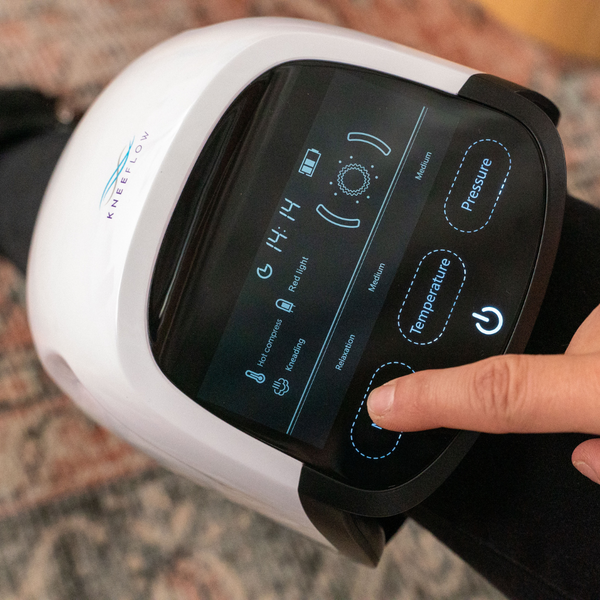
We created the Kneeflow Massager with nice air compression and infrared light, letting someone dial in a session that actually matches their comfort level rather than getting stuck with one fixed intensity. Portability matters here too. A wearable option that works while you're sitting or resting gets used far more consistently than something demanding you lie still in one spot, and consistency is really what separates a device that helps from one that ends up forgotten in a drawer.
None of this makes the device a treatment for whatever is structurally causing a specific case of knee stiffness. It supports comfort and circulation around a joint already being managed some other way, through activity, strengthening, weight management, or medical care when needed, rather than standing in for any of that.
When Knee Stiffness Needs Medical Attention
Most knee stiffness is manageable with what's covered here, but a few situations call for an actual exam instead of more home care. Swelling that won't ease within a couple of days. Sharp pain instead of general stiffness. An inability to bear weight on the leg. All three point toward something beyond ordinary stiffness.
A knee that locks, catches, or feels unstable. Visible deformity. Stiffness that keeps building instead of easing over two or more weeks of reasonable home care. These are reasons to get evaluated rather than wait it out. Same goes for stiffness following a specific injury, a fall, a twist, a direct impact, since that pattern points toward a structural cause needing a proper diagnosis.
None of this is meant to alarm anyone about ordinary stiffness. It's simply the line between what a comfort routine can reasonably help with and what needs a clinician's eyes on it first.
What to expect at the end
Knee stiffness almost always traces back to something identifiable, arthritis, age-related change, an old injury, overuse. Most of it responds well to a sensible mix of movement, heat, and consistency. Heat and vibration genuinely support comfort and circulation, backed by research that's real if still developing, without crossing into treating or curing whatever's structurally behind a specific case.
If ongoing knee stiffness has you wondering whether heat and gentle compression belong in your routine, is the moment to contact us with questions, or take a look at the Kneeflow Massager to see if it fits your situation.
FAQ
What Causes Knee Stiffness?
The most common causes are osteoarthritis, age-related changes in joint tissue and fluid, past injuries including ligament or meniscus damage, and overuse from repetitive movement, prolonged sitting, or carrying extra body weight. These causes frequently overlap rather than acting alone, an old sports injury can speed up arthritis development, for instance, and identifying which pattern fits your own knee stiffness helps determine what kind of relief actually makes sense. Stiffness that's worse in the morning and eases with movement points toward arthritis, while stiffness tied to a specific injury has a different profile entirely.
Do Knee Massagers Actually Reduce Inflammation?
Not in the sense of changing the underlying inflammatory process inside the joint, and claims that a home device reduces inflammation at a structural level should be viewed with real skepticism. What heat and gentle compression do support is circulation and muscle relaxation around the joint, which can ease the sensation of stiffness and discomfort without addressing whatever inflammatory or structural process is happening underneath. This distinction matters for setting realistic expectations, since comfort and circulation support is genuinely useful, just different from treating inflammation itself.
How Does Heat Help With Knee Stiffness?
Heat widens blood vessels and increases circulation to the area, which relaxes surrounding muscle tissue and temporarily increases the elasticity of tissue around the joint. This is why a stiff knee often moves more easily after a few minutes of warmth, whether from a heating pad, a warm shower, or a wearable heat device. Heat works best paired with movement rather than as a stand-alone fix, and some research suggests combining heat with exercise produces better results for knee stiffness than exercise alone, though heat by itself doesn't address the underlying cause of a specific condition.
Is Vibration Therapy Backed by Real Research?
Yes, though the evidence is still developing rather than settled. A systematic review of whole-body vibration for knee osteoarthritis found it showed promise for improving pain and function as an addition to regular exercise, and a separate controlled trial combining vibration with heat and gentle passive motion found meaningful improvement in pain and range of motion over four weeks compared with a sham treatment. Researchers are candid that standardized protocols, ideal frequency and intensity, aren't fully established yet, so vibration therapy is a reasonably supported but still-evolving option rather than a guaranteed fix.
How Often Should I Use a Knee Massager for Stiffness?
Most people start with daily or near-daily sessions of ten to fifteen minutes, since knee stiffness that's built up over time responds to consistent use over several weeks rather than occasional sessions during flare-ups. Using a session before activity can loosen a stiff knee ahead of movement, while an evening session can ease tension that built up during the day. Consistency generally matters more than session length, and stopping the moment stiffness improves tends to lead to it returning within a short time.
Can Stretching Help With Knee Stiffness?
Yes, gentle stretching and mobility work are a genuine part of managing knee stiffness, particularly for stiffness tied to age-related changes, overuse, or general muscle tightness around the joint. Stretching before or after a heat session, when tissue is warmer and more pliable, tends to feel more comfortable and effective than stretching a cold, stiff joint. Stretching alone doesn't address every cause of knee stiffness, especially structural issues like advanced arthritis, but it's a reasonable and low-risk piece of almost any stiffness routine.
Is Knee Stiffness Normal as You Get Older?
Some degree of knee stiffness becomes more common with age, since joint tissue naturally loses elasticity and synovial fluid production tends to decrease over time. That said, "common" doesn't mean stiffness has to be accepted without any attempt to manage it, and plenty of approaches, heat, movement, strengthening, weight management, meaningfully help regardless of age. Stiffness that's severe, rapidly worsening, or accompanied by significant pain deserves a doctor's evaluation rather than being written off as an inevitable part of getting older.
When Should I See a Doctor About Knee Stiffness?
See a doctor if stiffness is accompanied by swelling that doesn't ease within a couple of days, sharp pain rather than general stiffness, an inability to bear weight, or a knee that locks, catches, or feels unstable. Stiffness following a specific fall, twist, or impact also warrants an evaluation rather than home treatment, since that pattern often points toward a structural injury. Stiffness that keeps building instead of improving over two or more weeks of reasonable home care is another clear signal to get an actual exam rather than continuing to wait it out.