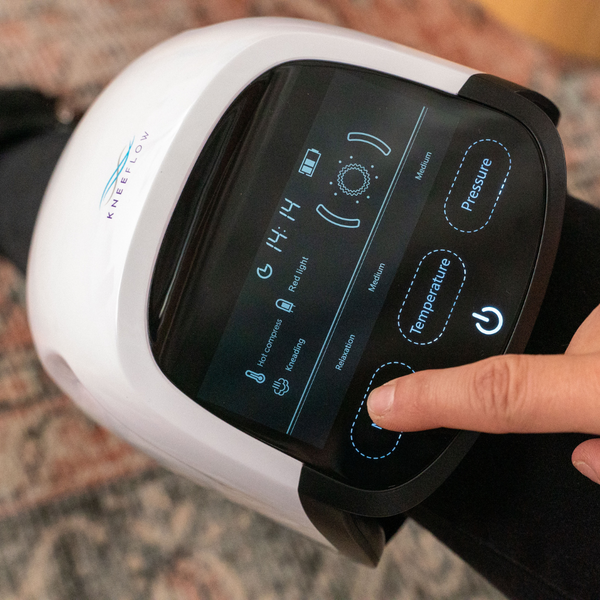
A knee massager for meniscus tear can have a place in recovery, but not on day one, and not without knowing what kind of tear you're dealing with. Right after a fresh tear, ice and rest come first. Heat and massage sometimes earn a spot later, once swelling settles and a doctor actually looks at what's going on.
This gets into what a meniscus tear is, why the tear type and timing change the answer completely, why ice beats heat early on, and where a device like this might reasonably fit once you're past the acute stage and cleared to use one.
People ask us about the Kneeflow Massager for exactly this reason, usually a week or two after a twist during basketball or a bad step off a curb, wondering if it's safe to add heat into the mix yet. It's a fair question about a knee massager for meniscus tear timing, and one that deserves a careful answer rather than a quick yes.
Nothing here replaces an actual diagnosis. A meniscus tear isn't something to self-confirm from symptoms alone, and the right next step depends entirely on specifics an exam or an MRI would tell you, not a blog post.
What a Meniscus Tear Actually Is
Two C-shaped pieces of cartilage sit between the thighbone and shinbone in each knee, cushioning the joint and helping it stay stable. A meniscus tear happens when one of them rips, usually from a sudden twist or pivot during sports, though tears can also develop gradually as cartilage wears thin with age. Anyone researching a knee massager for meniscus tear recovery is almost always dealing with one of these two patterns.
Blood supply is the detail that changes everything about recovery. According to OrthoInfo from the American Academy of Orthopaedic Surgeons, the outer third of the meniscus has a rich blood supply and tears there sometimes heal on their own or repair well with surgery. The inner two-thirds barely gets any blood flow at all, so tears deeper in that zone often can't heal the same way and are more likely to need trimming rather than repair.
That's why two people with the same diagnosis, a torn meniscus, can be looking at completely different paths forward. Location matters as much as severity, and neither one is something a person can determine by feel alone, which is exactly why a knee massager for meniscus tear recovery should never be the first thing tried before an actual exam.
Why Timing and Tear Type Change Everything
A small, stable tear in the outer, well-supplied zone behaves nothing like a large tear that's flipped a fragment into the joint and locked the knee. The second kind usually needs surgery fairly soon, sometimes urgently if the knee won't straighten. Whether a knee massager for meniscus tear discomfort has any role at all depends almost entirely on which of these two situations you're actually in.
The American Academy of Orthopaedic Surgeons' clinical guideline on acute meniscal tears notes that a displaced tear restricting knee motion often benefits from surgery sooner rather than later, while other tears that haven't responded to physical therapy might do better with surgery within about six months. Plenty of people manage a meniscus tear without surgery at all, especially smaller, degenerative tears in older adults, with physical therapy doing most of the heavy lifting.
The same guideline also notes that when surgery is recommended, preserving as much healthy meniscus tissue as possible tends to protect the knee better long term than removing it entirely, which is part of why some tears get repaired rather than trimmed even when trimming would be the quicker procedure.
Age plays a role too. A degenerative tear in a 60-year-old's already-thinning cartilage often gets managed differently than an acute sports tear in a 25-year-old athlete, even when the imaging looks similar. Whether a specific tear needs surgery, benefits from months of conservative care, or falls somewhere in between depends on imaging and an orthopedic exam.
Can You Use a Knee Massager With a Torn Meniscus?
Sometimes, and it depends almost entirely on where you are in the process. In the first few days after an acute tear, while swelling is active and a diagnosis is still being sorted out, the honest answer is no. That's when rest and ice do the work, not heat or massage.
Once swelling has settled, a doctor has confirmed what kind of tear it is, and either a nonsurgical plan or post-surgical rehab is underway, heat and gentle compression can sometimes support comfort around the joint, always with that clinician's input on timing. Used this way, a knee massager for meniscus tear recovery supports the muscles around an already-diagnosed and already-managed injury. It isn't a first response to a fresh one.
The question also looks different depending on whether surgery is part of the picture. Someone waiting for a scheduled arthroscopy, someone recovering from one a week ago, and someone managing a small stable tear with physical therapy alone are all technically dealing with a torn meniscus, but the appropriate use of heat and compression differs across all three. There's no single answer that covers everyone.
If surgery already happened, your surgeon's specific instructions about when heat is appropriate around the incision and healing tissue override anything general written here. Post-surgical guidance is always more specific to your actual procedure than any general article can be.
Why Ice Comes First, Not Heat, Right After a Tear
Standard first aid for a fresh meniscus tear follows the same rest, ice, compression, elevation approach used for most acute joint injuries. Ice constricts blood vessels and calms swelling, which is exactly what an angry, freshly injured joint needs in the first couple of days. This is the phase where a knee massager for meniscus tear discomfort should stay in the box, however tempting a heat setting sounds.
Heat does close to the opposite. It widens blood vessels and increases blood flow to the area, useful for loosening stiff, chronically tight tissue, but not what a swollen, actively inflamed joint needs right after an injury. Adding heat too early can make swelling worse rather than better, and undoing a few days of proper icing with one poorly timed heat session is a genuinely common setback.
This is the single biggest mistake people make with a fresh tear: reaching for a heating pad or a knee massager for meniscus tear discomfort because it feels soothing in the moment, when the joint actually needed calming down instead. Comfort in the first hour doesn't always mean the right call for the next few days.
When Heat and Gentle Compression May Have a Role Later
Once the acute swelling has genuinely settled, often a week or more in, and a treatment plan is in place, some people find heat and gentle compression useful for the muscle tightness that builds up around a knee that's been favored or immobilized. That's a different problem than the original tear, and it's one heat that is actually suited to. This is really the window where a knee massager for meniscus tear recovery starts making sense.
During post-surgical rehab specifically, many surgeons introduce heat at a certain point to ease stiffness before physical therapy sessions, though the exact timing is something your surgical team decides based on how the repair is healing, not a general rule that applies to everyone equally. Some surgeons wait several weeks. Others clear it sooner depending on the specific procedure and how the incision looks.
For non-surgical management of a stable tear, once a doctor or physical therapist has confirmed there's no ongoing swelling or instability, a short session of heat and gentle compression alongside prescribed exercises is the kind of addition plenty of people find genuinely comfortable. It supports the routine. It isn't the routine itself, and treating a knee massager for meniscus tear recovery as the main event rather than a supporting piece tends to disappoint people who expected more from it.
Signs That Mean Stop and Call Your Doctor Now
A knee that locks, catches, or won't fully straighten needs attention regardless of what stage of recovery you think you're in. That specific combination often means a torn fragment is physically blocking the joint's normal movement, and no amount of heat or gentle compression changes that mechanical problem.
Sudden increased swelling, a feeling that the knee might give way, or pain that's sharply worse than it was the day before all deserve a call to whoever's managing your care rather than continuing whatever routine you'd settled into. The same goes for fever, unusual warmth, or redness around the joint, which point toward something beyond the original injury and sometimes signal a separate problem like infection rather than the meniscus tear itself.
Inability to bear weight, or a knee that buckles unexpectedly during ordinary walking, belongs in this same urgent category, regardless of what stage of using a knee massager for meniscus tear discomfort you'd reached. None of these signs are things a knee massager, heat, or rest at home should be used to push through. They're reasons to pick up the phone, not adjust a setting.
What a Knee Massager Can't Do for a Meniscus Tear
Heat and gentle compression don't repair torn cartilage, reduce a displaced fragment, or replace whatever your specific tear actually needs to heal. They support comfort and circulation around a joint, which is a real and useful role, just not the same thing as fixing what's torn. A knee massager for meniscus tear recovery works alongside treatment, never as a stand-in for it, no matter how much better a session makes the knee feel afterward.
A device like this also can't tell you what kind of tear you have, whether it needs surgery, or whether it's healing as expected, no matter how a knee massager for a meniscus tear session feels afterward. That's exam and imaging territory. Using heat and massage as a substitute for actually finding out what's going on delays the one thing that actually determines your recovery path, and that delay is the real risk, more than anything the device itself does.
Using One Safely Once Your Doctor Clears It
Once you've got clearance, starting with shorter sessions and a lower heat setting lets you see how the knee responds before committing to anything longer. Watching for increased swelling or new pain after a session matters more here than with ordinary stiffness, since this joint has already been through something specific. Anyone using a knee massager for meniscus tear recovery should treat the first few sessions as a test, not a routine, and adjust based on how the knee actually responds rather than how good the first session felt.
We built the Kneeflow Massager with adjustable heat and gentle air compression specifically so people managing a cleared, stable knee condition, meniscus recovery included, can dial intensity down to something genuinely comfortable rather than being stuck with one fixed setting. Timing a short session before physical therapy exercises, once your PT has actually suggested that, is a common way people work it into a recovery routine, easing stiffness right before the harder work of strengthening and range-of-motion exercises begins.
Any new or returning symptom, swelling, locking, sharp pain, is a reason to pause and check back in with your doctor rather than adjusting the settings and continuing. That single habit, stopping instead of pushing through, is the one that keeps a knee massager for meniscus tear recovery genuinely safe rather than risky.
Knee Massager for Meniscus Tear: The final Line
A knee massager for meniscus tear recovery isn't a yes-or-no question so much as a when question. Ice and rest first, a real diagnosis next, and heat or compression only once swelling's settled and someone qualified has actually looked at the knee. Getting that order right matters more than any single feature a device has.
If you're past the acute stage and wondering whether heat and gentle compression fit into your specific recovery, don’t hesitate to call our team with questions about timing and settings, or take a look at the Kneeflow Massager once your doctor's given the go-ahead.
FAQ
Can You Use a Knee Massager With a Torn Meniscus?
It depends on timing more than anything else. Right after an acute tear, while swelling is active and a diagnosis is still pending, ice and rest come first, not heat or massage. Once swelling has settled and a doctor has confirmed the type of tear and a treatment plan, heat and gentle compression can sometimes support comfort around the joint, with that clinician's input on when to start. Using one during the first few days after a fresh injury risks worsening swelling rather than helping, so timing genuinely matters more than the device itself.
Is Heat or Ice Better for a Meniscus Tear?
Ice comes first, always, right after an acute injury, since it constricts blood vessels and calms the swelling a fresh tear typically brings. Heat does close to the opposite, widening blood vessels and increasing blood flow, which suits chronic stiffness far better than a freshly swollen joint. Once the acute swelling has genuinely resolved and a doctor has confirmed there's no ongoing instability, heat can become useful for the muscle tightness that builds up around an injured knee, but that's a later-stage tool, not a first response.
Can a Meniscus Tear Heal Without Surgery?
Yes, for some tears. Smaller tears in the outer, blood-rich zone of the meniscus sometimes heal on their own or respond well to physical therapy without surgery, and degenerative tears in older adults are frequently managed nonsurgically too. Larger tears, ones that have displaced a fragment into the joint, or tears in the inner zone with poor blood supply are less likely to heal without intervention. Which category a specific tear falls into depends on imaging and an orthopedic exam, not on symptoms alone.
How Do I Know If I Tore My Meniscus?
Common signs include a popping sensation at the moment of injury, swelling that develops over the following day, pain along the joint line, and a catching, locking, or giving-way sensation during movement. These symptoms overlap with other knee injuries though, so an actual exam and often an MRI are needed to confirm a meniscus tear specifically rather than something else like a ligament sprain. Self-diagnosing from symptoms alone risks missing a different injury that needs a different approach entirely.
Can Massage Make a Meniscus Tear Worse?
Used at the wrong time, yes, potentially. Heat and massage applied to an acutely swollen, freshly torn meniscus can increase blood flow to an already inflamed area and worsen swelling rather than easing it. Once the acute phase has passed and a doctor has confirmed the joint is stable, gentle massage and heat around the surrounding muscles is generally considered safe and can genuinely help with comfort. The risk is almost entirely about timing rather than the technique itself being inherently harmful.
When Can I Use Heat After Meniscus Surgery?
This depends entirely on your surgeon's specific guidance, since it varies based on the procedure performed, whether tissue was repaired or trimmed, and how your individual healing is progressing. Many surgical teams introduce heat at some point during rehab to ease stiffness before physical therapy sessions, but the exact timing is a decision your surgical team makes based on your incision, swelling, and healing progress. Following your surgeon's specific timeline matters more here than any general guidance about heat and knee injuries.
What Does a Locked Knee Mean?
A locked knee, one that won't fully straighten or bend, often means a torn piece of meniscus has flipped into the joint and is physically blocking normal movement. This is different from ordinary stiffness and typically needs prompt medical attention rather than home management, since it frequently indicates a tear that will need surgical treatment. Continuing to walk on a locked knee or trying to work through it with heat or massage isn't appropriate. It needs an actual evaluation.
Is Walking Okay With a Meniscus Tear?
It depends on the tear and what your doctor has recommended for your specific situation. Some smaller, stable tears allow for continued walking and even guided activity, while larger or displaced tears may require limited weight-bearing until surgery or until the joint has been properly assessed. A knee that locks, gives way, or causes sharp pain with walking is signaling that activity should stop until you've been evaluated, rather than something to push through based on general advice.