If you wake up in the morning with stiff knees or have trouble going up and down stairs, then researching a knee brace for arthritis could be of interest to you. If you have been experiencing soreness in your knee after longer periods of walking or standing, you may suffer one of the most common things that people with arthritis look at on the internet. Will a knee brace help with arthritis, or is it the kind of thing that sounds useful but delivers less than it promises?
The answer sits somewhere between both. Braces do specific things well. They also have clear limits, and understanding the difference between what they address and what they do not is what makes the difference between choosing the right tool and adding one more item to the drawer of things that helped a little. KneeFlow exists for exactly this kind of question.
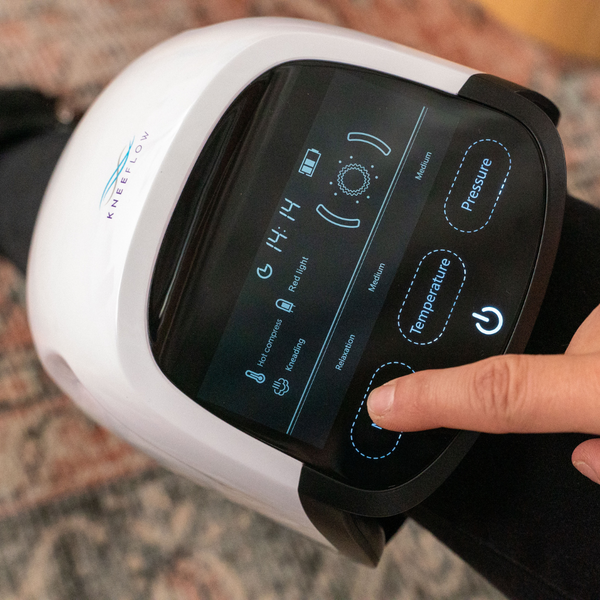
If you are looking for a recovery tool that works alongside the habits and devices you already have, the Kneeflow heated knee massager is worth understanding before you decide what your joint actually needs.
Will a knee brace help with arthritis? What a Knee Brace Is Actually Doing
The truth to the question: Will a knee brace help with arthritis? Is that, a brace doesn’t treat arthritis. It does not slow cartilage degradation, reduce the inflammation driving the condition, or reverse any of the structural changes that have already occurred in the joint. What it does is modify the mechanical environment the knee is operating in, and for many people with arthritis, that modification produces real and noticeable relief during activity.
The primary mechanisms are load redistribution, stability support, and proprioceptive feedback. Load redistribution shifts some of the compressive force away from the most damaged compartment of the joint, which reduces pain during weight-bearing activity. Stability support reduces the amount of work the surrounding muscles have to do to keep the knee tracking correctly, which matters when those muscles are fatigued or weakened.
Proprioceptive feedback sharpens the body's real-time awareness of joint position, which improves movement mechanics and reduces the risk of the awkward loading patterns that tend to flare arthritis symptoms. None of this addresses the underlying condition. All of it can make the daily experience of living with that condition more manageable.
The Types of Braces and What Each One Targets
Not every brace works the same way, and choosing the wrong type is one of the most common reasons people end up concluding that bracing does not work for them. Will a knee brace help with arthritis depends partly on which brace and partly on what kind of arthritis-related problem it is being asked to address.
Unloader braces are the most targeted option for individuals with compartment specific osteoarthritis (e.g. medial compartment arthritis, which is the most common form of OA). These braces work by shifting the load from the worn-out compartment to the healthier compartments through the frame of the brace. Clinical evidence for unloader braces in this population is reasonably strong. They are typically custom-fitted or semi-custom and sit at a higher price point than sleeve-style options.
Hinged braces provide lateral stability. They are typically used to treat patients with arthritis who have ligament laxity and consequent knee instability. Because they are bulkier than sleeves, hinged braces are generally recommended for higher-activity situations where the joint needs more structural support than compression alone can provide.
The most accessible option for treating arthritis pain is the compression sleeve. Unlike unloader braces, they don’t redistribute pressure, but they do provide constant compression to the affected area which reduces swelling and supports the body’s proprioception. For mild to moderate arthritis, a well-fitted compression sleeve worn during activity is often the most practical starting point.
The patellar stabilizing braces address tracking problems at the front of the knee, which can contribute to the pain pattern in some forms of arthritis. They are more specific in their application and less broadly useful than the options above.
Will a knee brace help with arthritis? What the Research Actually Shows
In summary, there is positive evidence to the question; will knee braces help with arthritis? Studies on unloader braces for medial compartment osteoarthritis have shown a reduction in pain and improvement in function of users during the time the brace was used. The improvements in pain and function that do occur are very real but they occur only as contingent on wearing the brace, which raises the question of long-term compliance, particularly with custom devices that are less comfortable to wear for extended periods.
Studies examining compression sleeves have found that they can help decrease pain and increase confidence during exercise. Many of the benefits of compression sleeves can be explained by proprioception (the ability to sense movement and position of the body), but compression sleeves can also have mechanical effects.
What the research does not show is any evidence that bracing slows the progression of osteoarthritis or produces lasting changes in joint health after the brace is removed. It is a management tool, not a disease-modifying one, and understanding that distinction helps set expectations that lead to useful outcomes rather than disappointment.
The Limits Worth Understanding Before You Buy
Will a knee brace help with arthritis if worn all day, every day? Probably not in the way most people hope. Extended continuous use of any brace, particularly compression sleeves, can lead to skin irritation, reduced circulation if the fit is too tight, and in some cases a gradual reduction in proprioceptive benefit as the nervous system adapts to the constant input. Most practitioners recommend activity-specific use rather than wearing a brace as a passive all-day intervention.
There is also the question of muscle dependency. When a brace is providing stability that the surrounding muscles would otherwise need to generate, those muscles get less of the training stimulus they need to maintain their strength. Over time, this can subtly reduce the joint's own dynamic support capacity. This is not a reason to avoid bracing entirely. It is a reason to pair it with active strengthening rather than use it as a substitute for the muscular work the joint actually depends on.
Will a knee brace help with arthritis? What Works Alongside a Brace
Bracing is most effective as part of a broader approach to arthritis management rather than as a standalone solution. The people who get the most consistent benefit from a brace tend to be those who are also doing the things that support the joint from the inside out.
Stronger quadriceps, hamstrings and hip girdle muscles support the knee outside of the brace. Anti-inflammatory foods reduce overall inflammation and prevent symptoms from flaring. Low-impact movement on a consistent basis keeps the joint flexible and supports the joint’s circulation. This is important because cartilage needs nutrients and targeted recovery tools, applied with the same consistency as the brace, address the muscular tension and circulatory stagnation that accumulate in an arthritic joint under daily demand.
The use of heat, compression and massage to a joint following activity is very different to the support of a brace during activity. Recovery of the joint and surrounding tissue, reduction of residual tension in the soft tissues, and maintenance of a good circulatory environment to manage inflammation over time are just a few examples of what a joint needs.
Closing Thoughts on Knee Braces and Arthritis
Will a knee brace help with arthritis? For most people dealing with mild to moderate knee osteoarthritis, the answer is yes, with the right expectations in place. A brace will not fix the joint. It will not slow the condition or produce changes that last beyond the period of use. What it will do, when chosen correctly and used appropriately, is make the daily experience of an arthritic knee more manageable during activity and reduce the pain that discourages the movement arthritis patients actually need to stay as functional as possible.
The brace handles one part of the picture. The rest of the picture, recovery, strength, inflammation management, and daily joint support, needs its own tools and its own consistency. If you have questions about where the Kneeflow device fits into that picture for your specific situation, the team is available to help. Reach out through the contact page and someone will get back to you directly.