People searching for an answer to what does arthritis in the knee feel like are rarely looking for a medical definition. They already know something is going on. What they want is a way to name it, a way to compare what they feel against what this condition actually produces, and some sense of whether what they're experiencing belongs in a doctor's office or in the category of things that can be managed at home.
This guide addresses all three. The symptom picture for knee arthritis is more specific than "it hurts" and more useful than a list of clinical terms. At Kneeflow, we work with people who are navigating joint discomfort every day, and we think accurate symptom knowledge is where effective self-management starts.
The Central Question: What Kind of Pain Is This?
The pain of knee arthritis has a character. It's not sharp the way an acute ligament injury is. Arthritis of the knee doesn’t arrive suddenly and most people cannot point to a specific moment when it first occurred. What does it feel like? Well, for people with osteoarthritis, the most common form of arthritis, it often feels like a dull ache.
Early on, pain worsens when the knee is loaded and eases when it isn't. Walking, climbing stairs, getting up from a low chair after sitting for a while: all of these activities produce or intensify the ache. Rest brings relief. That pattern, familiar to anyone exploring what does arthritis in the knee feel like, is characteristic enough to be diagnostically useful. Knee osteoarthritis is characterised by mechanical pain that worsens with use, with short-lived morning stiffness and the "gelling" phenomenon after rest.
As the condition progresses, that clear activity-rest pattern can break down. Rest pain appears. Some people notice that after a long day the knee aches even when they're doing nothing. In more advanced stages, nighttime pain that interrupts sleep is not uncommon.
Pain in knee arthritis also fluctuates across days and weeks in ways that can make the answer to what does arthritis in the knee feel like feel inconsistent. A bad week followed by a better one doesn't mean anything changed structurally.
Pain does not correlate with degree of structural change as seen on X-ray. Some individuals with severe cartilage loss may report only mild symptoms. Conversely, individuals with minor changes may report high levels of discomfort.
Morning Stiffness and the Gelling Phenomenon
Ask almost anyone with knee arthritis how their mornings feel, and the answer is consistent: stiff. Sometimes significantly so. The first steps out of bed are tentative; the knee doesn't cooperate immediately. This morning stiffness is one of the most reliably reported features of osteoarthritis, and it has a clinically useful time limit that helps distinguish OA from inflammatory arthritis types.
Stiffness in the morning or following inactivity (the "gel phenomenon") in osteoarthritis rarely exceeds 30 minutes. If the stiffness eases within that window once you start moving, what you're experiencing fits the OA pattern. If it persists well past that point (an hour or more), that suggests a different type of arthritis is involved, most likely rheumatoid arthritis, where prolonged morning stiffness is one of the defining features.
The gelling phenomenon extends beyond the morning. It happens any time the knee has been static for a while. A long car journey, an hour in a cinema seat, an afternoon meeting that ran long; and when you finally stand, the joint feels locked and reluctant. A few minutes of movement usually helps it loosen. Another common feature is "gelling," where the joint becomes stiff after sitting for a period of time, such as during a car journey or while watching a film, requiring a few minutes of movement to "loosen up”.
This is one of the most actionable aspects of what does arthritis in the knee feel like: recognizing that movement is the solution to gelling stiffness, not rest. Movement is the solution to gelling stiffness, not rest. The instinct to wait for the stiffness to pass on its own is less effective than gently working through it with low-impact movement.
Swelling: When and What Kind
Swelling is part of the answer to what does arthritis in the knee feel like, and the type of swelling matters. Knee swelling in arthritis takes more than one form, and distinguishing them helps make sense of what's happening. The first type is soft swelling: an accumulation of excess synovial fluid, sometimes called "water on the knee." It develops because the irritated joint lining produces more fluid than the joint can absorb.
The knee looks puffy or enlarged, feels fuller than usual, and may feel warm. This type of swelling responds to elevation, compression, and addressing whatever is irritating the joint.
The second type is bony rather than fluid-based. As cartilage wears down and osteophytes form at the joint margins, the joint itself changes shape in ways that become visible and palpable. Bony enlargement doesn't fluctuate the way fluid does; it's structural rather than reactive. Over time, this type of change can produce the characteristic knobby appearance associated with advanced knee arthritis.
Heat around the joint is worth noting separately. Knee appears warm or hot. Warmth of a knee with arthritis indicates active synovial inflammation. Rheumatoid arthritis typically produces more warmth than OA, but an OA knee can produce warmth localized to the joint during an inflammatory phase. Consistent warmth at the joint that isn't explained by activity is worth mentioning to a clinician, and it's an aspect of what does arthritis in the knee feel like that's easy to dismiss as minor but shouldn't be.
Crepitus: The Grinding and Crunching
Crepitus is the medical term for the grinding, popping, crunching, or creaking sensation that is felt within the knee. This is a very common feature that is when people describe what does arthritis in the knee feel like. It's one of the most commonly reported features when people describe knee arthritis, and it tends to be alarming when it first appears.
The reassuring point: crepitus by itself, without pain or swelling, is not a medical emergency and doesn't confirm arthritis. Many people without any joint disease have noisy knees. Crepitus by itself without other symptoms is not a cause for concern.
In the context of osteoarthritis, crepitus develops as cartilage surfaces roughen and lose their smooth contact. The sensation of grinding or catching when bending or extending the knee becomes more consistent as the condition progresses. Loose fragments of cartilage can also contribute, producing a catching sensation at certain angles of movement.
At advanced stages, the grinding becomes bony, reflecting direct bone-on-bone contact in areas where cartilage has been lost, which is among the most telling aspects of what does arthritis in the knee feel like in later stages, and where our Knee Massager can work as a complement for getting better.
What the Knee Feels Like During Activity
Of all the ways to answer what does arthritis in the knee feel like, the functional picture during activity is perhaps the most practically important. Abstract symptoms become tangible when they're attached to specific activities.
Stairs are a common early revealer. Descending stairs, in particular, produces more patellofemoral (kneecap against the thigh bone) force than ascending, and many people first notice consistent pain on the way down before it appears going up. Squatting, kneeling, and getting up from a low chair all stress the knee in similar ways..
Walking on level terrain is usually more comfortable than stairs or hills, particularly in the earlier stages. Running on hard surfaces is often the activity that tips people toward seeking evaluation: what was manageable on walks becomes reliably painful at a faster pace or on pavement.
Prolonged standing produces a different kind of fatigue than movement, and it's a distinction relevant to what does arthritis in the knee feel like in occupational or domestic contexts. The joint is under sustained static load, and the surrounding musculature works continuously to maintain stability. After an hour on hard floors, the knee can feel heavy, achy, and stiff in a way that's distinct from the activity pain of movement.
Instability deserves specific mention. Moderate to advanced knee osteoarthritis can cause the sensation of a knee giving way or buckling. This sensation can occur if uneven grooves or flaps in the degenerated cartilage catch, or if a piece of cartilage breaks off and becomes lodged in the joint.
How Rheumatoid Arthritis Feels Different
The type of arthritis changes the answer to what does arthritis in the knee feel like in ways that have real clinical implications. Rheumatoid arthritis presents with a symptom profile that overlaps with OA in some ways and diverges sharply in others.
RA morning stiffness lasts significantly longer. An hour or more is typical, sometimes extending well into the morning before the joint feels functional. This is one of the most reliable distinguishing features between the two conditions: OA stiffness clears in under thirty minutes; RA stiffness persists. The joints involved in RA are characteristically warm and boggy rather than bony, and the swelling has a soft, fluid quality that's different from the bony enlargement of advanced OA.
Systemic symptoms accompany RA in ways they don't accompany OA. Fatigue that isn't proportional to activity, a general sense of unwellness, and sometimes low-grade fever reflect the systemic inflammatory nature of the disease. RA also tends to affect joints symmetrically (both knees, both wrists, multiple small joints), while OA can be asymmetric and often starts with one knee before the other.
Both conditions affect the same joint but through different pathways, and what does arthritis in the knee feel like has genuinely different answers depending on which one is present. The Knee Arthritis Symptoms explores this trajectory in detail.
Symptoms That Need Medical Attention
Not every symptom of what does arthritis in the knee feel like requires a clinic visit. But some presentations should prompt evaluation rather than home management. Knowing the difference is part of understanding what does arthritis in the knee feel like versus what's outside the expected pattern.
Sudden, severe knee swelling following minimal or no activity (particularly if it appears within hours) warrants same-day assessment. A knee that locks in a fixed position and cannot be extended without manual manipulation is similarly urgent. The sensation of a knee giving way or buckling, especially if it's new or worsening, needs clinical evaluation before management decisions are made.
Fever alongside joint symptoms suggests septic arthritis or another systemic condition that requires prompt treatment. Pain that is actively worsening over several consecutive days, rather than fluctuating, is outside the expected pattern for degenerative OA and should be evaluated.
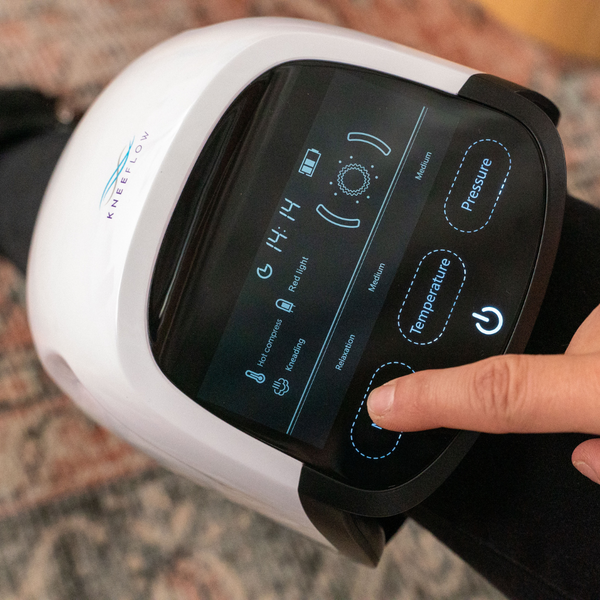
For people who have found the crepitus, stiffness, or post-activity tightness difficult to manage day to day, a device like the Kneeflow massager may offer practical support within a broader care plan. See how to choose the right device for arthritis in our guide page.
Managing the Symptoms: Where Daily Support Fits
Managing the symptoms that define what does arthritis in the knee feel like runs through exercise and professional care first, as explored in the full [Knee Arthritis pillar guide]. Physical therapy and targeted quadriceps strengthening address the mechanical underpinning of OA symptoms in ways that heat and comfort tools cannot.
That said, the daily symptom picture has a practical management dimension that exists between clinical appointments. The morning stiffness that is central to what does arthritis in the knee feel like for most people. The tightness that builds during a long afternoon at a desk. Heat and gentle compression can meaningfully support comfort during these periods, not by treating the underlying condition, but by addressing the muscle tension and circulation patterns that make symptoms more pronounced at rest.
For early-stage symptoms in particular, consistent low-impact movement, professional evaluation to confirm the type of arthritis, and targeted strengthening produce results that no comfort device replaces. The Knee Arthritis Symptoms: Early, Moderate, and Advanced Stages spoke explores this trajectory in detail.
For questions about whether our device fits what you're managing, reach out to the Kneeflow team and we'll give you a direct answer.
FAQ
What does osteoarthritis in the knee feel like at first?
Early knee osteoarthritis is a useful starting point for understanding what does arthritis in the knee feel like before symptoms become significant. It typically announces itself as a dull ache that's reliably worse during or after specific activities (stairs, prolonged standing, getting up from a low seat) and eases with rest. Morning stiffness is common and characteristically clears within thirty minutes of movement. Mild swelling may appear after activity and resolve overnight. The joint may make crunching or popping sounds during movement.
How do I know if my knee pain is arthritis or something else?
Understanding what does arthritis in the knee feel like versus an acute injury starts with the pattern. Arthritis pain is worse after activity and following rest, follows a predictable relationship with what you've done that day, and accumulates slowly over months or years rather than arriving suddenly. A sudden onset after a specific event (a fall, a twist, a pop during exercise) suggests a ligament, meniscal, or other structural injury rather than arthritis. Significant swelling appearing rapidly after minimal activity can suggest inflammatory arthritis or acute injury rather than gradual OA. The only way to confirm the cause is clinical assessment, which typically combines patient history, physical examination, and imaging. Self-diagnosis from symptom lists has real limits.
What does rheumatoid arthritis in the knee feel like compared to OA?
When comparing what does arthritis in the knee feel like across types, the most practical difference is morning stiffness duration. When comparing what does arthritis in the knee feel like across types, morning stiffness duration is the most reliable early indicator. In OA, it typically clears within thirty minutes of movement. In RA, it often persists for an hour or more. RA knees tend to be warmer and softer when swollen, reflecting synovial inflammation rather than bony change. Systemic features accompany RA in ways they don't accompany OA: fatigue, a general sense of unwellness, and sometimes low-grade fever.
Does knee arthritis feel worse at certain times of day?
Yes, and the pattern is one of the most practically useful aspects of understanding what does arthritis in the knee feel like on a daily basis. OA pain typically builds through the day and is most noticeable by evening, after cumulative loading. It's usually worst at the end of an active day and somewhat better in the morning before the joint has been loaded, though morning stiffness complicates that picture in the first thirty minutes. RA pain is characteristically worst in the morning and improves with movement and heat through the day.
Can knee arthritis symptoms go away on their own?
The symptoms that define what does arthritis in the knee feel like can fluctuate significantly, which feels like improvement when a better period arrives. Underlying structural changes don't reverse without treatment. But inflammation in the joint (which drives many of the acute symptoms like swelling and warmth) can settle on its own between flares. Weight loss, appropriate exercise, and improved muscle support around the joint can genuinely reduce symptoms to levels that feel like near-resolution for some people. The structural changes remain, but their functional impact is substantially modifiable.
What are the early warning signs of knee arthritis?
Several patterns that predate the more established symptoms of what does arthritis in the knee feel like tend to appear before the condition is severe: stiffness in the morning that takes a few minutes to ease, mild aching after specific activities that wasn't there before, crepitus that's new and consistent during certain movements, and slight swelling that appears after a demanding day and resolves with rest overnight. Joint line tenderness (a specific sensitivity when you press along the inner or outer edge of the knee) is an early clinical finding. Pain on squatting or descending stairs that doesn't have another clear explanation is worth investigating.