Many people with knee arthritis become overly cautious and even suspicious of their own bodies. If they go for a walk and experience pain, they assume that the activity caused more harm than good. Similarly, upon waking up from a long day, they may feel stiffer than ever before. To them, this means that they should have rested more. So the question people keep coming back to is a reasonable one: is walking good for arthritis in the knee, or is every step quietly adding to the damage?
Walking with arthritis of the knee is best protected by doing some walking in a way that is attentive to its execution, and within limits at first. While this activity is not always feeling good in every session of practice, the protective value tends to make the underlying condition harder to manage over time.
Kneeflow works with people navigating exactly this balance every day. If you are building a joint care routine and want to know where recovery fits alongside movement, the Kneeflow heated knee massager was designed for that specific gap.
What Stops Moving First in an Arthritic Knee
Arthritis is not something that develops suddenly and then begins to affect you. As the cartilage wears down and begins to rub against other bones, it can create friction and begin to cause pain. As the body tries to compensate for the arthritis in the surrounding tissues, the joint can begin to feel the effects of not being able to absorb and distribute load the way it used to.
The cartilage itself has no blood supply. It receives nutrients through synovial fluid, and synovial fluid only moves when the joint does. Compression and decompression, the mechanical cycle that happens with every step during a walk, is how cartilage stays fed. Most people are unfamiliar with the biological aspect of knee maintenance. While it may seem good to rest your knee to avoid excessive wear and tear, in reality, not moving your knee will deprive it of much needed blood circulation and care.
A joint does not get better faster if it is not moving. In fact, it is denied the necessary means to slow down the degeneration process that it is trying to avoid. Thus, understanding this reframes the question of whether walking is good for arthritis in the knee from a question about risk into a question about what kind of support the joint actually requires.
The Case for Walking, Built From the Ground Up
Is walking good for arthritis in the knee? Large clinical trials have consistently found that people with knee osteoarthritis who walk regularly experience lower levels of pain scores, better functional capacity, and greater joint confidence than those who avoid weight-bearing activity. That gap holds even when baseline cartilage damage is similar between groups.
Positive effects on the arthritic knee of walking include continued flow of synovial fluid to deliver nutrients to the cartilage surfaces. Contraction of the quadriceps, hamstring, and hip muscles also helps to stabilize the knee and can even make it stronger. Active individuals also need to pay attention to their body weight because each extra pound of body weight adds about four pounds of compressive force to knee joints during walking.
How Much Walking Is Actually the Right Amount
Although one can give a definitive answer to this question, the crucial point is how much exercise people with arthritis should do and is walking good for people with arthritis in the knee? The key issue is how much exercise is required. While a general guideline can be offered, the right amount is likely to vary from person to person. Research therefore suggests that people currently undertaking some level of activity for 150 minutes of moderate walking per week as a reasonable target for people who are already managing their condition with some baseline activity. That works out to roughly twenty to thirty minutes most days.
For someone who has been largely sedentary, that target is a destination, not a starting point. Ten minutes per session, on a forgiving surface, with attention to how the knee responds in the hours after, is a more intelligent beginning than an enthusiastic daily hour that leaves the joint inflamed for three days. The joint adapts, but it does so on its own timeline. Cartilage, tendon, and the supporting musculature all need progressive exposure to load rather than sudden increases they have no foundation to handle.
Walking With Knee Arthritis: The Details That Change the Outcome
Is walking good for arthritis in the knee regardless of how it is done? Surface, footwear, and warm-up are the three variables that determine whether the same distance produces recovery or sets off a flare.
Concrete and asphalt return impact energy to the joint with every step. Grass, packed earth, and rubberized track absorb a meaningful portion of that load before it reaches the knee. The difference accumulates over the course of a thirty-minute walk in ways that show up as either a joint that feels fine afterward or one that is swollen and stiff by evening. When options exist, softer surfaces are worth seeking.
Footwear influences knee alignment through the kinetic chain. A shoe that allows the foot to roll inward excessively shifts the angle at which the knee absorbs load, concentrating force in the medial compartment where arthritis most commonly develops. A well-cushioned shoe appropriate for the individual foot type distributes that load more evenly. For people who have noticed that certain shoes consistently produce more knee discomfort than others, that observation is worth acting on rather than attributing to coincidence.
Warming up before picking up pace does something specific for an arthritic knee. It gives the synovial fluid time to move through the joint before significant load arrives. Starting slowly for the first five minutes is not a formality. It is the difference between a joint that is prepared for the demands of the walk and one that absorbs the first ten minutes of load with cold, stiff tissue.
What Happens After the Walk Matters as Much as the Walk
Walking is good for arthritis in the knee because it creates an adaptive stimulus. The joint and surrounding tissue respond to that stimulus by building better support over time. But the adaptation itself does not happen during the walk. It happens during the recovery period that follows.
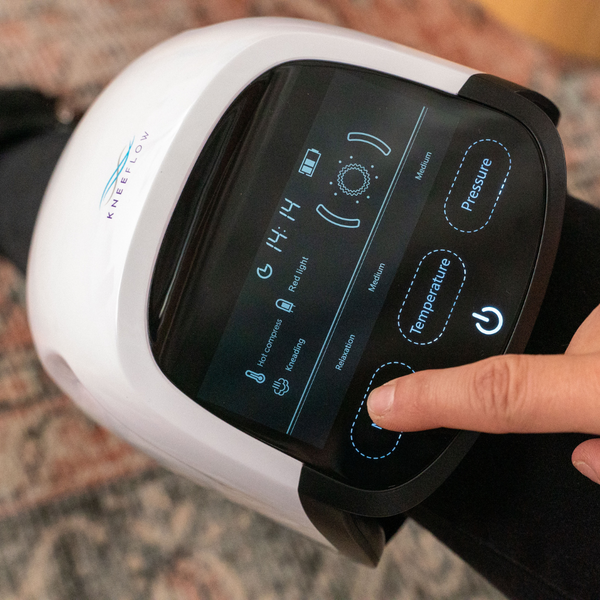
Heat applied to the knee after walking increases local circulation and supports the resolution of the minor inflammation that weight-bearing activity produces in an arthritic joint. It also relaxes the muscular tension that accumulates in the quadriceps, iliotibial band, and calf during activity, which left unaddressed gradually alters knee tracking mechanics. Compression reduces post-walk swelling and maintains the proprioceptive sharpness that helps the joint move with better awareness in the hours after activity. Massage reaches the soft tissue that surrounds the joint and addresses the tightness that neither heat nor compression fully resolves on their own.
Kneeflow combines these three mechanisms into a single wearable device, which makes the recovery routine something that fits between the end of a walk and the beginning of whatever comes next in the day, rather than a separate commitment that gets skipped when time runs short.
What Inactivity Costs Over Time
The fear that walking will accelerate arthritis is understandable. Pain after activity feels like feedback. But the cost of chronic inactivity in people with knee arthritis is well-documented and runs in the opposite direction from what the fear anticipates. Muscles weaken without the stimulus that regular movement provides. Weaker muscles mean less dynamic support for the joint, more direct load on the cartilage, and a higher risk of the awkward loading patterns that drive symptom flares. Synovial fluid stagnates. Cartilage nutrition suffers. The joint becomes more vulnerable to exactly the kind of stress it was being protected from.
The cycle that develops around fear-avoidance behavior in knee arthritis is one of the most consistently identified barriers to good long-term outcomes in people managing the condition. Walking, done with appropriate pacing and paired with genuine recovery support, is one of the most practical tools available for breaking that cycle.
Finding the Rhythm That Works for Your Knee
Is walking good for arthritis in the knee for everyone in exactly the same way? No. The stage of the condition, the individual's baseline fitness, body weight, joint alignment, and the quality of the muscular support surrounding the knee all shape how walking lands and what the recovery period needs to look like. What holds across all of those variables is the direction: consistent, appropriately paced walking produces better joint outcomes than avoidance, and pairing that walking with deliberate recovery produces better outcomes than walking alone.
If you are putting together a routine and want guidance on where Kneeflow fits into what you are already doing, reach out through the contact page and someone on the team will respond directly.