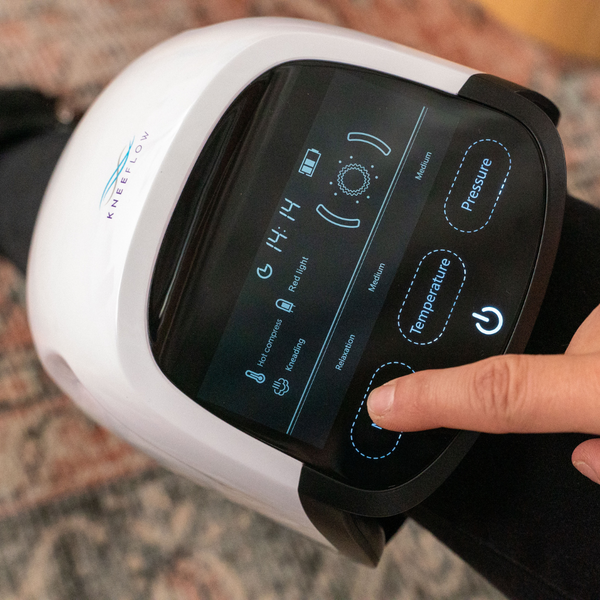
There is a particular cruelty to nighttime knee pain. During the day, movement offers a partial distraction. Activity keeps the joint warm, synovial fluid circulating, and the mind occupied with something other than the ache behind the kneecap. Then the day ends. The body goes horizontal, the world quiets, and the knee that cooperated through the afternoon announces itself with the kind of insistence that makes four in the morning feel very long. Figuring out how to sleep with arthritis pain in knee is not a secondary question in arthritis management.
What sleep research on chronic pain documents is that pain disrupts sleep and disrupted sleep amplifies pain, and the mechanism running between those two facts is not gentle.
At Kneeflow, we know that the nervous system that has been denied adequate rest lowers its threshold for perceiving discomfort. The joint that felt manageable through a well-rested week becomes noticeably more difficult to live with after several nights of fragmented sleep. Understanding how to interrupt that cycle is as important as any of the daytime habits discussed in arthritis management guides.
How to Sleep With Arthritis Pain in Knee: What the Knee Is Actually Doing Overnight
Most people experience nighttime arthritis pain as something the joint is doing randomly, an ache that arrived without clear cause and will presumably leave the same way. The biology behind it is considerably more specific than that, and understanding it changes how to approach the problem.
During the hours of sleep, synovial fluid circulation slows substantially. This fluid is what lubricates the joint surfaces and delivers nutrients to the cartilage that depends on it for maintenance. Movement drives its distribution. Rest allows it to pool. In a healthy knee, this overnight pooling is trivial.
In an arthritic one where the joint capsule is already more reactive and the cartilage surfaces are closer together, the accumulated fluid increases capsular pressure and stiffness in ways that show up as pain during the night and severe stiffness first thing in the morning.
Inflammation adds its own timing to the picture. The cytokines that drive the arthritic process follow a circadian rhythm, peaking in the early morning hours between roughly two and six. This is not a coincidence of perception. It is a measurable biological pattern that explains why so many people with knee arthritis describe waking in the worst pain of the day in the predawn hours regardless of how they went to sleep. Knowing how to sleep with arthritis pain in knee means working with that rhythm rather than being surprised by it every morning.
Positions That Change How the Joint Spends the Night
The knee does not sit passively in whatever position the body assumes. It responds to sustained angles, tissue tension, and gravitational forces across hours of stillness in ways that accumulate into the stiffness and pain that characterize the typical arthritic morning and learn how to sleep with arthritis pain in knee-
Lying on the back with support under the knees is the position most consistently associated with reduced nighttime knee pain in arthritis. A firm pillow or bolster placed beneath both knees creates a gentle bend of roughly fifteen to twenty degrees, which releases the tension on the posterior joint capsule that full extension places on the back of the knee. At the same time, it distributes the weight of the leg across the mattress rather than concentrating it through the joint itself.
Side sleeping with a pillow between the knees works well for the majority of people whose dominant sleep position is lateral. Without the pillow, the upper knee drops toward the bed and creates a rotational stress through the hip that places lateral strain on the lower knee and compressive force on the medial structures of the upper one simultaneously. A pillow thick enough to keep the upper knee level with the hip eliminates both problems.
Stomach sleeping is part of learning how to sleep with arthritis pain in knee. This is the position that produces the most consistent difficulty for arthritic knees. It forces the joint into full extension, and in many people into a degree of hyperextension, through the entire night. The anterior capsule and patellar tendon sustain tension for hours that they are not designed to handle in a compressed arthritic joint, and the morning stiffness that follows this position tends to be more severe than what either back or side sleeping produces.
The Hour Before Bed Shapes the Entire Night: How to Sleep With Arthritis Pain in Knee
The state the joint is in when sleep begins determines what the body has to manage through the following hours. Going to bed with a knee that is stiff, inflamed, and carrying the accumulated tension of the day creates a much harder baseline than one that has been deliberately prepared for rest.
Heat applied to the knee thirty to forty minutes before lying down increases local circulation, distributes synovial fluid through the joint before movement slows for the night, and relaxes the quadriceps, hamstring, and calf tension that accumulates through daily activity. A warm compress, a heated wrap, or a bath that allows the knee to soak in sustained warmth all deliver the benefit through slightly different pathways.
The choice between them is mainly personal comfort rather than clinical superiority. What matters is consistency: a joint that enters sleep in a warmer, more fluid state manages the transition to immobility more comfortably than one that simply goes to bed as it is.
Gentle pre-sleep movement, not exercise, but five to ten minutes of very easy range-of-motion work in the thirty minutes before bed, keeps the joint from seizing into stillness before the night even begins. Heel slides while lying on the back, slow ankle circles, and gentle knee bends through a comfortable range maintain fluid movement through the joint without the loading that would aggravate inflammation.
The goal is arriving at sleep with a joint that has been recently moved rather than one that has been static for hours.
What the Arthritis Foundation recommends for sleep and joint health consistently points toward this combination: pre-sleep heat to prepare the tissue, gentle movement to maintain circulation, and intentional positioning to reduce the sustained mechanical stress that drives nighttime pain.
The Sleep Environment Nobody Talks About
Temperature is among the most overlooked variables in nighttime arthritis management. Cold air causes synovial fluid to thicken, surrounding muscles to tighten, and local circulation to slow, all of which compound the joint stiffness that would develop anyway during hours of immobility. A bedroom that drops significantly in temperature overnight, or a knee left uncovered while the rest of the body is comfortable under blankets, introduces a preventable source of nighttime discomfort.
Keeping the leg covered even on nights when the room is otherwise comfortable maintains tissue warmth through the hours when the joint is most vulnerable to the stiffening that cold produces.
Mattress quality influences knee positioning more than most people connect. A surface that sags significantly at the center allows the hips to drop in ways that create rotational stress on the knee regardless of how carefully pillows have been placed. A medium-firm mattress that maintains spinal alignment provides a stable foundation for the positional adjustments that actually reduce joint discomfort. This is not an argument for a specific product. It is a note that positional advice applied to a compromised sleeping surface produces results that are limited by that surface.
When the Problem Has Been Running for a While
People who have been managing disrupted sleep from knee arthritis for months are not dealing with the same situation as someone whose sleep first became disturbed in the last few weeks. Chronic sleep disruption from pain produces central sensitization, where the nervous system's own amplification of pain signals becomes part of the problem independently of what the joint is doing structurally.
In this state, positional and pre-sleep adjustments still help, but they work best alongside interventions that address the broader picture: consistent daytime movement to reduce the overall pain burden, anti-inflammatory habits that lower the systemic inflammatory load the joint is operating in, and in some cases, medical consultation about whether the nighttime pain pattern warrants pharmacological support alongside the behavioral strategies.
Knowing how to sleep with arthritis pain in knee is not a single technique. It is a set of habits built around the biological reality of a joint that needs more support at night than a healthy one does, and maintained with enough consistency that their effects compound rather than reset with each disrupted night.
Closing Thoughts on Nighttime Knee Arthritis: How to Sleep With Arthritis Pain in Knee
The nights that go worst tend to follow the days when the joint's baseline inflammation was highest, which points back to the full picture of arthritis management rather than just the final hour before bed. Sleep quality and daytime joint health are not separate goals approached from separate directions. They are the same goal, and improvements in either one tend to create conditions where the other becomes more sustainable.
If you want to talk through what a more complete approach to managing knee arthritis looks like for your specific situation and know how to sleep with arthritis pain in knee, reach out through Kneeflow contact page and someone on the Kneeflow team will respond directly.