They sit in the same product category. They appear on the same search results page. At the higher end of the Snailax range, the prices are within ten dollars of each other. Theoretically cannot be a Kneeflow vs Snailax but none of that makes them the same device.
Snailax built its reputation on accessible comfort products across multiple body parts. Knee massagers, neck wraps, foot massagers, back cushions. The brand is consumer wellness. The goal is relief you can feel in the moment. Kneeflow was built for a narrower and more specific purpose: daily clinical management of a knee joint that has a problem, not just a need for comfort.
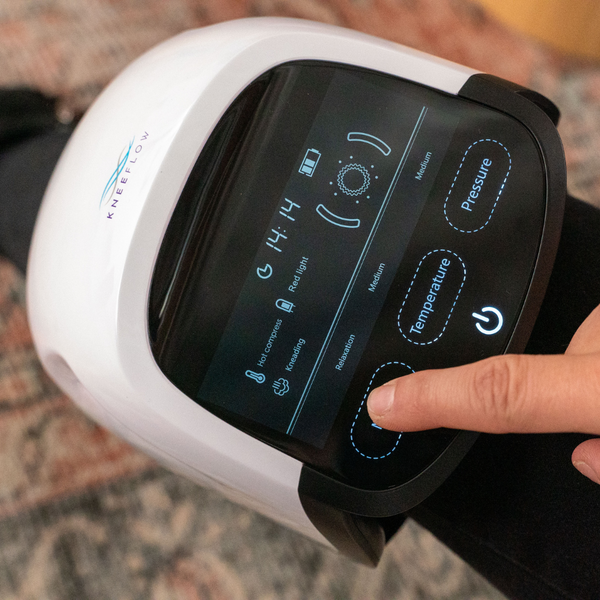
That distinction changes every design decision each device makes. It changes which user each one serves. And it changes whether someone who buys one in place of the other gets what their knee actually needs. The Kneeflow heated knee massager was built from the second premise. One joint. Three mechanisms. All three directed at the biological reality of knee pain rather than the surface experience of it.
Snailax: What It Is and What It Does Well
In this Kneeflow vs Snailax, the Snailax knee massager lineup runs from roughly $60 for the graphene vibration model to around $110 for the cordless vibration and infrared version. These are both wearable knee braces with rechargeable batteries, velcro straps and soft inner fabric panels. The graphene heating element in this brace is particularly well-designed in the lineup. It conducts heat evenly across the contact area without the hot spots that simpler heating elements sometimes produce, and it warms the tissue surrounding the knee quickly.
Most models have adjustable vibration intensity at different levels. Some warmers can reach as high as 149°F, which is important to distinguish from ‘mild’ warmers. All of the devices are very easy to operate. No learning curve, no companion app, no required setup.
Here is where the honest account matters. Some of the Snailax models are designed with a hard shell that does not conform to the shape of the knee. They are intended to be used while stationary and are best suited for sitting or lying on a hard surface. One of the reviewers even tested the infrared model and stated that wearing it while walking is not practical. That design choice is not a defect. It is a trade-off that suits some use cases and not others.
For someone who wants to sit down after dinner and put warmth on a stiff knee for twenty minutes, Snailax delivers that reliably. That is its category and it performs well within it.
The Infrared Claim: Worth Examining
Some Snailax models are marketed with infrared light as a feature. In a Kneeflow vs Snailax comparison, this is the point where the two devices appear most similar and are actually most different.
Infrared in the context of massage and warming devices typically refers to infrared radiation used to deliver heat into tissue. This is a thermal effect. Infrared radiation is absorbed by the tissue as heat, thereby promoting circulation and loosening of muscle.
Kneeflow’s near-infrared light delivers a separate and distinct set of effects known as photobiomodulation. Light of specific wavelengths around 850nm is absorbed by cytochrome c oxidase in the mitochondria to surrounding vasculature, and pro-inflammatory cytokines including IL-1β and TNF-α decrease in expression.
These are documented effects in peer-reviewed research across multiple knee conditions. They require specific wavelengths delivered at adequate power density to the depth of joint structures.
Whether Snailax's infrared LEDs meet those parameters is not documented in their product specifications. Consumer massage device infrared LEDs are generally calibrated for warmth and surface stimulation, not photobiomodulation at joint depth. Both use the word infrared. What happens at the cellular level in the target tissue is not the same process.
Kneeflow vs Snailax: What Kneeflow Does Instead
Three things at once. None of them optional.
Heat is the starting point, same as Snailax. But Kneeflow's heat works alongside two other mechanisms rather than in isolation. It increases local joint circulation, improves synovial fluid distribution through the joint space, and reduces the tissue stiffness that accumulates during inactivity. Anyone who wakes up with a stiff arthritic knee and waits for it to loosen through movement alone knows exactly what this addresses.
Compression is the first gap. Kneeflow includes purposeful therapeutic compression, not passive containment from the brace fitting around the knee, but active compression designed to reduce post-activity swelling and improve the proprioceptive input that helps the joint move accurately under load. Proprioception matters for arthritic knees specifically because structural changes degrade the joint's own position-sensing accuracy over time. External compression partially compensates for that. Snailax does not include this component.
Near-infrared photobiomodulation is the second and deeper gap. The cellular-level mechanism described above, cytochrome c oxidase activation, nitric oxide release, cytokine reduction, operates on the biological environment of the joint rather than the sensory experience of wearing something warm. For chronic knee conditions, the biology is where the meaningful intervention needs to happen. Warmth and vibration reach the surface and the musculature surrounding the joint. Near-infrared reaches the tissue inside it.
What the Price Gap Actually Reflects
Between Kneeflow vs Snailax; Snailax ranges from $60 to $110. Kneeflow is $119.
At the top of the Snailax range, the difference is nine dollars. That is almost nothing. The question that nine dollars raises is: what is each device doing for those prices?
At $109.99, the premium Snailax delivers heat, vibration, and infrared LEDs in a comfort format with good build quality and several intensity levels. At $119, Kneeflow delivers heat, therapeutic compression, and near-infrared photobiomodulation in a clinical management format with an evidence base behind its mechanisms.
Nine dollars for the difference between a comfort device and a clinical device is not a price comparison in any meaningful sense. The prices are nearly identical. The technology gap is not.
The value calculation for someone with morning knee stiffness that does not loosen for forty-five minutes, or for someone whose knee swells every time they walk more than a mile, is not about the nine dollars. It is about which device is built for what they are experiencing.
Two Different Users
In a Kneeflow vs Snailax, the second product is created for someone who wants to feel better after a long day. Knee soreness from overexertion, general tightness from sitting for hours, the mild ache that comes with getting older and staying active. For these people, Snailax's warmth and vibration deliver genuine relief in the moment at a price that does not require clinical justification. The device is appropriate and it works for its intended purpose.
Kneeflow on the other hand, is made for someone whose knee has an ongoing condition that affects the quality of their daily life. Knee osteoarthritis with morning stiffness, post-activity swelling, and the low-grade inflammatory ache that weather changes and activity levels make worse. Patellar tendinopathy that responds temporarily to rest but returns predictably with any increase in load.
Post-surgical recovery that needs targeted anti-inflammatory and circulatory support between physical therapy sessions. These are the situations where the biology of the condition needs to be addressed directly, not just made more comfortable while it continues.
One device serves the first group. The other serves the second. Most of the time, the user knows which group they are in.
Closing Thoughts Between Kneeflow vs Snailax
Kneeflow vs Snailax is not a difficult comparison once the lens is correct.
Snailax makes accessible, well-constructed comfort devices for general knee relief. The graphene heating is good. The vibration is adjustable. Some models are reasonably priced for what they deliver. For wellness use, it is a defensible purchase.
Kneeflow is built for something different. The three-modality approach of heat, compression, and near-infrared photobiomodulation addresses the biological reality of knee conditions rather than the surface experience of them. For someone managing a specific chronic knee problem, the device that reaches the joint tissue at the cellular level is the appropriate tool regardless of whether a cheaper option exists in the same product category.
If you are managing ongoing knee pain and want to understand whether Kneeflow fits your situation, the team is available and responds to every question directly. Reach out through the contact page and someone will get back to you.