Fifty dollars more. That is what the Hydragun HeatPulse costs over Kneeflow. At $169 versus $119, the gap is real without being dramatic. What it represents is the central question of the Kneeflow vs Hydragun comparison: does the extra cost reflect meaningfully superior technology, or are you paying for brand positioning in a product that delivers comparable outcomes?
The answer is neither. The Hydragun HeatPulse is not better or worse than Kneeflow in an absolute sense. It is different, serving a different use case with a different mechanism, and the price gap is less relevant than the technology gap for someone choosing between them for a specific clinical or comfort purpose.
Both devices strap around the knee. Both apply heat. Both vibrate. Neither of those similarities tells you anything useful about which one to choose. The Kneeflow heated knee massager was built around three mechanisms targeting the joint tissue specifically. The Hydragun HeatPulse was built around heat and vibration for general knee comfort. That difference matters.
Kneeflow Vs Hydragun: What Hydragun Built
Hydragun’s reputation is in massage guns. Percussive recovery tools for athletes. The HeatPulse knee massager is the brand’s entry into the wearable joint massager category, and it brings the same design philosophy: quality materials, clean engineering, a product that does what it claims without overreaching.
In the case of Kneeflow vs Hydragun; The HeatPulse in the second one uses graphene heating technology called HeatLast. Graphene conducts heat evenly and efficiently, reaching temperatures between 40°C and 70°C across the surface of the sleeve. A magnetic control pod attaches to the back of the sleeve, making it easy to charge and operate. The vibration cores target both sides of the kneecap. The whole unit weighs 300 grams, lighter than many competitors in the category.
Hydragun recommends using it seated or lying down, not while walking. That design choice reflects the sleeve’s form factor, which does not flex naturally with the knee during movement. For stationary recovery sessions of thirty minutes, the device performs its intended function.
Independent reviews are largely positive about the comfort experience. A reviewer from Tom’s Guide who wore it daily for a month described the immediate relief as real, noting the knee felt freer right after each session. The same reviewer noted that no significant change accumulated over the month of daily use. Short-term comfort. Limited long-term tissue change.
That observation is not a criticism of the device. It is an accurate description of what heat and vibration produce. Comfort during and immediately after use. Not the biological changes in joint tissue that characterize clinical-grade recovery intervention.
What Kneeflow Does Instead
Three mechanisms. Running simultaneously. All three at the joint itself.
Heat from a dedicated element does what the Hydragun’s graphene element does, warming the surrounding tissue, improving local circulation, and reducing the mechanical stiffness that chronic knee conditions accumulate. Both devices produce this benefit. One of them stops here.
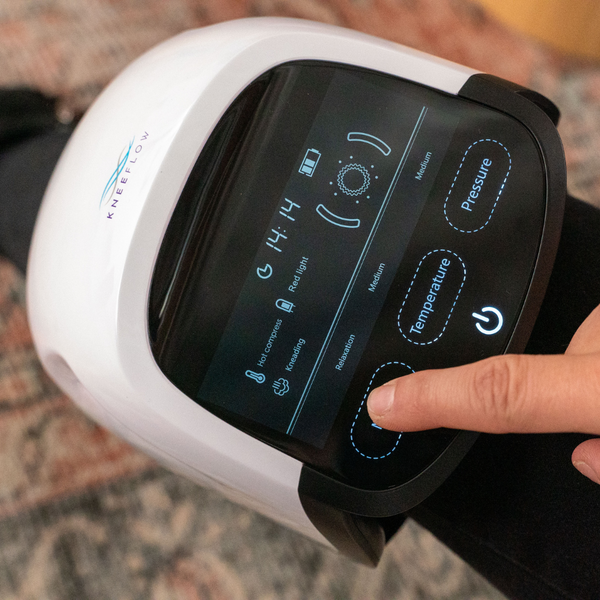
At Kneeflow vs hydragun, the compression in Kneeflow is purposeful, not incidental. It is not the passive containment of a sleeve fitting around a knee. It actively reduces post-activity joint swelling and sharpens the proprioceptive input that helps the joint move accurately under load. Proprioception degrades in arthritic knees as structural changes alter the quality of sensory signals from the joint capsule. External compression partially compensates. The Hydragun HeatPulse does not include this component.
Near-infrared red light therapy is the third mechanism and the one with no equivalent in the Hydragun’s design. Near-infrared wavelengths penetrate several centimeters into biological tissue and are absorbed by cytochrome c oxidase in the mitochondria, triggering photobiomodulation: ATP production increases, nitric oxide releases into surrounding vasculature, pro-inflammatory cytokines including IL-1β and TNF-α decrease in expression.
These cellular-level changes have a documented evidence base across multiple controlled trials for conditions including knee osteoarthritis, patellar tendinopathy, and post-surgical recovery.
Heat and vibration produce comfort. Near-infrared photobiomodulation produces documented changes in the inflammatory biology of the joint. Those are different outcomes through different mechanisms.
The $50 Price Gap, Honestly Examined
Kneeflow vs Hydragun: Hydragun: $169. Kneeflow: $119.
Hydragun costs more. Kneeflow delivers more mechanisms at a lower price. On paper, this looks like a straightforward win for Kneeflow. It is worth being more precise than that.
The Hydragun HeatPulse is a well-designed product. The graphene heating element is genuinely good technology for even heat distribution. The magnetic pod design reduces friction in the daily use routine. The brand has credibility built from its massage gun line. For someone who specifically wants a premium feel and clean aesthetics alongside comfort-focused heat and vibration, the Hydragun delivers that experience at $169.
The question for someone managing a specific knee condition is whether premium aesthetics and brand credibility are the relevant variables in their decision. For knee osteoarthritis, tendinopathy, post-surgical recovery, or the daily management of chronic joint inflammation, the relevant variable is whether the device is addressing the tissue biology of the condition. Kneeflow does. The Hydragun does not, through no fault of its design. It was simply not designed for that purpose.
Paying $50 more for a comfort device over a clinical management device is not a bargain. It is a misalignment between the product and the need.
Multi-Joint Use: A Real Hydragun Advantage
Credit where it is due.
The Hydragun HeatPulse can be used on elbows and shoulders in addition to the knee, with the included extension strap. For someone managing discomfort in multiple joints, that versatility has genuine practical value. Kneeflow is designed specifically for the knee. It addresses the knee joint with purpose and precision, and it does not serve the elbow or shoulder.
For users whose recovery needs span multiple joints, the Hydragun’s versatility is a legitimate consideration in the Kneeflow vs Hydragun comparison. A device that treats three joint areas at $169 versus a device that treats one at $119 frames the cost differently. The photobiomodulation component of Kneeflow still matters for knee-specific clinical management. But if the knee is one of three areas being managed and the others require only heat and vibration, the Hydragun addresses the full picture in a single device.
What Independent Testing Found
The Tom’s Guide reviewer wore the Hydragun HeatPulse every day for a month. Thirty minutes per session, once or twice daily. The verdict was consistent: the knee felt better immediately after each session. No significant change accumulated across the month.
This is what the device is designed to produce. Immediate relief from warmth and vibration. No mechanism in the HeatPulse’s design is expected to produce accumulated tissue-level change over time, because heat and vibration do not alter the biology of the joint at the cellular level. The reviewer’s experience is consistent with how the technology works.
Devices that include photobiomodulation show a different pattern in clinical research. Four to eight weeks of consistent daily use in populations with knee osteoarthritis or tendinopathy produces measurable changes in inflammatory markers and pain scores that accumulate rather than reset between sessions. The mechanism is different. The timeline is different. The outcomes are different.
Kneeflow vs Hydragun: Who Should Choose Each
Hydragun HeatPulse is the better choice for someone who wants a premium feel, clean design, comfort-focused heat and vibration, multi-joint versatility, and does not have a specific chronic knee condition requiring clinical-grade anti-inflammatory support.
Kneeflow is the better choice for someone managing knee osteoarthritis, patellar tendinopathy, post-surgical recovery, or chronic knee inflammation that requires a device reaching the joint tissue at the cellular level through photobiomodulation alongside heat and compression.
If the problem is a tired knee after a long day, either device works. If the problem is a knee condition that affects daily function and quality of life, one of them is clinically relevant and the other is not. That distinction determines the choice more reliably than the $50 price difference or the brand aesthetics of either product.
In this case, if you feel identified with our product, contact Kneeflow now and our team will help you to solve all doubts you have.