Comparing Firefly Recovery vs Kneeflow is ultimately a question about mechanism: what kind of recovery support does your situation require, and which device is designed to deliver it. Two devices. Two completely different approaches to recovery. One uses electrical nerve stimulation to create passive circulation throughout the lower body. The other combines heat, compression, and red light therapy directly at the joint. Both are legitimate tools.
Neither does what the other does. The question is not which one is better in the abstract. It is which one addresses what you are actually dealing with. Kneeflow brings a real comparison between these two options, so you can be the one who takes the last decision.
Firefly Recovery Vs Kneeflow: What Firefly Recovery Actually Does
Firefly is a neuromuscular electrical stimulation device. A small adhesive unit placed just below the outer knee delivers low-level electrical pulses that stimulate the peroneal nerve, which triggers rhythmic contractions in the calf muscles. Those contractions create what Firefly describes as a walking-like muscle pump that boosts blood flow through the lower extremity by up to 400%.
The device is designed to be worn during passive periods: long flights, post-workout recovery windows of one to four hours, or while sitting at a desk. It is FDA Class II cleared and uses low-level electrical signals to activate the peroneal nerve, creating a gentle, walking-like muscle pump in the lower leg.
The mechanism is systemic rather than local. Firefly does not apply any treatment to the knee joint itself. It stimulates a nerve below the knee to drive circulation through the lower limb broadly. The benefit is real: improved blood flow supports the removal of metabolic waste, reduces muscle soreness, and keeps legs feeling fresher between training sessions. Each pair costs $49 and delivers 30 hours of recovery treatment before the battery, which is not rechargeable, reaches the end of its life.
That last detail matters for anyone evaluating long-term cost. At $49 per pair for 30 hours of use, the per-session cost accumulates significantly for athletes who use the device daily across a full season.
Firefly Recovery Vs Kneeflow: What Kneeflow Actually Offers
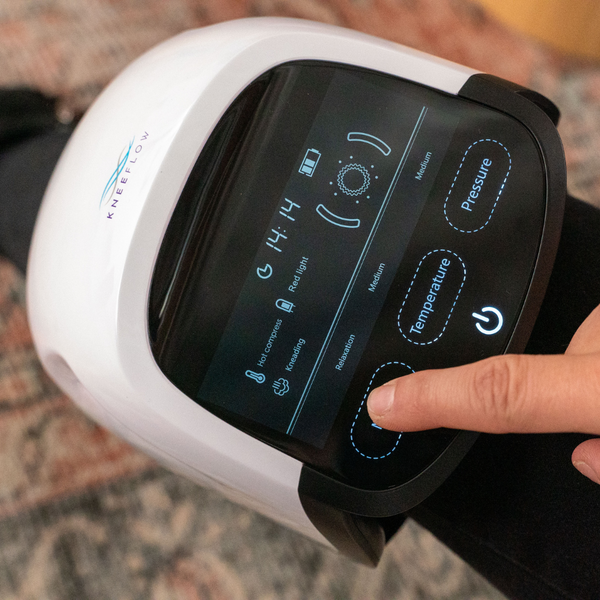
Kneeflow is a different category of device entirely. Where Firefly works systemically through nerve stimulation, the Kneeflow heated knee massager works locally, delivering heat, compression, and red light therapy directly to the knee joint and the tissue surrounding it.
Heat increases local circulation within the joint itself, supporting synovial fluid distribution and reducing the mechanical stiffness that arthritic and overloaded knees accumulate. Compression provides proprioceptive support and reduces post-activity swelling at the joint. Red light therapy, through near-infrared wavelengths, penetrates the tissue and triggers photobiomodulation at the cellular level, reducing pro-inflammatory cytokine expression and supporting collagen synthesis in the tendon and soft tissue around the knee.
The device is rechargeable, reusable, and designed for daily long-term use as part of a structured joint care routine. It is HSA and FSA eligible, priced at $119, and built specifically for people managing chronic knee conditions, recovering from knee injuries, or supporting an arthritic joint through regular activity.
Firefly Recovery vs Kneeflow: The Core Difference
The most important distinction is target tissue and mechanism.
Firefly targets the peroneal nerve to drive systemic lower leg circulation. It does not apply heat to the knee. It does not deliver a red light to the joint. It does not provide targeted compression at the joint line. Its benefit is in the blood flow it creates passively through the lower limb, which is genuinely useful for muscle recovery and travel-related circulatory stagnation.
Kneeflow targets the knee joint directly. Every component of the device, the heat element, the compression sleeve, the red light LEDs, is calibrated for the specific tissue of the knee and the structures immediately surrounding it. Its benefit is in the local tissue environment it creates inside and around the joint, which is what people managing knee pain, knee arthritis, tendinopathy, or post-surgical knee recovery actually need.
In a Firefly Recovery vs Kneeflow, the populations these devices serve overlap only partially. A runner who wants faster leg recovery between training sessions might find value in both. Someone managing knee osteoarthritis who needs anti-inflammatory support and improved joint circulation will find that Firefly's systemic mechanism does not reach what they need to address.
Who Firefly Recovery Is Built For
Firefly is at its best for athletes managing the systemic fatigue of high-volume training. Runners, triathletes, cyclists, and team sport athletes whose primary problem is heavy legs, delayed onset soreness, and the need to recover quickly between sessions are the core users the device was designed around.
Originally developed for post-surgery patients to prevent blood clots, Firefly uses the same nerve stimulation principle to flush lactic acid, reduce inflammation, and deliver fresh oxygen exactly where it is needed. For that original purpose, and for its athletic translation, the mechanism is appropriate and clinically grounded.
It is also genuinely useful for travel. After six hours, prolonged sitting can reduce lower leg circulation by up to 38%, and Firefly is clinically proven to boost blood flow by up to 400%. For people who travel frequently and experience the heavy leg fatigue that follows long flights, Firefly solves a real problem in a portable format.
Who Kneeflow Is Built For
Kneeflow is built for a different primary user: someone whose knee itself is the problem, not just the legs around it.
People managing knee osteoarthritis need local anti-inflammatory support, improved synovial circulation, and tissue-level recovery that systemic blood flow improvements alone cannot provide. People recovering from patellar tendinitis need heat to support collagen synthesis, compression to manage swelling, and the photobiomodulation effects that reduce the chronic inflammatory signaling in the tendon. People returning from ACL surgery or meniscus repair need targeted joint support that a calf-stimulating device placed below the knee simply does not deliver to the relevant structures.
Kneeflow is also the more practical long-term tool from a cost perspective. At $119 with a rechargeable battery and no consumable elements, the device is designed for months and years of daily use without recurring expenditure. Firefly's $49 per pair cost for 30 hours of single-use battery life adds up to a meaningfully higher per-session cost for anyone using it consistently over the long term.
Where They Could Work Together
These are not mutually exclusive tools for athletes managing both systemic leg fatigue and specific knee joint issues, so one Firefly Recovery vs Kneeflow is just not fair.
A runner managing IT band syndrome who also needs faster leg recovery between hard training days could reasonably use Firefly post-run for general circulation support and Kneeflow for targeted heat and compression at the lateral knee. The mechanisms do not overlap or conflict. They address different tissue targets through different pathways.
The question is always what the priority is. If the knee joint is the primary concern, Kneeflow addresses it directly. If systemic lower body recovery is the primary concern and the knee is otherwise healthy, Firefly is the more focused tool for that goal.
Closing Thoughts on Firefly Recovery vs Kneeflow
Two well-made devices. Two genuinely different jobs. Between Firefly Recovery vs Kneeflow, the first one is a portable systemic circulation tool that excels at reducing muscle fatigue and accelerating recovery for athletes training at high volume.
And, Kneeflow on the other side, is a targeted joint recovery device that addresses the specific tissue needs of a knee under chronic or acute stress. Choosing between them is really a question of what you are trying to treat. Leg fatigue or knee pathology. Systemic recovery or joint-specific support. Both matter. They just matter to different people in different situations. Contact Kneeflow now if what you are looking for is what you already read.