Most information on managing knee arthritis focuses on what you can add to your routine, such as exercises, supplements, and foods that are good for you. Most people dealing with knee arthritis are not ignoring their joints. They are managing them with reasonable effort and still wondering why some weeks feel worse than others. In many cases, what not to do with knee arthritis is the missing piece of that equation.
The seven mistakes below are not obscure. They are the patterns that come up consistently in the experience of people managing knee osteoarthritis, and most of them are easy to recognize once someone points them out.
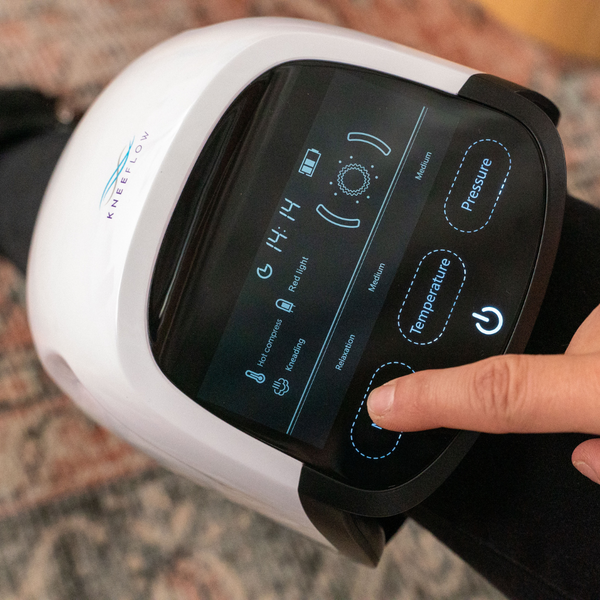
Kneeflow works with people navigating exactly this kind of daily management. If you are building a joint care routine and want to understand what targeted recovery support looks like in practice, the Kneeflow heated knee massager is designed around the specific needs of the arthritic knee.
Mistake 1: Resting Too Much to Avoid Pain

The instinct to protect a painful joint by moving it less is understandable. Pain during activity feels like feedback that activity is harmful, and resting tends to reduce the immediate discomfort. The problem is that this logic inverts the actual biology of the joint.
Cartilage has no direct blood supply. The nutrients in the synovial fluid are circulated around the joint by movement. So, extended periods of rest mean that there is little circulation of nutrients to the cartilage to enable its maintenance, and at the same time the surrounding muscles deteriorate due to inactivity. Weaker muscles mean less dynamic support for the joint, which means more direct stress on the cartilage during activity when it does occur.
Understanding what not to do with knee arthritis starts with recognizing that prolonged inactivity is not protection. It is a slower version of the same damage, compounded by muscular atrophy.
What clinical evidence on osteoarthritis management consistently shows is that regular low-impact movement reduces pain and improves function more reliably than rest. The goal is not pushing through significant pain. It is maintaining enough movement to keep the joint supported, lubricated, and functional.
Mistake 2: Avoiding All High-Impact Activity Without Distinction

The opposite extreme carries its own risks. Some people with knee arthritis interpret the need to protect their joints as a reason to avoid any activity that feels demanding, including activities that research consistently supports as beneficial. Running, for example, is often abandoned at diagnosis when moderate recreational running at appropriate volume is not among the things to cut when managing what not to do with knee arthritis.
It is important to distinguish between the amount of stress the joint can handle and come back from, and the amount of stress the joint cannot handle. Running high mileage on hard surfaces without appropriate support of the muscles and recovery may fall into the second category.
Running for 30 minutes three times a week in good shoes with strong supporting muscles and with due care for recovery from running is not generally sufficient. The general avoidance of any hard activity tends to produce deconditioning that ultimately makes the joint more vulnerable rather than less.
Mistake 3: Ignoring Body Weight as a Variable

Your body weight is a major direct mechanical influencer of your knees. It is often one of the biggest, underutilized influences that healthcare providers have to influence in the management of people with arthritis. For every excess pound above ideal body weight that you walk around, your knees are subjected to an additional 4 pounds or so of compressive force during walking. Over thousands of steps per day and years of cumulative loading, that ratio matters enormously for how quickly cartilage wears and how much pain each step produces.
Knowing what not to do with knee arthritis includes recognizing that managing the condition without addressing body weight, when weight is a contributing factor, leaves one of the most impactful variables untouched. This is not about aesthetics or reaching an arbitrary number.
It is about reducing the mechanical demand on a joint that is already operating below its original capacity. Even modest weight reduction of five to ten percent of body weight produces measurable reductions in knee pain and improvements in function in people with osteoarthritis.
Mistake 4: Using Pain as the Only Metric for Progress

While pain is the most obvious signal coming from a knee with arthritis, it is not a reliable indicator of how that knee is changing from week to week. Pain also appears because of weather, sleep quality, stress levels, activity variation, and inflammatory inputs from diet that have nothing to do with whether the joint is structurally better or worse than last week. Using pain as the primary measure of progress leads to decisions that often work against the joint's actual needs.
A pain-free day can produce overconfidence in how much activity is appropriate. A painful day can produce unnecessary rest and the associated deconditioning. What not to do with knee arthritis includes treating every quiet day as clearance and every uncomfortable day as a reason to stop. More reliable metrics include consistency of movement over weeks, range of motion at the start of the day, how quickly morning stiffness resolves, and how the joint responds to a standard activity rather than a highly variable one.
Mistake 5: Skipping the Recovery Side of Activity

Activity is half of the joint care equation. The daily joint care recommended by the Arthritis Foundation for healthy joints consists of exercise as well as recovery. The majority of people carry out regular physical activity but nothing else after it.
Heat applied after activity increases local circulation and helps resolve the low-grade inflammation that load-bearing movement produces in an arthritic joint. Compression reduces post-activity swelling and maintains the proprioceptive awareness the joint needs to move with good mechanics.
Massage addresses the muscular tension that accumulates in the quadriceps, hamstrings, and iliotibial band when those structures are working harder than usual to compensate for reduced joint efficiency. Skipping recovery is one of the clearest answers to what not to do with knee arthritis if the goal is sustainable activity over months and years rather than short bursts followed by flares.
Mistake 6: Relying Entirely on Pain Medication Without Addressing Root Causes

Pain medication has a legitimate place in knee arthritis management. It reduces the discomfort that otherwise makes movement impossible, and enabling movement is one of the most important things arthritis management needs to accomplish. The problem arises when medication becomes the primary strategy rather than a tool that enables the other strategies.
Analgesics such as NSAIDs manage the symptom of arthritis pain but do nothing to address the root causes of that symptom, including weak surrounding muscles, excess body weight, sedentary behavior, poor eating habits, and inadequate recovery time. By relying on medication to treat the pain of arthritis on a feedback signal that might otherwise motivate the behavioral changes that actually shift the condition's trajectory.
Knowing what not to do with knee arthritis includes recognizing when medication use has shifted from enabling better habits to substituting for them.
Mistake 7: Waiting for a Bad Flare to Start Managing the Joint

Perhaps the most consistent and most costly mistake in knee arthritis management is reactive rather than proactive care. The majority of people pay more attention to a painful joint when symptoms are bothersome and less when they are not. Thus, there is a ‘baseline’ of decreased attention between painful flare-ups.
What not to do with knee arthritis is treat it like an acute condition that needs management when it announces itself and can be left alone when it does not. Osteoarthritis is a chronic condition. The joint is always in a process, either one that is being supported with consistent habits or one that is being left to its own devices.
The people who manage it most effectively are those who maintain a baseline of consistent movement, recovery support, dietary awareness, and joint protection regardless of whether the knee is in a flare or not. The habits are not the response to the problem. They are what keeps the problem from becoming the primary feature of the day.
What not to do with knee arthritis: What Knowing the Mistakes Actually Changes
Understanding what not to do with knee arthritis does not replace the positive habits, the walking, the strengthening, the dietary adjustments, the recovery tools. It adds a layer of awareness that makes those positive habits more effective because the patterns undermining them have been identified and addressed. The joint does not need perfect management. It needs consistent management that is no longer working against itself.
If you have questions about building a joint care routine that covers both the activity and the recovery side, the Kneeflow team is here to help. Reach out through the contact page and someone will respond to you directly.