Knee pain after menopause can feel confusing because it appears without one clear injury. You may notice aching after stairs, stiffness after sitting, soreness during walks, or discomfort that moves in and out of your routine. The knee may not look dramatically different, but it can start to feel less forgiving than it used to.
That change can feel personal. Many women know their bodies well enough to sense when something has shifted, even when the pain is mild. It may show up alongside sleep changes, weight changes, muscle tension, hot flashes, or a general feeling that recovery takes longer than before.
At Flow Knee, we approach menopause knee pain with care. A knee massager may support warmth, relaxation, and everyday comfort, but it should not replace medical guidance, physical therapy, hormone care, or evaluation when pain is severe, swollen, sudden, unstable, red, hot, or worsening.
Why Knee Pain After Menopause Can Happen
Knee pain after menopause is rarely about one single cause. Hormonal changes may influence joint comfort, inflammation, muscle tone, sleep quality, weight distribution, and the way the body responds to daily stress. The knee may become one of the first places these changes feel obvious because it carries weight, absorbs impact, and supports frequent movement.
Lower estrogen is often part of the conversation because estrogen plays a role in joints, muscles, tendons, and connective tissue. When hormone levels change, some women notice more aching, soreness, stiffness, or reduced resilience in areas that used to feel manageable. This does not mean every knee symptom is caused by menopause alone, but it can be part of the picture.
The important point is not to blame age too quickly. Knee pain after menopause can overlap with arthritis, past injury, tendon irritation, bursitis, weight changes, activity changes, or reduced strength. A careful approach looks at the full pattern rather than assuming the knee is simply “getting older.”
Knee Pain During Menopause May Feel Different From an Injury
Knee pain during menopause may not feel like pain after a twist, fall, or obvious strain. Instead of one sudden moment, it may build gradually. It may feel achy, heavy, stiff, or more noticeable in the morning, after sitting, after longer walks, or after a full day of standing.
That slower pattern can make the discomfort easy to dismiss. Some women tell themselves it is just aging, being tired, or part of normal life. But discomfort that changes how you move deserves attention, even if it is not intense. The goal is not to panic. The goal is to understand the pattern early enough to respond well.
If the knee is uncomfortable but not swollen, unstable, hot, or locked, gentle home comfort may help. If pain is sharp, worsening, persistent, or limiting daily movement, a clinician can help determine whether the issue is hormonal, arthritic, mechanical, inflammatory, or connected to another condition.
Menopause Knee Pain and the Role of Hormones
Menopause knee pain is often discussed alongside hormones because estrogen changes can affect how joints and surrounding tissues feel. Some women notice more sensitivity in the knees, hips, hands, shoulders, or feet during the menopause transition or after menopause. The discomfort may feel widespread for some people and more localized for others.
Hormones are not the only factor, but they can influence the environment around the joint. Sleep disruption may lower pain tolerance. Muscle loss with age can reduce joint support. Weight changes may add more load to the knees. Lower activity during uncomfortable seasons of life may also make the joint feel less prepared for movement.
This is why knee pain and hormones women experience should be handled with nuance. Hormones may be part of the story, but the knee still needs practical support. Strength, movement, pacing, sleep, medical guidance, and comfort routines can all matter.
Arthritis Can Become More Noticeable After Menopause
Knee pain after menopause may also be linked to osteoarthritis or joint wear that becomes more noticeable over time. Arthritis-related knee pain may feel deep, achy, stiff, or more intense after activity. Some women notice creaking, swelling, reduced range of motion, or discomfort that returns after rest.
This can be frustrating because arthritis does not always appear suddenly. It may develop quietly, then become more obvious when hormonal changes, reduced muscle strength, or daily load make the joint less tolerant. Menopause may not be the only cause, but it can be the season when symptoms become harder to ignore.
If knee pain is recurring, swollen, or limiting daily life, a healthcare professional can help clarify whether arthritis is involved. That matters because arthritis care may include movement guidance, strength work, weight support, medication options, injections, or other treatments depending on the person.
Muscle Strength Changes Can Affect Knee Comfort
Knee pain after menopause can also relate to changes in muscle support. The quadriceps, hamstrings, calves, glutes, and hips all help protect the knee during walking, stairs, standing, and bending. When those muscles become weaker or less active, the knee may take on more stress.
This does not mean the knee is fragile. It means the knee needs support from the rest of the body. Many women notice that movements they used to do without thinking, like rising from a chair, walking uphill, or carrying groceries, start to feel more demanding when muscle support changes.
Gentle strengthening can help, but it should be realistic and safe. A physical therapist or healthcare professional can guide exercise if pain is persistent, if arthritis is present, or if the knee feels unstable. The best plan is usually steady, not aggressive.
Daily Habits That May Make Menopause Knee Pain Worse
Menopause knee pain can be influenced by ordinary habits. Long sitting can make the knee feel stiff. Standing on hard floors can increase aching. Sudden changes in exercise can irritate the joint. Poor sleep can make discomfort feel sharper. Shoes without support can make walking feel harder on the knees.
These details may seem small, but they can add up. A knee that is already sensitive may not respond well to a full day of sitting followed by stairs, errands, or a long walk. The body often prefers smaller transitions and more consistent movement.
Simple adjustments may help. Short walking breaks, supportive footwear, lower-impact exercise, gentler progressions, and rest after higher-load days can make daily knee comfort feel less unpredictable. The goal is not to avoid movement. The goal is to make movement easier for the knee to accept.
How to Support Knee Comfort After Menopause
Knee pain after menopause often responds best to a layered routine. Gentle movement helps keep the joint active. Strength work supports the muscles around the knee. Rest helps the body recover. Cold may feel better when the knee is irritated or swollen. Warmth may feel better when the knee is stiff, tense, or guarded.
The choice between heat and cold depends on the pattern. A hot, swollen, red, or newly injured knee should not be treated with heat. A chronically stiff or tense knee may respond well to warmth, especially when there are no warning signs. If you are unsure, medical guidance is safer than guessing.
Home support should feel calm and controlled. Pushing through pain, forcing deep bends, or using intense massage over a sensitive knee is not a good strategy. Comfort is most useful when it helps you relax around the joint without ignoring what the knee is communicating.
Where Kneeflow May Fit Into a Comfort Routine
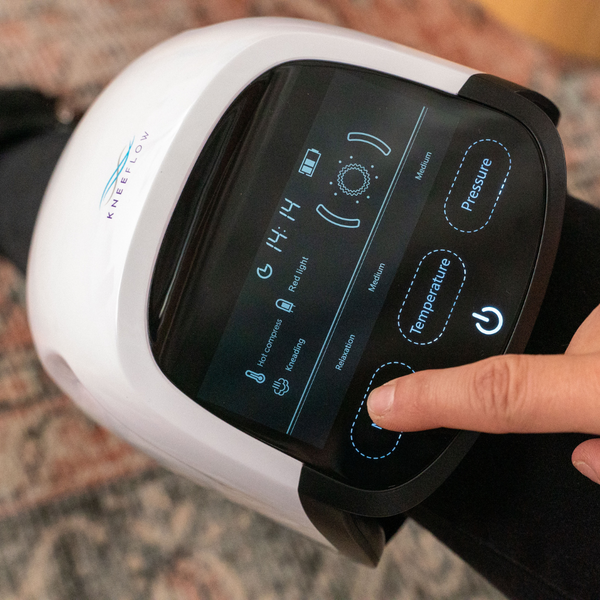
Knee pain after menopause can make women look for support that feels simple enough to return to. In Kneeflow our knee massager combines controlled warmth, red light support, and soft airbag massage in a wraparound design made for knee comfort. For mild, familiar discomfort, that kind of routine may help the knee area feel more relaxed.
Its role should stay realistic. Kneeflow is not a menopause treatment, arthritis treatment, hormone therapy, or replacement for physical therapy. It does not diagnose why the knee hurts. It may support comfort when symptoms are appropriate for home care and the knee is not swollen, hot, red, unstable, recently injured, or severely painful.
For some women, the value is consistency. A short comfort routine can help the knee feel cared for after walking, errands, desk work, or a long day. That repeatable support can make daily movement feel less discouraging when the knee feels tense or tired.
When to Talk to a Doctor About Knee Pain After Menopause
Knee pain after menopause should be checked if it is severe, persistent, worsening, or limiting normal life. It should also be evaluated if the knee is swollen, red, warm, unstable, locked, numb, or difficult to bear weight on. Pain after a fall, twist, or sudden movement should also be treated more carefully.
You should also consider medical guidance if joint pain is widespread, if morning stiffness lasts a long time, or if symptoms appear with fatigue, fever, rash, unexplained weight changes, or other body-wide symptoms. Not all post-menopause joint pain is hormonal. Arthritis, autoimmune conditions, gout, injury, and other issues can also affect the knees.
A clinician can help separate menopause-related discomfort from conditions that need targeted care. That clarity matters because the best relief plan depends on the cause. Hormone-related joint aches, osteoarthritis, tendon irritation, and swelling do not all need the same approach.
A Calmer Way to Think About Knee Pain and Hormones Women Experience
Knee pain after menopause can feel frustrating, especially when it changes ordinary routines like walking, climbing stairs, standing, or getting comfortable after a long day. The right response is not to ignore it or assume it is only part of aging. It is to notice the pattern, respect warning signs, and choose support that fits what the knee is actually telling you.
For many women, that may mean combining gentle movement, strength support, better recovery habits, medical guidance when needed, and simple comfort routines at home. Kneeflow may help support warmth, relaxation, and everyday knee comfort when symptoms are mild and safe for home care, but it should not replace evaluation for severe, swollen, hot, unstable, or worsening pain.
If you are looking for a calmer way to support daily knee comfort after menopause, contact Flow Knee to learn whether Kneeflow may fit into your routine safely and practically.
FAQ
Can menopause cause knee pain?
Yes, menopause can be associated with knee pain, although it is not always the only cause. Lower estrogen levels may affect joints, muscles, tendons, inflammation, and pain sensitivity. However, knee pain after menopause can also come from arthritis, injury, weakness, weight changes, or activity changes, so persistent or worsening symptoms should be evaluated.
What does knee pain during menopause feel like?
Knee pain during menopause may feel achy, stiff, heavy, sore, or more noticeable after sitting, walking, stairs, or standing. Some women feel discomfort in several joints, while others notice it mostly in the knees. If the pain is sharp, swollen, hot, unstable, or limiting movement, it should not be assumed to be hormonal without medical guidance.
Is menopause knee pain the same as arthritis?
No, menopause knee pain and arthritis are not exactly the same. Menopause-related joint discomfort may be connected to hormonal changes, sleep disruption, inflammation, or muscle changes. Arthritis involves joint changes that may cause pain, swelling, stiffness, and reduced motion. The two can overlap, especially after midlife, which is why evaluation can be helpful.
Why do my knees hurt more after menopause?
Your knees may hurt more after menopause because of hormonal changes, reduced muscle support, sleep disruption, weight changes, lower activity, or arthritis becoming more noticeable. The knee carries body weight and handles repeated daily movement, so it can be especially sensitive to changes that affect strength, inflammation, and recovery.
What helps knee pain after menopause at home?
Gentle movement, low-impact exercise, strength work, supportive shoes, healthy sleep habits, pacing, cold for irritation, and warmth for non-swollen stiffness may help. A knee massager may support comfort when symptoms are mild and safe for home care. Severe, swollen, hot, red, or worsening knee pain should be checked.
When should I see a doctor for knee pain after menopause?
See a doctor if knee pain is persistent, severe, worsening, swollen, red, warm, unstable, locked, numb, or making it hard to bear weight. You should also seek care if pain appears after an injury or comes with fever, fatigue, rash, or symptoms in multiple joints. These signs may need more than home care.
Can low estrogen make knee pain worse?
Low estrogen may contribute to joint discomfort for some women because estrogen can influence inflammation, connective tissue, muscle function, and pain sensitivity. However, knee pain is usually not caused by hormones alone. Arthritis, past injuries, reduced strength, weight changes, or activity changes may also play a role, especially if symptoms persist or worsen.
Can a knee massager help menopause-related knee discomfort?
A knee massager may help support comfort when menopause-related knee discomfort feels mild, stiff, tense, or tired, especially when there is no active swelling, redness, heat, injury, or sharp pain. It should be used as a comfort tool, not as treatment for the underlying cause. If knee pain is persistent, worsening, unstable, or swollen, medical guidance is safer.