Knee pain can feel difficult to judge because not every ache means something serious, but not every ache should be ignored either. Some discomfort appears after a long walk, a hard workout, or a change in routine. Other pain feels sharper, heavier, or more limiting from the start, and that difference can make people wonder whether home care is enough.
That is why when to see doctor knee pain is such an important question. People are often trying to avoid overreacting, but they also do not want to miss a sign that the knee needs proper attention. The uncertainty itself can become stressful, especially when pain starts changing how someone walks, rests, exercises, or moves through the day.
At Flow Knee, we believe knee pain guidance should feel calm and practical. A useful distinction between self-treatment and medical care should reduce fear, not create more of it. The goal is to help people understand which symptoms may be manageable at home, which ones deserve more caution, and where daily support fits into a responsible comfort routine.
Why Knee Pain Can Be Hard to Interpret
Knee pain often feels confusing because the same joint can react in very different ways. A dull ache after activity may feel manageable, while sudden swelling or instability can create immediate concern. The difficulty is that both experiences happen in the same part of the body, which makes it tempting to treat all knee pain as either harmless or alarming.
That uncertainty becomes stronger when the pain changes throughout the day. A knee may feel stiff in the morning, better after moving, and sore again after stairs or exercise. This pattern can make people second-guess their own judgment, especially when they are trying to stay active without making the problem worse.
A better way to understand knee pain is to look at function as much as discomfort. Pain that still allows normal movement and gradually improves often feels different from pain that limits weight-bearing, causes major swelling, or makes the knee feel unstable. That distinction helps the decision feel more grounded.
When Self-Treating Knee Pain at Home May Make Sense
Home care can make sense when knee pain is mild, came on gradually, and does not stop someone from moving through daily life. Mayo Clinic notes that self-care may be reasonable when knee pain has no clear signs of trauma and a person can still go about normal daily activities. That kind of pain often feels like soreness, stiffness, or irritation rather than a sudden loss of function.
This does not mean the discomfort should be dismissed. It means the knee may be responding to load, overuse, a small change in activity, or stiffness that can improve with rest and better support. MedlinePlus also explains that simple causes of knee pain may clear up with symptom management, while pain caused by an accident or injury should be discussed with a healthcare provider.
Home care works best when the pain is watched honestly. If it settles, feels less intense, and movement becomes easier, the body may be responding well. If it worsens, spreads, swells, or starts changing how someone walks, the situation deserves a different level of attention.
When Knee Pain Needs a Doctor’s Attention
Some symptoms change the conversation immediately. Mayo Clinic’s guidance on when to see a doctor for knee pain points to warning signs like major injury, visible deformity, inability to bear weight, intense pain, sudden swelling, redness, warmth, tenderness, and pain that affects sleep or daily tasks.
This kind of guidance matters because many people try to explain away symptoms that feel inconvenient or intimidating. Instability, severe swelling, fever, or inability to use the knee are not just stronger versions of ordinary soreness. They point to situations where the body may need clearer assessment.
Seeing a doctor in those moments is not overreacting. It is a way to protect movement, confidence, and long-term knee function. The sooner the cause is understood, the less likely someone is to keep compensating in ways that create more strain.
Why Swelling, Instability, and Locking Matter
Swelling can feel like a normal part of knee pain, but significant swelling often means the joint is responding to something more than everyday soreness. It may reflect injury, irritation, or inflammation that needs more attention. The same is true when the knee gives way, locks, or cannot move normally.
MedlinePlus guidance on knee pain warning signs advises contacting a provider if the knee cannot bear weight, has severe pain, buckles, clicks, locks, looks deformed, cannot fully bend or straighten, or has fever, redness, warmth, or a lot of swelling. These signs matter because they affect function, not just comfort.
This does not mean every swollen knee is an emergency. It means swelling should be interpreted alongside the rest of the picture. A knee that is swollen, unstable, hot, locked, or unusable is asking for more than simple self-care.
Why Pain Duration Matters Too
Knee pain that lasts longer than expected can become harder to judge. If it is mild, people may keep waiting for it to disappear. If it is familiar, they may assume it is just part of aging, training, or daily life. That patience can be helpful at times, but it can also delay support when the knee is not improving.
MedlinePlus recommends contacting a provider if knee pain is still present after three days of home treatment. That does not mean every person needs to panic after a few days of soreness, but it does give people a practical checkpoint when symptoms are not settling.
The key is the direction of change. Pain that slowly improves feels different from pain that stays the same, returns repeatedly, or begins limiting normal activities. Duration matters because persistent discomfort can reveal that the knee needs a clearer plan.
Where At-Home Support Fits Responsibly
At-home support is most useful when the knee pain is mild, manageable, and not showing warning signs. In that setting, comfort routines can help reduce stiffness, calm tension, and make daily movement feel easier. The goal is not to pretend home care replaces medical evaluation when symptoms are serious.
This distinction matters because people often want one simple answer. Either they should self-treat or see a doctor. Real life is more nuanced. At-home support can be part of responsible care when the symptoms are appropriate for it, and medical help can be the right choice when the knee shows signs that need assessment.
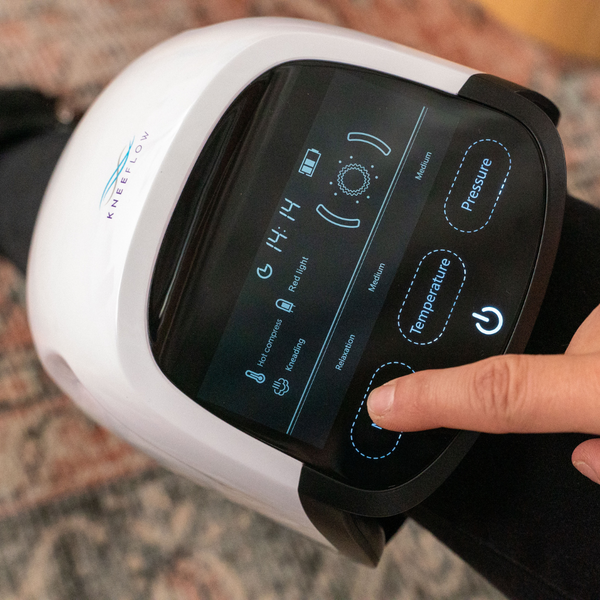
For those in the self-care category, the Kneeflow heated knee massager can fit into a daily comfort routine. Flow Knee’s role is not to diagnose pain, but to make gentle, repeatable support feel easier when the situation is appropriate for home-based relief.
How to Think About Self-Treatment Without Ignoring Risk
Self-treatment can feel empowering when it is based on awareness rather than avoidance. A person who notices mild stiffness after activity and responds with rest, gentle support, and reduced strain is making a very different choice from someone who keeps pushing through worsening pain. The difference is honesty.
That honesty helps protect the knee from being either overmanaged or neglected. Not every ache needs urgent care, but recurring or worsening symptoms deserve respect. A healthy self-care mindset includes the possibility that medical guidance may become necessary if the knee does not improve.
This kind of thinking gives people more confidence. It lets them support the knee at home when that makes sense, while staying alert to symptoms that should not be minimized. That balance is often where the safest decisions happen.
When the Right Next Step Becomes Clearer
Knee pain becomes less stressful when the decision is based on function, severity, and change over time. Mild, gradual discomfort that allows normal movement may be reasonable to support at home. Severe pain, major swelling, inability to bear weight, fever, deformity, locking, or instability deserves medical attention.
That distinction does not make every decision perfect, but it makes the process less confusing. People do not need to panic over every sensation, and they do not need to ignore symptoms that clearly cross a threshold. Better judgment often comes from understanding the pattern rather than reacting to fear.
If your knee pain feels mild and you are looking for daily support, Flow Knee can help make comfort routines feel more practical. If you are unsure whether your symptoms fit self-care or need professional attention, contact our team and we can help you think through the next step in a grounded way.
When Knee Pain Decisions Start Feeling Less Uncertain
The hardest part of knee pain is often not the discomfort itself, but the question of what it means. That uncertainty can make people wait too long, worry too much, or bounce between home remedies without a clear sense of direction. A calmer framework makes the experience easier to handle.
Self-care has a place when pain is mild, gradual, and improving. Medical guidance has a place when pain affects function, worsens, or comes with warning signs. Both choices can be responsible when they match the reality of the symptoms.
At Flow Knee, we believe support should help people feel more confident, not more confused. When the knee needs daily comfort, gentle routines can matter. When the knee needs professional attention, that clarity matters too.
FAQ
When should I see a doctor for knee pain?
See a doctor if knee pain is severe, swollen, unstable, linked to injury, or stops you from walking, bending, or bearing weight.
Can I treat knee pain at home?
Mild knee pain may be managed at home if there is no major injury, swelling, instability, or loss of normal function.
Is swelling a warning sign with knee pain?
Significant swelling can be a warning sign, especially if it appears suddenly, worsens, or comes with pain, heat, redness, or instability.
How long should knee pain last before seeing a doctor?
If knee pain does not improve after a few days of home care, keeps returning, or affects movement, medical guidance is worth considering.
Can heat help knee pain at home?
Heat can help some mild knee pain feel less stiff or tense, especially when discomfort is linked to tightness rather than acute injury.