Knee pain from squats can make a familiar exercise suddenly feel uncertain. One week, you are moving comfortably through your sets. There is pressure around the kneecap, sharp pressure in the kneecap, a sharp ache in the joint line, a soreness after you come out of the workout and you get sore for several hours. The pain can only show up near the bottom of the squat, at the bottom, as you drive up, or several hours later after training is over.
That does not mean squats hurt your knees. Squatting is a normal exercise you do when you are sitting, standing, lifting, climbing, and getting close to the floor. Problems typically occur when the exercise is demanding more from your knee than it can tolerate at the time. Sometimes that is a sudden increase in weight, volume, depth, or training frequency.
At Flow Knee, we believe the goal is not to fear the squat or push through it. The more useful way is to identify the pattern, reduce the strain, and then rebuild the movement as it happens. A knee massager can help comfort after appropriate training when symptoms are mild, but it should not be used to cover sharp pain, swelling, instability, locking, or a new injury.
Why Knee Pain From Squats Does Not Always Mean Knee Damage
Pain is real, but pain and structural damage are not always the same thing. A knee can get sensitive when the demands of training change faster than the joint and surrounding muscles can adjust. This can happen even if no major tissue injury has occurred. Think about what you were doing before symptoms started.
You could have had more sets, returned from time away, squatted deeper, changed your shoes, moved from a wide stance to a narrow stance, or added heavy lunges and running to the same week. Any of those changes may be manageable by itself. But combined, they put an additional load on the knee.
The knee might also respond differently when sleep is poor, recovery is limited, or nearby muscles are fatigued. A squat performed early in a workout can feel different from the same movement performed after jumping, running, or several heavy compound lifts.
This is why the statement “squats hurt knees” is too simple. The movement itself is not the only variable. Load, range, speed, frequency, fatigue, previous injuries, and current capacity all shape how the knee responds.
The key question is not whether squats are universally safe or unsafe. It is whether the version you are doing matches what your knee can currently tolerate.
Training Load Is Often the First Place to Look
Knee pain from squats can appear after a training change that seemed reasonable at the time. Adding weight to the bar may not feel dramatic, but the knee feels the impact of every repetition, every set, and every other lower body exercise in that week. Load is more than weight. It also includes: Total repetitions, number of working sets, squat frequency, depth of each repetition, time under tension, exercise order, training speed, nearby running or jumping volume.
A lighter squat for many slow repetitions can be demanding. A heavy squat once a week can also be hard work. Neither is necessarily better for a painful knee. Look back at the last two or three weeks. Did you increase the amount of squats with lunges, step-ups, hill running or sports practice? Did you return to your old weight after a break? Did you go from box squats to deeper free squats without a transition period?
The first thing you might do is reduce the one thing that had changed most and that could be lowering weight, shortening the range, doing fewer sets or temporarily reducing squat frequency. The goal is not to stop training forever. It is to put the demand back into a range that the knee can manage.
Squat Depth Can Be Adjusted Without Abandoning the Exercise
Deep squats require more knee flexion than partial squats. That is not necessarily harmful, but a painful knee may not currently tolerate the same depth it handled before. If discomfort begins only below a certain point, use that information. Squat to a depth just above the painful range and pause there. It can be useful to have a box, bench, or target that keeps the depth consistent rather than guess every time.
This is the quickest way to learn how to do squats from the bottom for knee pain. You continue to move and you temporarily reduce the part that causes the most pain, but the movement pattern is maintained. The depth can be rebuilt gradually over time. When symptoms settle and strength improves, lower the target gradually.
The process must be controlled, not a test of how much pain you can take. Don’t think that a shallow squat is always easier. Some people shift their body in ways that are more painful when attempting to stop early. The altered depth has to feel balanced, stable, and repeatable. A physical therapist or coach can help if every depth hurts to do or the movement changes dramatically from one side to the other as well.
Ankle Mobility Can Change What Happens at the Knee
The ankle has to bend forward when the body is squatted. If that is limited, the body finds a way to reach depth. The heels can lift, the feet may turn out too much, the torso may lean forward, or the knees can shift in a way that’s uncomfortable. For squats, people who have good ankle mobility do not suffer knee pain, but they can be able to use it to help with their movements.
A heel lift, weightlifting shoe, or wedge may be helpful for some lifters to stay on balance and get deeper. It is not a cure; it is just a way to change the mechanics and see if the knee reacts differently. Calf stiffness, previous ankle injury, and long periods of sitting can all affect ankle motion.
Gentle mobility work is possible, but aggressive stretching is not always the answer. If the ankle feels blocked, unstable, or painful, professional assessment might be more useful than constantly forcing it forward. The point is that knee pain during squats may be more than just knee pain. The ankle, hip, trunk, and foot all contribute to the movement.
Knee Position Should Be Controlled, Not Forced
You may have heard that the feet should never move past the toes during a squat. That rule is too rigid for most people. Knee position changes with limb length, stance, squat depth, footwear, and the type of squat being performed. If you try to press knees forward at all costs you may have an exaggerated forward lean or move more weight forward to hips and lower back.
Letting the knees move doesn’t make you unsafe. The more useful goal is control. The knees should take a route that feels stable and coordinated with the feet. They don’t have to always move straight ahead, but sudden collapses, twisting, and uncontrolled movement will result in a squat that feels less secure. For others, some lifters feel better in a more neutral way, but some lifters prefer a slightly wider stance and toes turned out.
There is no stance that suits every body perfectly. Use a stance such that the feet stay planted and the knees move smoothly. Record a few repetitions from the front and side if necessary, but don’t stress about doing it in the manner of a textbook. A squat can be a little different for different people and still be effective.
Hip and Thigh Strength Help the Knee Handle the Squat
The quadriceps make up most of the force needed to straighten the knee when you squat. Glutes and other hip muscles help to control the pelvis, thigh and overall direction of movement. The knee might be more sensitive if these muscles are underprepared for the current workload. That is not to say weakness is always the cause, but building capability around the joint is a good recovery plan. There is no need for heavy squats to begin with strength work.
Depending on symptoms, a program might take place with supervised sit-to-stands, step-ups, leg presses, knee extensions, bridges or other exercises for the individual. A right exercise should create a manageable challenge without causing a major flare.
Mild discomfort may be tolerated in a clinician-managed program, but sharp pain, swelling, instability or worse function should not be dismissed. Improvement is not achieved from one heroic session. A lighter exercise done consistently will yield more useful capacity than a heavy exercise that repeatedly forces you to stop.
How to Do Squats With Knee Pain Without Making It Worse
Are you learning to do squats with knee pain from the top by changing the mode of the exercise? Instead of proving that you can still lift the same weight, focus on finding a version the knee can tolerate. Start with a bodyweight squat and a light goblet squat. If it is hard to control depth, find a box. It is okay to work slow enough to see where discomfort starts, but don’t do it all so fast.
Think about changing one variable at a time: reduce weight, do fewer reps, shorten the range of motion, make the stance wider or narrower slightly, lean back inwards, use a supported squat, lower heels slightly, raise the heels a little, slow down the lowering phase, and replace back squats with an appropriate level of support.
Changing more than one of the variables at once can make it hard to know what worked. Give time to assess the response. And pay attention at the beginning of the session and after. A squat should be acceptable for training but have a bigger effect later that day or the next day. But that delayed response is still useful feedback.
A training change should lead to the same knee feeling better over time. If every version produces escalating pain, then it may not be the right outcome to continue experiments alone.
Should You Train Through Knee Pain From Squats?
There is no universal pain number that tells everyone whether to continue. The context matters. Mild, familiar discomfort that stays stable, does not change your movement dramatically and settles soon after training may be managed with modifications. Sharp, increasing, or unfamiliar pain deserves more caution. Stop the set if the knee feels unstable, catches, locks or suddenly loses strength
If swelling is quick or if you can’t walk properly after a session you do not need to keep going. And then there’s the trend. A level of discomfort that gets worse with every session is not a stable one. A modified squat that feels easier each week is going to be more effective.
Pain is not the only measure. Look at confidence, range of motion, walking, stairs, and how the knee feels the next day. The progression of training is on the right track when symptoms and function are becoming more manageable which means that the training is moving in the right direction.
When Squats Hurt Knees After the Workout
The knees are sometimes sore after training but squats hurt only after training. The session may feel normal but aching happens later or the next morning. This might happen if the total dose was too much for the knee to take. It doesn’t always mean the technique was wrong, though. A good squat can still be too heavy or deep, or too often to be performed at the current level of ability. Watch for delayed responses.
Ask if pain settles down in a few days, remains elevated for more than a few days, or is worse after each workout. Also see if swelling, warmth, or movement restriction are present. If the knee is somewhat tired, then a quieter day and a little lower exercise load may be enough.
Do not treat it as just muscle soreness: if it gets swollen, hot, sharply painful, or hard to bend, do not treat it as soreness. Cold may feel more appropriate for active irritation or swelling. Gentle warmth may feel better for familiar stiffness when the knee is not hot, red, swollen, or recently injured.
When to Stop Squatting and Get the Knee Checked
Knee pain from squats should be evaluated when it follows a fall, twist, awkward landing, or sudden pop. Pain that accompanies immediate swelling, instability, locking, or an inability to bear weight could mean a serious injury but may not be treated.
Medical or physical therapy guidance would be appropriate when: Pain is worsening despite reduced training, knee becomes swollen or unusually warm, you can’t bend or straighten the joint, knee catches or locks, leg feels weaker, pain changes normal walking, symptoms persist with daily activities, knee keeps giving way.
These are not symptoms that tell you what is wrong, but they are symptoms that make trial-and-error training less appropriate. A clinician can assess the location, movement patterns, strength, mobility, training history, and injury mechanism. That information helps to determine if the problem is likely related to patellofemoral pain, tendon irritation, meniscus symptoms, arthritis, instability, or another cause.
Where Kneeflow May Fit After Squat Training
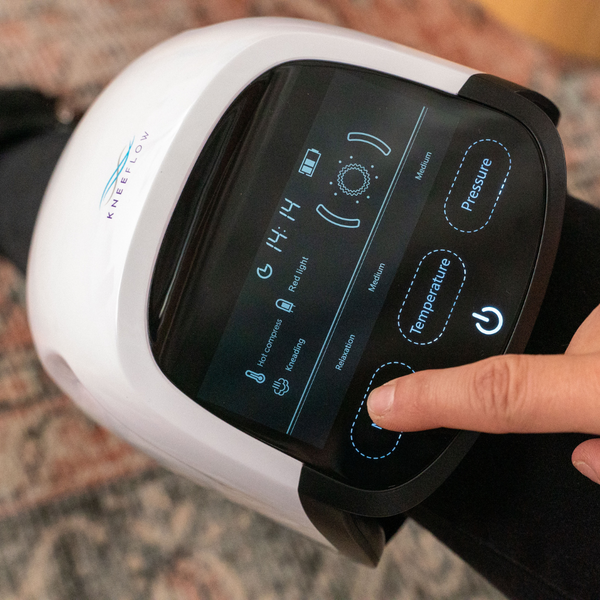
A knee massager is not an end to squat technique and can’t treat the reason squats hurt knees. It doesn’t build strength, improve ankle mobility, repair a meniscus or stabilize an injured ligament. Its role is narrower.
When the knee feels mildly tired, tense or stiff after an appropriate workout, gentle warmth and soft massage may support a calmer recovery routine. Don’t use heat, compression or massage on a newly injured, swollen, hot, red, unstable or severely painful knee. A device shouldn’t numb discomfort so that you can return to a movement that is still aggravating the joint immediately.
At Flow Knee, comfort is something we see as supporting good decisions and not replacing them. Change the training first. Let the knee settle. Then use comfort tools only when they match what the joint needs.
Keep the Squat, Change the Demand
Knee pain from squats does not always mean you need to stop the exercise forever. It could mean the weight, depth, frequency or variation is no longer the right one for the current capacity. Begin with the simplest changes. Limit the painful range. What’s changed with your training? Give the knee time to respond.
Build up the muscles that support the movement and slowly build depth. The goal is not perfect squats. It is a squat that you can control, recover from and repeat and it doesn’t create a bigger problem. When the pain is mild and improving, smart modification can keep you active.
We think progress should make you more confident in movement, not more afraid of it. Your squat should change with your body and Kneeflow can be the best routine after the work is done and the knee is safe for gentle support.
FAQ
Why do I get knee pain from squats?
Knee pain with squats can arise when the training load, depth, frequency or movement demand is too much for the knee to handle. It can also be caused by patellofemoral irritation, tendon sensitivity, limited ankle movement, decreased hip or thigh strength or a previous injury. The location, timing, swelling pattern and recent training changes help determine the appropriate response.
Is squats bad for your knees?
Squats are not bad for healthy knees. They are a normal movement pattern and can help the legs to be stronger if done at an appropriate load and range. Problems can arise if volume increases too fast, the knee is already irritated and movement is forced through pain. A squat should be adapted to the individual and not assumed to be safe or harmful.
Should I stop if squats hurt my knees?
If pain is sharp, getting worse, unstable or changes how you move, stop. A mild, familiar discomfort may be alleviated by reducing weight, range, repetitions or frequency, particularly with professional advice. Stop training and seek evaluation if pain occurs following an injury or when it is swollen, locked, unstable, difficult to bear weight, or if knee motion is compromised.
How can I do squats with knee pain?
Use a lighter load, fewer repetitions and a depth that stays above the painful range. A box squat, supported squat, or light goblet squat may be easier to control. Control one variable at a time and monitor how the knee feels later that day and the next morning. If every variation remains painful, take the knee to have it assessed.
Should my knees go over my toes in a squat?
The knees can naturally move past the toes during squats depending on body height, ankle position, stance, footwear and depth. Holding them back can generate other compensations. The better goal is a controlled movement in which the feet are stable and the knees follow a comfortable route with no sudden twisting, collapsing or sharp pain.
Do tight ankles cause knee pain when performing squats?
If you are limited in ankle movement the body will perform a squat differently. The heels might rise, the torso may lean, or knees and feet may move to get back to the depth. These changes can cause pain in some people, but ankle stiffness is not the only cause. A clinician can help if the ankle feels blocked, painful or so different from one side to the other.
Can you keep training legs if squats hurt your knees?
You can continue training with exercises and ranges that don’t make your knee worse. That could be decreasing the squat depth, changing the variation, reducing the load or using other leg exercises temporarily. Training should not cause worsening swelling, instability, sharp pain or reduced daily function. A physical therapist can help build a more specific progression.
Can a knee massager help after squats?
A knee massager can provide comfort when the knee feels mildly tired, tense or stiff after training. It doesn’t correct squat mechanics, build strength, or treat an injury. Never use heat, massage, or compression over active swelling, redness, unusual warmth, instability, numbness, or sharp pain. If squat-related symptoms keep returning, address the training pattern and underlying cause first.