Knee pain from hiking can turn the last miles of a beautiful trail into a slow calculation of every step. The climb may have been easy, but the descent is painful around the kneecap. A rocky section can give you something sharp as a result of the sharpness on the inside of the joint. When you’re in the car, your knee might feel stiff, heavy, or not as durable as it did at the trailhead.
That’s especially frustrating for hikers and why it’s frustrating for people who are out there as a part of the world for health, freedom, and connection. You might still feel strong enough over the distance, but your knees start to revolt before the rest of your body is tired. The pattern is more obvious for hikers in their 50s, 60s, and older, with old injuries, arthritis changes, or shorter recovery times.
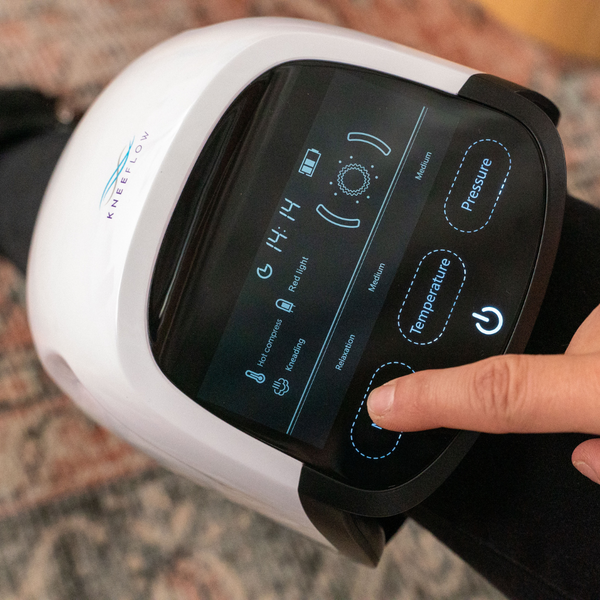
Recovery should help you understand the knee rather than simply quiet it, Flow Knee says. Kneeflow can provide a feeling of comfort and relaxation after a hike if discomfort is mild and the joint is safe for home comfort. It should not be used over large swelling, unusual warmth, redness, painful instability, a recent twist, or a knee unable to bear weight normally.
Why Hiking Can Be Harder on the Knees Than Ordinary Walking
Hiking is more difficult than walking on a flat sidewalk. The surface moves constantly. Rocks, roots, mud, loose gravel, side slopes and uneven steps force the legs to be adjusted with almost every step. The knee does more than bend and straighten. It helps absorb force, control the body during descents, stabilize the leg when the foot lands unevenly and manage the transfer of weight from one step to the next.
A trail also makes demands that accumulate slowly. The first downhill mile may feel easy. After hours, the quadriceps become fatigued, balance is less precise and each step is less controlled. A movement that was comfortable early in the hike can get frustrating if repeated hundreds of times under fatigue.
Walking on uneven terrain can be challenging for people with arthritis and for those with some degree of joint sensitivity, and downhill walking can be more difficult on the knees. That doesn’t make hiking dangerous. And it means trail selection, conditioning, pacing, and recovery matter more than they would for a kid walking around the neighborhood.
Downhill Hiking Is a Common Trigger for Hiker’s Knee
Many hikers feel fine during the climb and only come to notice pain on the way down. That pattern is known as hiker’s knee and is not a diagnosis. During a descent, the quadriceps help control the body as gravity pulls it down. The muscles have to slow each step down and not just bring the body forward.
When they strain, the knee may feel less supported and the pressure around the kneecap may become more apparent. It’s exacerbated by long steps. Walking far downhill with the foot creates a braking motion that puts pressure back through the leg. To do so, and then repeat that process for a full hour or longer, the knee will get irritated even if nothing is hurt.
A shorter stride tends to give the body more control. Slowing the pace down, using switchbacks instead of straight down, and not braking the feet too aggressively (in the heel-first direction) may also make the descent less punishing.
Trekking poles can help some hikers stay more upright and maintain balance, improve balance, and absorb some of the landing impact, especially in a downhill phase of hiking (or even absorb some of the impact of a fall, especially during downhill movement).
Pack Weight Changes Every Step
A backpack might not feel heavy when you first put it on, but the knees are under that load consistently throughout the entire hike. Water, food, clothing, camera equipment, emergency gear, and other things that have to be added in quickly can be added to the load.
On a long descent, it involves having a balance between your body weight and the pack. You don’t have to hike without safety equipment. It is to make decisions. And if you have duplicates, big containers, or things that are no longer in line with the course or weather, pack fit also matters.
A bad backpack might pull your body back and make the hiker lean forward to compensate or tilt them back, causing balance issues and affecting how your legs absorb force. For hikers with knee sensitivity, losing a few pounds now and then for the last descent will really help.
Front Knee Pain May Point to Patellofemoral Irritation
Pain around or behind the kneecap is one of the most prominent patterns of hiking. It may show up in downhills, big step-downs, up and down stairs after a hike or just standing after sitting in the car. It feels dull, achy or pressurized. Some hikers also notice grinding, clicking or a feeling of friction when the knee bends. This may be a sign of patellofemoral irritation, also called anterior knee pain.
It does not necessarily mean that the kneecap is damaged. Fatigue, training load, leg strength, movement control and joint sensitivity can all influence how the area responds. The pain tends to show up more when the knee is deeply bent and a person repeatedly controls the body on descents. Which is why a hiker might be able to climb up but struggle down the hill.
If the pain is mild and settles down with reduced activity, a temporary change in trail difficulty can help. All pain, swelling or symptoms that start affecting normal stairs and walking should be evaluated.
Inner Knee Pain Can Have Several Causes
Pain on the inside of the knee, after hard climbing, side slopes, repeated step-ups or long days in uneven terrain, may be the source. One possible source is irritation around the pes anserine area, on the inner side of the upper shin below the joint. In this area, repeated stair climbing, uphill activity, sudden training increases, tight hamstrings, arthritis and alignment might be sources of pain.
Inner joint-line pain can also be due to the meniscus or other structures. This is particularly relevant if the pain follows a twist on a planted foot or comes with swelling, catching, locking, or difficulty straightening the knee. Do not diagnose the problem based on location only.
Many tissues sit close together and symptoms can overlap. Mild soreness that is less acute after a long hike might be better treated with a lighter training load and recovery. Sharp, persistent pain or mechanically limiting pain needs to be carefully assessed.
Uneven Terrain Can Expose Balance and Strength Gaps
A smooth trail allows the body to repeat a fairly predictable pattern. A technical trail does not. One foot may land higher than the other. The ankle may roll a little to match a sloped rock. The hip must hold the thigh while the knee adjusts to the surface. When strength or balance is starting to decline, the joint will not move as smoothly. This doesn’t mean your form should be perfect.
Hiking naturally involves variation. The issue is how the body can handle it over the course of the route. Hip muscles, quadriceps, calves, and the muscles around the ankle are there to hold the leg up in each step. If they are tired, then the knee is likely to take on more of the load. Step-downs, controlled step-ups, calf raises, balance training, and progressive leg strengthening can assist to prepare the body to tackle the trail.
The right program is based on symptoms, previous injury, and overall ability. Many hikers with chronic knee pain will see a physical therapist who can assess strength, range of motion, balance, walking mechanics, and stair control.
Footwear Can Affect Trekking Knee Pain
Maybe shoes don’t solve every knee problem but worn, unstable or poorly fitting shoes can make a long hike more difficult. You have to be able to match a hiking shoe to the terrain and fit your foot well enough not to slide down the hill. Repeatedly hitting the front of the shoe can cause you to step wrong and increase the pressure in your legs.
Trail traction is critical on loose or wet ground. When hikers don’t trust their grip it’s easy for them to stiffen their legs, slow down the way they walk or brake aggressively. That guarded pattern can lead to more fatigue around the knee. A heavy boot is not always more supportive and a lightweight shoe isn’t always better.
This is a matter of foot shape, ankle situation, pack weight, trail conditions and personal preference. When the tread is worn unevenly, the midsole is compressed, or the shoe no longer provides a stable base, use new shoes on shorter walks before you’ll use it on a tough route.
What to Do When Knee Pain Begins on
Knee Pain from hiking is the worst and also the worst time to ignore it. Pause and think about it. Is that pain mild and steady, or sharp and increasing? Is the knee swollen, unstable, locked, or unable to support your weight? What could it be from? If for mild discomfort, slow your pace and shorten your stride.
Use trekking poles if you have them. Slow down and be deliberate rather than rush down the descent. If you have to bend deeply, don’t do it too many times, or you will feel the pain. At very steep sections, switchbacks or even a slightly angled route may be easier than moving downhill, as long as you stay on the established trail and do not damage the surrounding environment.
How to Recover From Knee Pain After Hiking
Knee pain after hiking often needs a quieter period rather than complete inactivity. Start by reducing the activity that clearly aggravates the joint. That may mean avoiding another steep hike for several days while continuing short, comfortable walks on level ground. Cold can feel helpful when the knee is irritated or swollen. Wrap a cold pack rather than applying it directly to the skin. Elevation may also help when the joint feels puffy after a long day.
Heat may be more appropriate for familiar stiffness or surrounding muscle tension when there is no active swelling, unusual warmth, redness, or recent injury. Gentle movement can keep the knee from becoming more guarded. Easy bending and straightening, short walks, or clinician-approved exercises may be useful if they do not increase symptoms.
A small increase in discomfort after activity may sometimes settle within 24 hours. When pain remains elevated beyond that point, reviewing and reducing the previous activity load is sensible. The goal is to see a gradual improvement in walking, stairs, bending, and confidence. If those areas are getting worse, the problem may need more than ordinary post-hike recovery.
When to Return to the Trail
Do not use a single pain-free morning as proof that the knee is ready for a difficult hike.
First, check how the joint handles everyday demands. Can you walk comfortably on level ground? Can you go up and down stairs without a major increase in pain? Does the knee tolerate a controlled step-down? Is there swelling later in the day?
Begin with a shorter trail that has limited elevation change and a predictable surface. Keep the pack light and leave enough time to move without rushing. If the hike goes well, increase one variable at a time. Add a little distance before adding steep technical terrain. Increase elevation before adding heavy pack weight. This makes it easier to identify which demand the knee is not yet tolerating.
Recovery between hikes matters too. Scheduling several difficult trail days close together may create a larger reaction than any one hike by itself. The aim is not to prove that the knee can survive the trail. It is to build enough capacity that the route feels repeatable.
How to Reduce the Chance of Hiker’s Knee Returning
Once pain settles, think beyond the knee itself. Build leg endurance with progressive walking, hills, stairs, or step exercises before a major trip. Include controlled downhill practice rather than training only on climbs. Strengthen the quadriceps and hips so they can manage repeated braking and uneven surfaces. Work on calf strength and balance to help the lower leg adjust to the trail.
Increase route difficulty gradually. A hiker who is comfortable with five miles on rolling terrain may still need preparation for five miles with a steep, rocky descent. Use trekking poles correctly. Plant them far enough ahead to support balance without reaching excessively. Practice on easier trails before relying on them during a technical route.
Warm up at the beginning of the hike by starting slowly instead of attacking the first climb. Gradual preparation before exercise can help muscles and joints adapt to the activity. Most importantly, pay attention to patterns. If every descent produces pain in the same location, the answer is not simply to recover and repeat the same route. Adjust training and consider professional guidance.
Where Kneeflow May Fit After a Hike
Kneeflow cannot correct hiking mechanics, strengthen the quadriceps, reduce pack weight, or diagnose why the knee hurts. It should not be treated as a cure for hiker’s knees or a substitute for physical therapy.
Its role is comfort.
When knee pain after hiking has settled into mild, familiar stiffness or surrounding tension, Kneeflow may support a quieter recovery routine with controlled warmth, red light support, and soft airbag massage. It should not be used directly over active swelling, unusual heat, redness, a new injury, open skin, numbness, instability, or severe pain. When the knee feels inflamed, cold or professional guidance may be more appropriate than warmth and compression.
A short comfort session can fit after an easy recovery walk, during a rest evening, or once the knee has calmed after the trail. The goal is not to erase pain so you can hike again immediately. It is to help the area feel more relaxed while you make sensible decisions about recovery.
At Kneeflow, we believe outdoor movement should remain something you look forward to. Address the trail demands first, then let Kneeflow support the calmer moments between adventures.
Keep Hiking by Matching the Trail to Your Knees
Knee pain from hiking does not always mean your hiking years are behind you. It may mean the current distance, descent, terrain, pack weight, or pace no longer matches what the knee is prepared to manage.
Start with the pattern. Does pain appear only downhill? Does it begin after a certain distance? Is it worse with a heavy pack or technical terrain? Does it settle within a day, or does it interfere with stairs and walking throughout the week?
Then change the demand. Choose a shorter route. Reduce elevation. Use trekking poles. Lighten the backpack. Strengthen the muscles that control descents and give the knee enough recovery time between difficult outings.
A trail does not become less meaningful because you adjust the route. The real goal is to keep returning to the outdoors with enough confidence and capacity to enjoy the experience.
When the knee is calm and safe for warmth and soft massage, Kneeflow can help turn post-hike care into a routine you will actually use. Let the trail challenge you, but let your recovery prepare you to come back.
FAQ
What causes knee pain from hiking?
Knee pain from hiking can result from long descents, uneven terrain, rapid mileage increases, muscle fatigue, a heavy pack, limited conditioning, arthritis, tendon irritation, or an existing knee injury. Pain location and timing matter. Front knee pain during descents may have a different cause from sharp joint-line pain after a twist. Persistent, swollen, or unstable symptoms should be evaluated.
Why do my knees hurt more when hiking downhill?
Downhill hiking requires the quadriceps to slow and control the body against gravity. As those muscles fatigue, pressure and discomfort around the knee may become more noticeable. Long braking steps can add to the demand. Shorter steps, a slower pace, trekking poles, and better downhill conditioning may help, but recurring or severe pain deserves professional assessment.
How long should knee pain after hiking last?
Mild soreness may improve over the next day or two with reduced activity and appropriate home care. The overall trend should be toward easier walking and less irritation. Pain that remains elevated, keeps returning after similar hikes, or affects stairs and ordinary movement suggests that the route exceeded current capacity or that an underlying knee issue may need evaluation.
Can trekking poles help hiker’s knee?
Trekking poles may improve balance and help absorb some landing impact, particularly during descents. They can also give hikers more points of contact on uneven terrain. Poles do not remove all knee load or treat an injury, so technique, pace, trail difficulty, strength, and pack weight still matter. Practice using them before relying on them during a demanding route.
Should I use heat or cold for trekking knee pain?
Cold may feel better when the knee is newly irritated, swollen, or warm after a hike. Heat may be more appropriate later for familiar stiffness or muscle tension when the joint is not swollen, red, hot, or recently injured. Protect the skin during either method. When symptoms are severe or unclear, medical guidance is safer than choosing based only on comfort.
Can I keep hiking with knee pain?
You may be able to continue on easier, shorter trails if pain is mild, stable, and does not alter your walking. Reduce distance, descent, technical terrain, and pack weight while monitoring the response. Do not push through sharp pain, swelling, instability, locking, or difficulty bearing weight. Those symptoms need assessment before another demanding hike.
Can a knee massager help after hiking?
A knee massager may support relaxation when the knee feels mildly stiff, tired, or tense after activity. It does not correct trail mechanics, build strength, or treat an injury. Avoid heat, compression, or massage over active swelling, unusual warmth, redness, numbness, instability, or severe pain. The training load and cause of recurring symptoms should be addressed first.
When should I see a doctor for knee pain after hiking?
Seek care when pain follows a fall, twist, impact, or sudden pop, especially if the knee swells quickly or cannot support weight. Medical guidance is also appropriate for locking, repeated instability, redness, fever, numbness, calf swelling, worsening pain, or symptoms that keep returning and interfere with normal walking, sleep, or daily activity.