Do knee massagers work for arthritis? Yes, for many people with arthritis heat, infrared and massage with gentle compression can relieve pain and stiffness in the knee on a daily basis. But a knee massager will not reverse the joint changes behind arthritis itself, and any page promising otherwise is stretching the truth further than the evidence goes.
I dive into why arthritis affects the knee so much, review the actual science behind heat and light therapy for arthritis, how a combo device like Kneeflow can fit into your daily routine, and when your arthritis pain just requires more than a massager can provide. If you read through “Do knee massagers work for arthritis” expecting a simple yes or no, the honest answer sits somewhere more useful than either.
We hear from a lot of people managing arthritis who've tried ice packs, pain gels, and the occasional heating pad before landing on the Kneeflow Massager, usually looking for something that reaches the ache sitting deeper in the joint.
None of this replaces a rheumatologist or an orthopedic doctor. Arthritis management works best as a real plan, and a massager is one piece of that plan, not the whole thing.
Why Arthritis Hits the Knees So Hard
Arthritis isn't simply age catching up with you. It's cartilage thinning, inflammation flaring, and a joint that no longer moves the way it used to. Two forms account for most of what shows up in the knee specifically.
Osteoarthritis wears down the cartilage that cushions the joint over years, gradually enough that people often chalk up the early aches to just being tired. Rheumatoid arthritis works differently. The immune system attacks the joint lining itself, which tends to bring more swelling and warmth, sometimes in both knees at once rather than one side wearing out faster than the other. Do knee massagers work for arthritis of both kinds equally? Not quite, which is worth knowing before assuming one routine fits every diagnosis.
Sharp pain while moving your joints, morning stiffness, creaking or grinding sounds while moving and red or swollen joints are most typical symptoms of arthritis as reported by sufferers. Do knee massagers work for arthritis symptoms like these specifically? In general, yes, though the two forms don't necessarily respond to comfort tools in exactly the same way, and it's worth knowing which one you're dealing with before building a routine around it.
Do Knee Massagers Work for Arthritis? What the Mechanisms Actually Do
Heat widens blood vessels near the skin and pulls more circulation into the joint, which loosens tight muscle around a stiff knee and can make movement feel easier within minutes. A Cochrane review of thermotherapy for knee osteoarthritis found real benefit for pain and range of motion from heat and cold packs, though the reviewers were candid that the underlying trials were small, calling it the best evidence currently available rather than proof of a dramatic effect.
Low intensity infrared light penetrates deeper into tissue than heat from the surface. Such low intensity light can be beneficial for relieving pain from knee osteoarthritis. Research into such low intensity light therapy for knee osteoarthritis,including a 2019 systematic review and meta-analysis in BMJ Open, has found modest but real improvements in pain and function at certain doses. That's genuinely useful information, and it's also a long way from proof that infrared reduces inflammation at a cellular level in the way some product pages casually claim.
Gentle compression adds a third layer, encouraging fluid movement around the joint and giving a sense of support that a lot of people describe as steadying rather than just warm. Together, these three inputs work on comfort, circulation, and muscle tension. None of them rebuild cartilage or halt whatever's driving a specific case of arthritis forward, and being clear about that distinction is really the whole answer to do knee massagers work for arthritis at a mechanism level rather than a marketing level.
The Real Benefits, and Their Real Limits
Do knee massagers work for arthritis in ways that actually matter day to day, or just in theory? Here's where the real benefit shows up, and where it stops.
Circulation and Stiffness
Arthritic joints tend to become stiff as blood flow is reduced and apply heat with infrared light to return the circulation and allow the joint to return to full mobility within a few minutes of treatment. This effect is short-term rather than cumulative in any structural sense, though the day-to-day comfort adds up with consistent use.
Muscle Tension Around the Joint
The increased muscle tension around an arthritic knee from pain causes additional discomfort. The increased warmth and gentle compression of the surrounding soft tissues causes the increased muscle, which tends to make the knee feel less locked up rather than resolving the underlying joint change.
People who've dealt with both the joint pain and the muscle bracing around it often notice this specific effect first, before anything else.
Getting Up and Moving Easier
The stiff, guarded first few steps after sitting for a while, getting out of a chair, standing up from the couch, tend to ease when the joint has been warmed and loosened beforehand.
This is comfort and preparation, not a fix for whatever's structurally happening inside the cartilage, and it's usually the specific benefit people mean when they say do knee massagers work for arthritis in their own words rather than a doctor's.
Fewer Reasons to Reach for Medication
Plenty of people managing arthritis want to rely less on pain medication day to day, and heat, light, and compression offer a non-drug way to take the edge off.
That's a legitimate benefit on its own, though it's worth being clear that comfort support and disease management are two different things, and one doesn't replace the other.
What Sets a Combination Device Apart
A device that only vibrates or only heats up tends to fall short for arthritis specifically, since stiffness usually has more than one contributing factor at once. This is where do knee massagers work for arthritis really gets decided, in whether the device covers more than one mechanism at once.
By incorporating adjustable heat, infrared light and gentle air compression into a single device, the problems of circulation, of muscle tension, and of joint support are all addressed in a single session, rather than through the use of three separate devices. Therefore, the question of whether do knee massagers work better for arthritis as a bundled device than as three separate purchases, and for most people juggling a stiffness routine, the answer leans toward yes simply because one habit is easier to keep up than three.
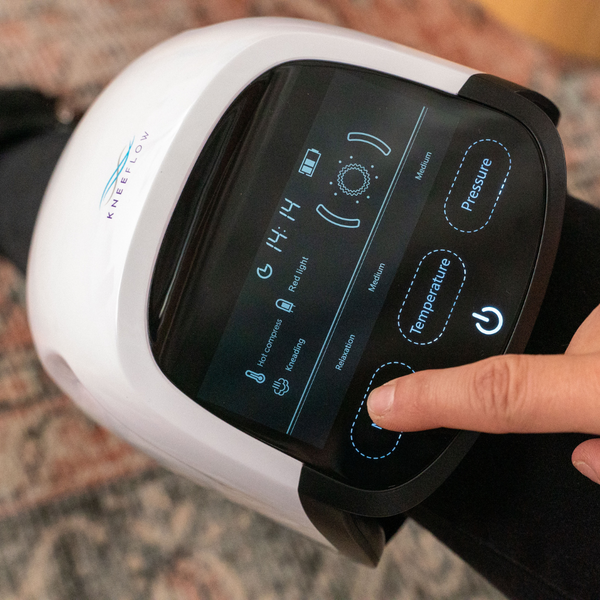
We built the Kneeflow Massager around that combination, with a wrap that covers the sides of the knee rather than just the front, adjustable heat and compression settings, and a portable, cordless design that runs an automatic session rather than needing to be timed by hand.
None of this makes any single device a cure or a guaranteed fix. Do knee massagers work for arthritis better as a combination unit than as separate tools? Generally yes, and what separates a genuinely useful combination device from a basic one is whether it actually gets used consistently. A device that's comfortable, portable, and easy to fit into an evening routine tends to win on that front over one with a longer feature list that ends up in a drawer.
Is It Safe to Use for Arthritis?
Generally, yes, for most people managing ordinary arthritis symptoms, since heat, light, and compression are non-invasive and the intensity stays entirely in your control. Answering do knee massagers work for arthritis honestly also means being upfront about who should pause and check first. Kneeflow's automatic shutoff after a set session length is a reasonable safeguard against overuse, though it doesn't replace paying attention to how the knee actually responds.
A few situations call for checking with a doctor before starting. Severe or sudden swelling, open wounds or broken skin near the knee, a recent fracture, or notably fragile skin, more common in older adults or with certain medications, are all reasons to get clearance first rather than assuming a device is automatically fine.
Anyone with a circulation disorder, diabetes affecting sensation in the legs, or an active rheumatoid arthritis flare with significant warmth and swelling should also check in before adding heat to their routine, since those situations sometimes call for a different approach than a straightforward osteoarthritis case.
None of this is meant to sound alarming for the average person managing everyday stiffness. It's simply the honest boundary behind do knee massagers work for arthritis safely, and that boundary is worth knowing before the first session rather than after.
How Often and How Long to Use It
Most people managing arthritis find a rhythm of once or twice a day works well, leaning toward two sessions on flare days and easing back to something closer to every other day once things settle into a maintenance rhythm. Sessions in the ten to fifteen minute range are typical, long enough to genuinely warm and loosen the joint without tipping into overuse territory.
Consistency matters more than any single session's intensity. A short, moderate session most days tends to outperform an occasional long one, largely because arthritis-related stiffness responds to a steady routine rather than sporadic effort. Do knee massagers work for arthritis better with that kind of rhythm than with occasional use? The pattern in how people describe their results says yes.
Common Mistakes People Make
Cranking the heat to its highest setting on the assumption that more intensity means more relief is probably the most common misstep, and it's a habit that quietly answers do knee massagers work for arthritis with a no for a lot of people who never gave a moderate setting a real chance. A comfortable, moderate setting held for the full session generally does more for circulation than a brief blast that gets cut short because it's too hot to sit through.
Using a device only during flare-ups, then dropping it entirely once things feel better, is another frequent pattern. Arthritis-related stiffness tends to respond to steady use over weeks, so treating a massager like an emergency tool rather than a daily habit tends to produce less consistent results.
Skipping movement and relying on heat or compression alone rounds out the list. Gentle activity, stretching, and whatever exercise a doctor or physical therapist has recommended still do the heavy lifting for joint health long term.
A massager supports that work. It doesn't substitute for it. Forgetting that distinction is exactly where people end up disappointed, expecting a full answer to do knee massagers work for arthritis from a device that was only ever meant to carry part of the routine.
When Arthritis Knee Pain Needs More Than a Massager
Sudden, severe swelling, a knee that's hot to the touch and visibly red, or fever alongside joint pain point toward something beyond ordinary arthritis and need prompt medical attention rather than a heat session at home. The same goes for a knee that locks, gives way, or won't bear weight at all.
Pain that keeps getting worse instead of settling into a manageable pattern, or a rheumatoid arthritis flare that isn't responding to your usual management plan, are both reasons to check in with whoever manages your care rather than increasing how often you use a comfort device.
Do knee massagers work for arthritis flares like that on their own? No, and that's the honest edge of what they actually cover. A massager working alongside a treatment plan is the goal. A massager standing in for one isn't.
Do knee massagers work for arthritis? The Bottom Line
Do knee massagers work for arthritis? For everyday stiffness, muscle tension, and the ache that builds up from a joint that isn't moving the way it used to, heat, infrared light, and gentle compression genuinely help, backed by real if still modest research. What they can't do is reverse cartilage loss or replace whatever a doctor has actually recommended for managing the condition itself.
If you're weighing whether the Kneeflow Massager fits your arthritis routine, feel free to contact our team with questions about settings, sessions, or what's realistic to expect.
FAQ
Are Knee Massagers Any Good for Arthritis?
For a lot of people, yes. Knee massagers combining heat, light, and gentle compression can genuinely ease stiffness and the deep ache arthritis brings, mainly by improving circulation and relaxing the muscle tissue around the joint. They won't cure arthritis or reverse cartilage changes, but many people find the day-to-day discomfort noticeably more manageable with consistent use. The relief tends to build gradually with regular sessions rather than showing up dramatically after one try.
What Are the Real Benefits of a Knee Massager?
The most consistently reported benefits are easier movement after a session, reduced muscle tension around the joint, and a non-drug way to take the edge off arthritis discomfort. A combination device supporting both the muscles and the joint tends to leave the knee feeling less restricted than heat or compression used alone. It's worth keeping expectations grounded, though, since these are comfort and circulation benefits rather than a change to the underlying arthritis itself.
Does Heat Therapy Actually Help Arthritis Pain?
Yes, heat relaxes the muscles around the knee and increases blood flow to a stiff joint, and a Cochrane review of thermotherapy for knee osteoarthritis found real, if modest, benefit for pain and range of motion. A warmed joint tends to bend and move more comfortably than a cold, stiff one, which is part of why heat shows up so often as a first recommendation for arthritis discomfort. The effect is generally short-term per session rather than a lasting structural change, so it works best as a regular habit rather than an occasional fix.
Is Infrared Light Safe and Effective for Knee Arthritis?
Infrared light is generally considered safe and is used in some clinical settings, and research including a 2019 systematic review in BMJ Open found modest improvements in pain and function from low-level light therapy for knee osteoarthritis. It reaches somewhat deeper than surface heat alone, though the evidence doesn't support claims that it reduces inflammation dramatically or resolves the underlying joint condition. Most people who notice a difference describe gradual improvement with consistent use rather than an immediate transformation.
Can Knee Massagers Replace Physical Therapy?
No, and it's worth being direct about that. Physical therapy builds strength, corrects movement patterns, and addresses the specific mechanics behind joint pain, none of which a massager can do on its own. A knee massager works well as a comfort tool alongside physical therapy or an exercise plan, easing stiffness before or after sessions, but it isn't a substitute for the guided strengthening work that actually protects a joint over the long term.
How Often Should I Use a Knee Massager for Arthritis?
Most people find once or twice a day works well, with two sessions common on flare days and roughly every other day once symptoms settle into a maintenance pattern. Sessions of ten to fifteen minutes are typical. Consistency matters more than intensity, since arthritis-related stiffness tends to respond to a steady routine rather than occasional, more intense sessions.
Can Older Adults Safely Use a Knee Massager?
Generally, yes, with a bit of extra caution around settings. Older adults are more likely to have thinner, more sensitive skin, so starting on a lower heat setting and paying attention to how the skin responds matters more than it might for a younger user. Anyone managing diabetes, a circulation condition, or taking medication that affects skin sensitivity should check with a doctor before starting a regular routine, regardless of age.
Do Knee Massagers Help With Related Issues Like Tendonitis?
They can support comfort around tendon and soft tissue irritation near the knee, since heat and gentle compression ease surrounding muscle tension and support circulation the same way they do for arthritis. They don't repair a tendon or resolve a structural tear, and using one instead of getting a persistent issue properly diagnosed risks missing something that actually needs treatment. As a comfort layer alongside appropriate care, though, plenty of people find it genuinely helpful during recovery.
How Do I Know if a Knee Massager Is Actually Safe for My Situation?
For most people managing ordinary osteoarthritis symptoms, a combination heat, light, and compression device is considered low risk. Checking with a doctor first makes sense if you have severe or sudden swelling, open skin, a recent fracture, a circulation disorder, or an active rheumatoid arthritis flare with significant warmth, since those situations sometimes need a different approach before heat is appropriate. When in doubt, a quick conversation with whoever manages your arthritis care is a reasonable step before starting a new routine.