Knee muscle strain recovery time is not the same for everyone. It depends on how much the muscle has been affected, how the injury happened, and how the knee responds during healing. A mild strain may start feeling better within a few days and improve significantly over one or two weeks, while a more serious tear can take several months to recover and may require more advanced treatment.
A knee muscle strain is caused by overstretching of the muscles and/or supporting structures around the knee joint. This can happen suddenly during sports or other physical activities or during lifting, repetitive activities, and even during normal activities such as bending, straightening, climbing up and down stairs and standing up from sitting. It also explores where comfort support may fit once the initial irritation has settled and the knee is ready for a gradual return to normal movement.
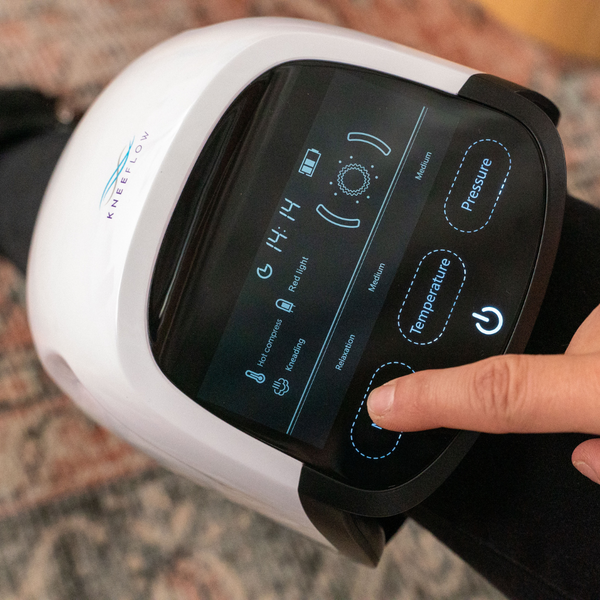
A fair number of people asking us about the Kneeflow Massager are somewhere in the middle of this exact recovery, past the first rough week, still not quite back to normal, wondering what comes next and whether adding heat to the routine makes sense yet. None of this replaces a doctor's evaluation. Getting the grade right, and ruling out something more serious like a tendon tearing off the bone, isn't something to guess at from home.
What Counts as a Knee Muscle Strain
A strain is damage to a muscle or the tendon connecting it to bone, different from a sprain, which involves a ligament instead. Around the knee, the muscles most commonly strained are the quadriceps at the front of the thigh, the hamstrings at the back, and the calf muscle just below the joint, all of which cross the knee and take real load during running, jumping, or a sudden change of direction. Athletes in sprinting-heavy sports, soccer, track, basketball, show up disproportionately in strain statistics for exactly this reason.
Muscle overload causes most strains: the muscle gets stretched past what it can handle, often while it's already contracting, which is exactly the kind of load a sprinting stride or a hard deceleration puts on it. A sudden pop, a sharp pain during the activity, and swelling or bruising that shows up over the following day or two are the usual signs. Some people describe feeling a distinct tearing sensation at the moment of injury, while others notice the pain building over the following hours instead.
Getting strain and sprain sorted out matters for knee muscle strain recovery time specifically, since the two injuries follow different healing paths and, in some cases, need entirely different treatment.
Recovery Time by Grade
Doctors grade muscle strains on a three-point scale, and that grade is really the whole story behind knee muscle strain recovery time.
A grade 1 strain involves overstretched fibers without a real tear, mild tenderness, and only a small loss of strength or motion. According to Harvard Health Publishing, almost all grade 1 strains heal within a few weeks. Most people are back to normal activity within one to three weeks, sometimes sooner with a light case.
A grade 2 strain tears through some of the muscle fibers, bringing more pain, noticeable swelling, and a real drop in strength and range of motion. Harvard Health notes this grade can take two to three months or longer, a much wider window than a grade 1 injury, largely because partial tears need time to actually knit back together rather than just calm down.
A grade 3 strain is a complete tear straight through the muscle or tendon. OrthoInfo from the American Academy of Orthopaedic Surgeons describes this as a severe tear that may take months to heal, and some complete tears, especially where a tendon pulls away from the bone entirely, need surgical repair.
After surgery, regaining normal muscle function typically takes several months of dedicated rehabilitation, easily the longest end of knee muscle strain recovery time across all three grades. This is the grade where recovery stops being measured in weeks at all and starts being measured in a season, sometimes longer for a competitive athlete.
What Affects How Long Recovery Actually Takes
Grade sets the baseline, but several other factors shift knee muscle strain recovery time in either direction for a specific person. Age plays a role, since tissue heals somewhat slower later in life, and a previous strain in the same muscle raises the odds of a slower, more cautious recovery the second time around.
Overall fitness and how well-conditioned the muscle was before the injury matter too, since a stronger, more resilient muscle generally tolerates the rehab process better than one that was already deconditioned, and that baseline fitness quietly shapes knee muscle strain recovery time before the injury even happens.
How closely someone follows the RICE protocol and their rehab plan in the first couple of weeks matters more than almost anything else. Rushing back to full activity before the muscle's actually ready is the single most common reason a strain that should have healed in a few weeks drags on for months instead, often because a partially healed strain gets re-injured and the clock effectively resets.
Location within the muscle counts as well. A strain near the muscle-tendon junction, where blood supply is thinner, tends to heal slower than one in the fleshier middle of the muscle where circulation is richer, another quiet variable in knee muscle strain recovery time that has nothing to do with how hard someone works at rehab.
The RICE Phase: The First 48 to 72 Hours
Rest, ice, compression, and elevation form the standard first response to a fresh strain, and getting this part right sets up everything that follows for knee muscle strain recovery time down the line, before anything else about grade or age or rehab quality even enters the picture. Resting means backing off from the activity that caused the strain, not necessarily complete immobility, while ice applied for around 20 minutes at a time, several times a day, keeps swelling from spiraling in those first couple of days.
A compression wrap, snug but not so tight it cuts off circulation, helps control swelling further, and elevating the leg above heart level when resting adds one more piece to the same goal. This phase isn't where the muscle actually repairs itself. It's where the initial inflammatory response gets managed so healing can proceed without excess swelling getting in the way.
Heat doesn't belong in this early window. It increases blood flow to an area that's already inflamed, which can worsen swelling rather than calm it down, and reaching for it too soon is one of the more common ways people accidentally extend their own recovery.
When Heat and Gentle Movement Enter the Picture
Once the acute swelling has settled, typically somewhere past the first few days for a mild strain or a bit longer for anything more serious, heat and gentle movement start to earn a place in the routine. Heat at this stage relaxes tight muscle tissue around the healing strain and can make gentle stretching or light activity more comfortable to actually do, which matters since avoiding movement entirely for too long has its own downsides for a healing muscle.
Gentle range-of-motion work and light strengthening, introduced gradually and often guided by a physical therapist for anything beyond a mild grade 1 strain, help rebuild the strength and flexibility lost during the injury. Pushing this stage too early, before swelling has actually settled, risks the same kind of setback described above, essentially restarting the clock on knee muscle strain recovery time from wherever the reinjury happened.
This is generally the point in someone's recovery where a heat and gentle compression routine, layered on top of actual rehab exercises rather than instead of them, starts to make sense, and there is when our KneeFlow Massager appears, giving the tools for creating an excellent physical therapy that can work in pair with the specialist checking.
Common Mistakes That Slow Recovery Down
Returning to full activity based on how the leg feels rather than how much time and rehab has actually passed tops the list. A strain can feel deceptively fine at rest well before the tissue has the strength to handle a hard sprint or a sudden pivot again, and this single habit probably extends more people's knee muscle strain recovery time than anything else on this list.
Skipping the strengthening phase entirely, resting until pain fades and then jumping straight back into normal activity, is a close second. That approach frequently leaves the muscle weaker than it was before the injury, which raises the odds of straining the same spot again within weeks.
Applying heat too early, during the still-swollen acute phase, rounds out the list. It feels good in the moment and can quietly sabotage the healing that needs to happen first, tacking real weeks onto an otherwise straightforward knee muscle strain recovery time.
Building Confidence Back Into the Knee After a Strain
Once a doctor or physical therapist has confirmed a strain is healing on schedule, a heat and gentle compression routine can support the later stages of knee muscle strain recovery time, easing tightness before stretching or rehab exercises and calming things down afterward. Plenty of people find this kind of routine makes the unglamorous, repetitive part of rehab, the daily stretches and strengthening sets, easier to actually stick with.
We built the Kneeflow Massager with adjustable heat and gentle air compression specifically for this kind of supporting role, letting someone dial in a comfortable session rather than being stuck with one fixed setting during a recovery that already demands enough patience on its own.
If you're past the acute phase of a knee muscle strain and wondering whether heat and gentle compression fit into your recovery, it’s time to text our team with questions, or take a look at the Kneeflow Massager once you've got the go-ahead to add it in.
FAQ
How Long Does a Knee Muscle Strain Take to Heal?
A muscle strain in the knee takes various amounts of time to heal, depending on the extent of the damage. Initially a large amount of damage is caused by an overstretching of the tissue, however most of this will have healed within a short period of time. A Grade 1 strain is the mildest type and often improves within one to three weeks. A Grade 2 strain involves a partial tear, meaning the muscle needs more time to regain strength and function. A Grade 3 strain is the most serious form because the muscle or tendon has completely torn and may require surgery followed by a longer rehabilitation process.
What Is the Difference Between a Strain and a Sprain?
There’s often confusion between a strain and a sprain as they can feel similar. Both are caused by injury, but they affect different parts. Strains are caused by muscle or tendon being stretched or torn and sprains are caused by ligament being stretched or torn. Ligaments are small tissues that connect the bones together and support the joint. Around the knee, strains often involve the quadriceps, hamstrings, or calf muscles. Sprains are more commonly associated with knee ligaments such as the ACL or MCL. Both injuries can cause pain, swelling, and limited movement, which is why identifying the affected structure matters for recovery.
Can I Walk With a Strained Knee Muscle?
Gentle walking may be possible with a mild knee muscle strain, as the muscle strain starts to settle and begin to return to full activity. This will help to prevent stiffness and allow for a gradual return to full activity. Paying attention to how the knee moves with walking will help to determine whether the injured part is returning to full activity. If walking changes your movement pattern, increases pain, or causes more discomfort afterward, the injury may need more time to recover. Moderate or severe strains can make walking much harder and may require reduced activity while the tissue heals.
When Can I Come Back to Sports after a Knee Muscle Strain?
Return to activity should be based on the functional performance of the knee and not solely on the reduction of pain. The surrounding muscles need to regain strength, flexibility, coordination and function to manage activities that require high levels of function and participation in demanding sporting activities. Mild strains may allow a return within a few weeks when mobility and strength are restored. More serious injuries usually require a slower progression, especially in sports involving sprinting, jumping, quick stops, or changes in direction.
Warm or Cold for a Knee Muscle Strain?
Choosing between heat and ice depends on the stage of recovery and how the knee feels. After a recent injury, especially when swelling, tenderness, or irritation are present, cold therapy is commonly used to help calm the area. Heat is generally more suitable later, when stiffness and muscle tightness become the main concerns. Warmth may help surrounding tissues relax and make gentle movement feel easier. A newly swollen knee and a stiff knee during recovery require different approaches.
How to know if a Strain Is Grade 1, Grade 2, or Grade 3?
The grade of a knee muscle strain indicates the amount of damage to the muscle. For example, a Grade 1 knee muscle strain is a slight over-stretching of the muscle fibers with minimal loss of strength. The knee may feel sore and sensitive to touch. A Grade 2 knee muscle strain is a partial tear of some of the muscle fibers. This type of injury can often cause more noticeable pain, weakness, or swelling. A Grade 3 strain involves a complete tear and represents the most severe type of injury. Since symptoms can overlap, especially early on, a professional evaluation may be needed to determine the severity.
Do All Knee Muscle Strains Need Physical Therapy?
Not all knee muscle strains need formal physical therapy. Many mild strains will resolve with adequate rest, gentle movements, and a gradual return to activities. However, if the strain impacts a person’s strength, mobility, confidence or ability to return to activities for work, life or exercise, this therapy can be the best option, a trained professional can guide the recovery process, helping rebuild function safely instead of relying only on waiting for symptoms to fade.
A Knee Massager is Enough for Muscle Strain Recovery?
A knee massager could be used in the latter stages of your recovery from a knee injury. Once the initial cause of your pain has subsided and your knee is able to return to some gentle activities, a knee massager could provide you with some comfort. The warm massage could help to relax the surrounding muscles, which could become tight after periods of reduced movement. However, using heat or massage too early, particularly when the knee is swollen, hot, or recently injured, may not be appropriate. Comfort tools are most useful when they complement a recovery plan rather than replace proper care.