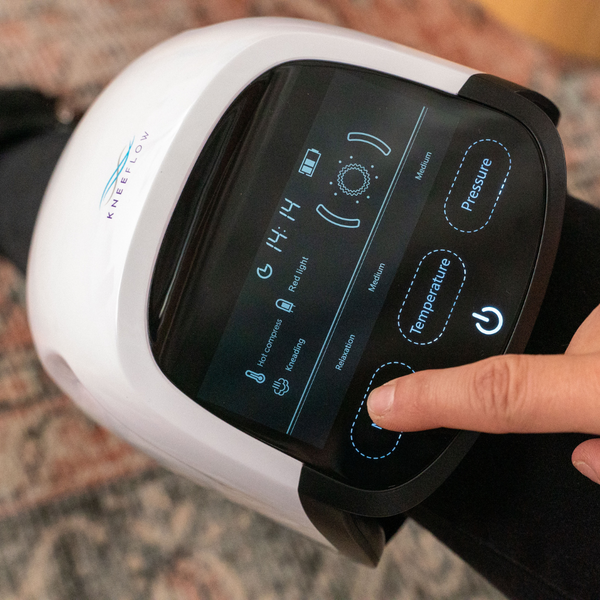
The process of learning how to use a knee massager post workout starts with this simple point: “Tiredness after exercise is not the same as a swollen, injured, or unstable knee.” After a regular training session, the area around the joint might be tense, slightly stiff, or just fatigued. In that case, warm and soft massage can aid in a more stable recovery process. But if the knee is hot, swollen, painful, and hard to deal with, a massager is not the first thing to do.
The same care is needed before exercise. A brief session can make a familiar, non-swollen knee feel less guarded, but it does not replace an active warm-up. The body needs gradual movement, a wider range of motion, and exercise-specific preparation before it can handle weight, speed, impact, or repeated bending.
Kneeflow can provide comfort, warmth, and soft airbag massage in a wraparound design of controlled warmth, red light support, and airbag massage. It does not prevent every exercise injury, accelerate tissue healing on command, remove lactic acid, repair cartilage, or replace strength work, physical therapy, sleep, hydration, and recovery.
What Exercise Actually Asks of the Knee
The knee transfers force from the hip to thigh to lower leg and foot. When squats, lunges, running, cycling, jumping, hiking and strength training are done, it bends, straightens, stabilizes and absorbs load. That work is not necessarily bad. Exercise can strengthen muscles that support the joint and improve overall physical function. The difficulty comes when training demand grows faster than your body can handle it.
A workout may be more demanding if you have: more resistance, more sets or repetitions, deeper knee bending, faster movement, new exercises, running or jumping harder, less recovery between sessions and a sudden return to work after time away.
The knee may feel completely normal during the initial stage of training and begin to feel tired as the quadriceps, hips and calves are worn out. It might feel fine during the workout but then be still achy a couple hours later.
That delayed response is useful information. It may have been that the session created more demand than the knee is able to handle. A massager can make the area feel more comfortable, but it does not change whether the workout dose was correct.
How to Use a Knee Massager Post Workout Safely
There’s no better moment at how to use a knee massager than post workout, the workout is done and breathing and body temperature have settled down, and the knee doesn’t hurt but feels slightly tired or stiff. Before the device wraps around the knee, take a minute to check how you’re feeling and check for swelling, redness, unusual heat, bruising, skin irritation and what’s happening to the knee.
If the knee feels stable and the discomfort is not too bad, begin with the gentlest settings. The wrap should feel secure without a tight squeeze and warming should be mild and not strong. A practical routine would be like this: Finish the workout and take a gentle cooldown, walk slowly for a few minutes rather than stop abruptly, hydrate and let the knee settle, check for swelling, sharp pain, unusual heat or instability, apply the massager according to the device instructions.
The device should leave the area feeling calmer. If you need to use stronger heat, longer sessions, or greater compression repeatedly to deal with worsening symptoms, the training plan or the knee problem is something to be considered.
A Knee Massager Should Not Replace the Cooldown
A cooldown allows exercise intensity to decrease slowly. Depending on the workout, that may be easy walking, light cycling, relaxing breathing, or gentle movement across a comfortable range. A knee massager is passive. It may give warmth and sensory comfort, but it does not provide movement. It cannot sustain cardiovascular activity, regain exercise tolerance, or develop strength around the joint.
That matters because it can get tempting to just finish a hard workout and sit down, and use a device as the whole recovery plan. The knee responds better when comfort support takes place after a few minutes of calm movement.
The sequence of events is not complicated. Finish the exercise, slow things down a little, adjust the knee gently, and then use the massager if the joint is still safe for heat and soft pressure. Comfort after the workout is best as one layer of recovery, not a substitute for everything else.
How Heat May Fit Into Post-Workout Knee Recovery
Controlled heat might feel soothing when the knee and surrounding muscles feel stiff, tense or guarded after normal exercise. A quiet recovery period is much more comfortable if there is no swelling or recent injury. Heat is not always needed immediately after training. If the knee is puffy, feels unusually warm or irritated after impact or twisting, more warmth may not be appropriate for the joint.
Cold is often used for active pain and swelling after an injury or flare. AAOS recommends cold packs for some painful knee conditions and advises protecting the skin rather than applying ice directly.
The decision should be symptom-based. Familiar stiffness without swelling may respond comfortably to warmth, a hot, red, swollen or recently injured knee may need cold and evaluation, general muscle fatigue may benefit from gentle movement and rest and sharp joint pain should not be managed by increasing heat. Don’t think heat is more effective simply because it feels stronger. The lowest comfortable setting is usually a better starting point.
What Soft Airbag Massage May Support
Another way to know how to use a knee massager post workout is through soft airbag massages. This gives the knee a sensation of changing pressure. Some prefer this to vibration because it feels more like a gentle hold than a buzzing sensation. Massage does help to relax and to get short-term comfort, but the evidence varies by condition and type of massage.
NCCIH describes massage as manipulation of soft tissues and says that there are low safety risks for many people, but vigorous massage has been associated with rare serious complications in higher-risk situations. That is why intensity matters. Pressure is not necessarily so much better after exercise.
The airbags should not cause numbness, tingling, throbbing, skin color changes, increased swelling below the wrap and sharp or deep joint pain. A gentle massage on a slightly tired knee might feel nice. Pressure over active swelling, bruising, fresh strain, or a newly injured joint can be inappropriate. AAOS warns against massaging a newly bruised muscle during the acute phase. Comfort support must be gentle enough to allow you to see what the knee is communicating.
How Red Light Support Fits Into the Routine
Red light support is often included in knee devices alongside heat and massage. It is commonly associated with photobiomodulation, but a home knee wrap should not be treated as proof of improved athletic performance, faster tissue repair, or reduced recovery time.
Device features vary. Wavelength, output, distance from the skin, session duration, coverage, and heat production may differ between products. That makes it inappropriate to transfer results from one clinical protocol to every consumer device.
In a workout routine, red light should be viewed as a comfort-oriented feature. Some users may appreciate having it as part of a short, repeatable session. Others may notice warmth or air compression more clearly.
It should not be used to justify returning to exercise while the knee remains painful or unstable. Feeling more comfortable for a short period does not confirm that the joint is ready for more load.
The most useful measure is not how bright the device appears. It is whether the knee continues to function normally, tolerates appropriate movement, and feels no worse after use.
Can You Use Kneeflow Before a Workout?
Kneeflow may fit before exercise when the knee feels mildly stiff from sitting or inactivity and there are no warning signs. A short, low-intensity session may help the area feel warmer and less guarded.
That does not mean the knee is fully prepared for training.
A proper warm-up should include active movement. The exact sequence depends on the exercise, but it may involve easy walking, light cycling, bodyweight movements, or gradual practice sets. The pace and range should build progressively rather than jumping directly into maximum effort.
A passive device cannot prepare coordination, balance, reaction time, cardiovascular response, or exercise-specific control. It also cannot show whether the knee will tolerate running, jumping, squatting, or lifting.
A safer sequence is: first, use a brief comfort session only if the knee is calm, remove the device and check how the skin feels, begin an active warm-up, progress from easy movement to workout-specific movement and last, reduce or stop the workout if pain increases.
It’s very important not to use Kneeflow immediately before exercise to hide pain that normally prevents training. If the knee needs heat or pressure before every session just to tolerate basic movement, the symptom pattern deserves evaluation.
How to Use a Knee Massager Post Workout for Leg Training
Leg workouts place direct demand on the knees through exercises such as squats, lunges, step-ups, leg presses, running, and jumping.
After a normal session, the quadriceps and surrounding tissues may feel tired. The knee may also feel mildly stiff after repeated bending. Once the cooldown is complete and no swelling or sharp pain is present, a gentle Kneeflow session may support relaxation.
Keep the pressure low after a high-volume leg day. Muscles may already feel sensitive, and more intensity is unlikely to improve recovery simply because the workout was hard.
Use the session as a quiet transition out of training. Sit comfortably, allow the leg to rest, and avoid repeatedly bending or testing the knee during the device cycle.
Afterward, stand slowly and notice how the joint responds. The knee should not feel numb, unstable, or more irritated.
If leg training repeatedly produces joint pain rather than ordinary muscle fatigue, look at exercise load, range, technique, recovery, and programming. A massager should not become the solution to a workout pattern that continues aggravating the knee.
How to Use It After Running, Hiking, or Cardio
Running, hiking, stairs, and high-impact cardio can create a different post-workout pattern than resistance training. So, this is how you can use a knee massager post workout in the mountains.
The knee may feel tired after repeated impact, downhill movement, changes in direction, or long periods of weight-bearing. Mild, familiar stiffness may be appropriate for comfort support once the session has ended and the joint has been checked.
Active swelling changes the plan. If the knee becomes puffy after running or hiking, begin with load reduction, elevation, cold when appropriate, and medical guidance when symptoms are significant.
Do not apply strong air compression over unexplained swelling. Do not use warmth over a knee that is already hot. Do not treat instability or difficulty walking as routine post-workout soreness.
The cardiovascular workout may be over, but symptoms can continue developing during the following hours. Check the knee again later in the day rather than assuming the immediate response tells the full story.
If discomfort consistently appears after a certain distance, pace, route, or terrain, the most useful adjustment may be changing that training variable.
Post-Workout Soreness Is Not Always Knee Pain
Delayed-onset muscle soreness, commonly called DOMS, usually affects muscles after unfamiliar or demanding exercise. It often begins one to three days after the workout rather than during the activity itself.
DOMS may make the quadriceps, hamstrings, glutes, or calves feel tender and stiff. It is different from a sharp sensation inside the knee, sudden swelling, locking, or instability.
The old explanation that post-workout soreness comes from lactic acid remaining in the muscles is misleading. Cleveland Clinic notes that soreness in the days after exercise is associated with microscopic muscle damage and the subsequent repair process, not lactic acid simply accumulating and needing to be “flushed out.”
A knee massager should therefore not be marketed as a device that removes lactic acid. Its more realistic role is helping the area feel comfortable while normal recovery occurs.
If soreness is severe, causes major weakness or swelling, or appears after nearly every workout, it should not automatically be dismissed as ordinary DOMS.
Recovery Depends on More Than a Device
Understanding how to use knee massager post workout is useful, but recovery still depends on the rest of the routine.
Sleep supports physical recovery. Hydration replaces fluid lost through exercise. Nutrition provides energy and materials the body uses after training. Rest days and easier sessions help manage accumulated load. Gentle activity can also keep the body moving without repeating the same high demand.
ACSM emphasizes a broad recovery approach that includes sleep, hydration, nutrition, and appropriate activity rather than relying on one recovery method.
This does not make a comfort device unimportant. A routine people enjoy is easier to repeat, and a calm post-workout transition may help someone become more aware of how the knee feels.
The key is proportion. Kneeflow can support the comfort side of recovery, while training decisions, movement, sleep, hydration, nutrition, and clinical care handle the parts a massager cannot.
Where Kneeflow Fits Before and After Exercise
Before exercise, Kneeflow may support a brief comfort routine for mild stiffness, provided the knee is not swollen, injured, red, hot, or unstable. Follow it with an active warm-up that prepares the body for the actual workout.
After exercise, Kneeflow may fit once the cooldown is complete and the knee feels mildly tired, tense, or stiff. Begin with controlled warmth and soft air pressure rather than maximum intensity.
Kneeflow should not be presented as a preventive treatment or a way to accelerate healing. It does not guarantee fewer injuries, improve athletic performance by itself, or replace professional rehabilitation.
Its value is simpler. It brings warmth, red light support, and gentle airbag massage into one wraparound comfort session. For someone who wants an easy way to settle after training, that may be enough.
Use Kneeflow when the knee is calm, respect symptoms that call for a different response, and let comfort complement the recovery work your body is already doing.
Build a Post-Workout Routine You Can Actually Repeat
The best recovery plan is not the one with the most tools. It is the one that fits the workout, the symptoms, and the way your body responds.
Finish training gradually. Move gently. Hydrate. Notice whether the knee is tired or injured. Use cold for active irritation when appropriate. Consider controlled warmth and soft massage for familiar stiffness when no warning signs are present.
When you learn how to use a knee massager post workout, start with restraint. Use a shorter session, lower settings, and enough attention to notice whether the knee improves or becomes more reactive.
The device should never become permission to ignore pain. If the same workout causes worsening knee symptoms week after week, recovery technology is not the missing answer. The training demand or underlying condition needs to be addressed.
When the knee is safe for comfort support, Kneeflow proportions a healthier active day. Let the workout provide the challenge, then give recovery the patience it deserves.
FAQ
How should I use a knee massager after a workout?
Complete a gentle cooldown first, then check the knee for swelling, redness, unusual heat, sharp pain, or instability. If the joint feels mildly tired or stiff, apply the massager according to its instructions and begin with low heat and gentle pressure. Stop if symptoms increase, numbness appears, or the skin becomes irritated. A post-workout session should feel calming rather than intense.
Can I use Kneeflow before exercising?
You may use a brief, gentle session before exercise when the knee feels mildly stiff and has no warning signs. Kneeflow should be followed by an active warm-up that gradually prepares the muscles, balance, range of motion, and movement pattern required for the workout. Do not use it to hide pain or make an injured, swollen, hot, or unstable knee feel temporarily ready to train.
Is heat or cold better after a workout?
Heat may feel helpful for familiar stiffness or muscle tension when the knee is not swollen or unusually warm. Cold is often more appropriate for active irritation, swelling, or a recent minor injury. Neither option should be applied directly to unprotected skin. Severe pain, major swelling, instability, or difficulty bearing weight should be evaluated rather than managed only with heat or cold.
Can a knee massager reduce post-workout soreness?
A knee massager may help the area feel warmer and more relaxed, but it does not eliminate the biological process that causes muscle soreness. Delayed-onset muscle soreness commonly develops after unfamiliar or demanding exercise and improves as the muscles recover. A massager should be viewed as comfort support. Sharp joint pain, swelling, locking, or weakness should not be treated as ordinary soreness.
How long should I use a knee massager post workout?
Follow the instructions for the specific device and begin with a short session at the gentlest comfortable settings. More time or pressure does not automatically improve recovery. Stop if the knee becomes painful, swollen, numb, irritated, or unusually warm. If longer sessions are needed to control worsening symptoms, reconsider the workout load and seek medical guidance rather than continuing to increase use.
Can I use a knee massager after leg day?
Yes, it may fit after leg day when the knee feels mildly tired, tense, or stiff and there is no active swelling, sharp pain, injury, or instability. Complete your cooldown before using it and avoid maximum pressure on already sensitive tissues. If squats, lunges, or other exercises repeatedly cause joint pain, the training plan should be adjusted instead of relying on massage after every session.
Can Kneeflow prevent workout injuries?
No device can guarantee injury prevention. Kneeflow may support warmth and relaxation, but injury risk also depends on exercise selection, training load, strength, recovery, technique, sleep, previous injuries, and many other factors. An active warm-up, gradual progression, appropriate conditioning, and attention to pain are more important than using a massager as a preventive treatment.
When should I avoid using a knee massager after exercise?
Avoid use over active swelling, redness, unusual warmth, open skin, bruising, numbness, severe pain, or a newly injured knee. Do not use it when the joint locks, gives way, or cannot support normal walking. People with circulation problems, blood clot history, reduced sensation, recent surgery, or complex medical conditions should obtain professional guidance before using heat, red light, massage, or compression.