There is a particular kind of knee swelling that does not respond to rest the way it should. It is the fluid that lingers after surgery longer than the incision itself takes to heal. The puffiness that accumulates throughout an arthritis flare and is still there three days later. The tightness that follows a hard training session and never quite resolves before the next one begins. Elevation takes the edge off. But the fluid stays, sitting in the joint like something the body decided to hold onto without explanation. Lymphatic drainage massage for the knee exists precisely for that scenario.
By accessing the lymphatic system around the joint, something that most recovery methods fail to achieve, it clears excess fluid that has built up in the knee due to prolonged stress. By understanding how this technique works, when to use it and how to apply it at home changes what is possible for people whose joint recovery has stalled at the swelling stage.
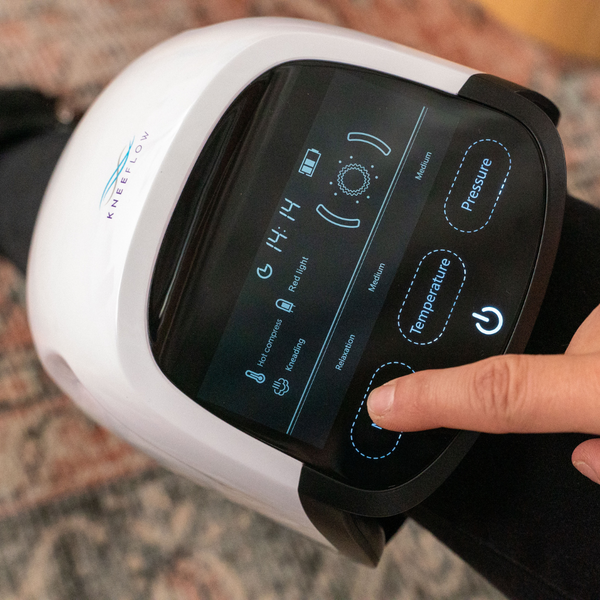
Kneeflow supports people dealing with that exact plateau. If you are looking for a recovery tool that addresses the joint's daily circulatory needs, the Kneeflow heated knee massager combines heat, compression, and targeted massage in a format built for consistent home use.
The System Nobody Talks About in Knee Recovery
Blood circulation has been given more attention in relation to joint health than the corresponding lymphatic system, functioning in parallel to the blood vessels. Around the knee, lymphatic vessels collect proteins, fluid and even waste from cells in active, inflamed or damaged tissue.
In a well-functioning knee, this process is invisible. The joint handles its own housekeeping without any noticeable accumulation. In a knee managing post-surgical trauma, chronic arthritis, or a significant soft tissue injury, the production of fluid outpaces the lymphatic system's clearing capacity.
The result is the swelling that most people describe as the most frustrating aspect of joint recovery, not because it is the most painful symptom, but because it limits movement, delays rehabilitation progress, and persists long after other symptoms have begun to resolve.
Lymphatic drainage massage for the knee works by manually stimulating those vessels to move more efficiently. The technique does not create new drainage capacity. It helps the existing system perform closer to its potential under conditions that have overwhelmed it.
Why This Is Nothing Like a Regular Massage
The most common mistake people make when they first hear about lymphatic drainage massage for the knee is assuming it is a gentler version of deep tissue work. The two techniques share almost nothing beyond the word massage.
Many methods of Deep Tissue and Trigger Points use sustained pressure with some intensity on areas of muscle tension, fascial restrictions and areas of connective tissue adhesions. These methods have little to no effect on the superficial lymphatic vessels. The lymphatic sit in the superficial tissue just beneath the skin and respond to an entirely different kind of stimulus.
Lymphatic vessels are thin-walled and pressure-sensitive. Significant compression collapses them rather than encouraging fluid movement. What they respond to is light, rhythmic, wave-like stimulation that moves the overlying skin slightly in the direction of lymphatic flow. The force used in manual lymphatic drainage is so minimal that people who receive it for the first time often question whether anything is actually happening. The mechanism is working at a level that does not register as conventional touch.
Applying pressure directly at a swollen knee without clearing the pathway ahead of it produces limited results, because there is nowhere for the mobilized fluid to go. What peer-reviewed research on manual lymphatic drainage confirms is that this sequenced, proximal-first approach produces measurable reductions in limb volume and tissue tension that localized pressure alone cannot replicate.
The Situations Where It Makes the Most Difference
Lymphatic drainage massage for the knee is not universally necessary for every presentation of joint discomfort. It is specifically valuable when the dominant symptom is fluid accumulation rather than structural pain, muscular tightness, or mechanical dysfunction.
Much more consistent evidence relates to post-surgical recovery. This is particularly relevant to total knee replacement, ACL reconstruction and meniscus repair. Here, significant swelling can prevent early return of full range of motion and being extremely uncomfortable from distended tissue makes it more difficult to participate in the movement that recovery requires.
Some post-surgical knee rehabilitation guidelines are now including manual lymphatic drainage in the early post-operative period in order to help reduce fluid in the knee as quickly as possible and to aid in a speedier and more comfortable return to exercise. In contrast, chronic knee arthritis is characterized by the synovial membrane continuously in an arthritic joint which overproduces fluid as part of the ongoing inflammatory response, and that fluid rarely resolves completely between flares.
Regular lymphatic drainage massage for the knee in this population does not address the underlying joint changes, but it manages one of their most limiting consequences in a way that consistently improves daily function and range of motion over time.
For acute soft tissue injuries it is best to wait until the initial inflammatory phase has passed. In the first 48 hours after a knee injury of significant force, any form of massage is contraindicated as active inflammation is protective. When the joint is no longer hot, reactive and acute pain is replaced without the same level of heat and reactivity, lymphatic drainage becomes an appropriate and effective recovery tool.
How to Apply It at Home
The self-administered sequence for lymphatic drainage massage for the knee follows the same proximal-first logic as professional manual lymphatic drainage, simplified for practical home use.
Start at the inguinal nodes in the groin. Using the flat of the palm with barely perceptible pressure, make slow, gentle pumping movements aimed toward the crease of the hip for about forty-five seconds. This step is not optional. It is what makes the rest of the sequence work by creating the destination space for fluid to move into.
Move to the thigh with long, upward strokes from just above the knee toward the groin. The sensation should be of skin moving slightly against the underlying tissue, not of pressure penetrating into muscle. Keep both hands in contact and work the inner and outer thigh separately, two minutes per side. The pace is deliberately slow, roughly three to four seconds per stroke.
Address the tissue immediately surrounding the knee using gentle crescent-shaped movements just above and to the sides of the kneecap, always directing the motion upward. Two to three minutes here, with the same feather-light pressure used throughout. Avoid pressing directly into the joint or over any area that is actively hot or tender.
Return to the thigh strokes to move the fluid that has been mobilized toward the groin. The full sequence takes ten to twelve minutes and can be repeated once or twice daily during periods of active swelling, with three to four sessions per week sufficient for maintenance once the acute phase has resolved.
What Makes the Technique Work Better
Consistency matters more than session length. Ten minutes daily for two weeks outperforms a thirty-minute session performed every four days, because regular stimulation keeps the lymphatic vessels responsive and prevents fluid from re-accumulating between sessions to the level it started from.
Hydration supports the entire system. Lymphatic fluid moves more readily when the body is well-hydrated, and sessions performed when someone is chronically mildly dehydrated produce slower clearance than those done with adequate systemic fluid levels. A glass of water before a session and consistent intake throughout the day are the simplest and most accessible supporting habits.
Gentle movement after massage continues the work the technique began. The muscular contractions of a short walk act as a natural pump for lymphatic vessels, which unlike blood vessels have no autonomous pumping mechanism and depend on surrounding tissue movement to keep fluid progressing through them. Complete rest after a session is less effective than ten to fifteen minutes of easy walking followed by elevation.
Closing Thoughts on Lymphatic Drainage and the Knee
Swelling is the symptom that most consistently outlasts every other part of a knee injury or flare. Lymphatic drainage massage for the knee addresses it through a mechanism that rest, ice, and compression can only partially replicate, by actively engaging the system responsible for clearing the fluid rather than simply reducing the conditions that produced it.
Used consistently and with the correct technique, it is one of the more practical and accessible tools available for people whose knee recovery has been stalled by persistent fluid accumulation.
If you want to talk through how targeted recovery support fits into your specific situation, reach out through the contact page and someone on the Kneeflow team will get back to you directly.