Does cold weather affect arthritis in knees? While many people with knee arthritis will tell you that their knee feels worse with cold weather, it is less clear why this is the case and how knowing this will help manage the condition. Most people with knee arthritis will be able to tell you what the first cold front of winter feels like, and most will not need to think about the answer. The joint stiffens. The ache that was manageable a week ago settles in at a different depth.
Stairs that were once no problem in September can become a challenge in November. Whether science has kept up with experience or not, the experience itself is universal to millions of individuals.
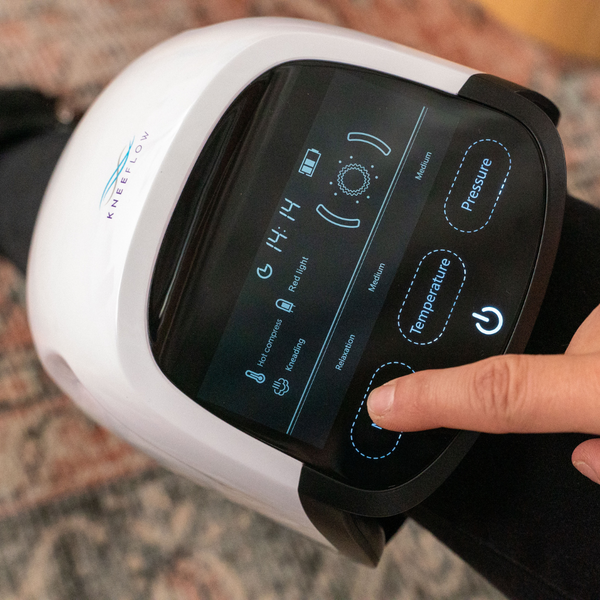
In this piece we look at the science behind weather and joints, the variables that determine the extent to which a person is affected by practical habits that tend to make cold months more manageable. Kneeflow supports people navigating exactly this kind of seasonal challenge. If you are looking for a recovery tool that addresses joint discomfort directly, the Kneeflow heated knee massager combines heat, compression, and massage in a format built for daily use at home.
Does Cold Weather Affect Arthritis in Knees? The Science Behind Cold Weather and Knee Arthritis
The question of whether does cold weather affect arthritis in knees has been studied with enough consistency to produce a reasonable picture, even if some details remain debated. Several mechanisms appear to be operating simultaneously, which is part of why the effect feels so reliable to those who experience it.
Of all the atmospheric variables, barometric pressure is probably the most noted in relation to cold fronts. It generally decreases prior to and during the approach of a cold front. The inner structures of a joint, including the synovial membrane and the structures surrounding the cartilage, are sensitive to pressure differentials. A drop in external pressure allows those tissues to expand slightly.
The space in a normal joint can increase by a few percent without any problems. In arthritic joints with thin cartilage and an irritable synovial membrane, however, such an increase in tissue volume can lead to an increase in pressure and to pain. The evidence from studies on this topic suggests that this mechanism is real, though the magnitude of its effect varies considerably between individuals.
In addition to the above mentioned pathways, temperature itself can affect joint function. Cold temperatures cause the synovial fluid of the joint to become thicker. Such thick synovial fluid is not distributed optimally between the cartilage surfaces and as a result the joint cannot be moved as smoothly as at higher temperatures. The muscles and tendons also stiffen in cold temperatures, altering how load is transmitted through the knee and reducing the dynamic support the joint depends on during activity.
Reduced physical activity in cold weather amplifies both effects. When people move less during winter months, synovial fluid circulation slows, cartilage nutrition suffers, and the muscular support around the knee weakens gradually. This behavioral component is often underestimated when people ask does cold weather affect arthritis in knees, because the temperature is the visible variable and the reduced movement is invisible by comparison.
Why Some People Feel It More Than Others
Does cold weather affect arthritis in knees equally across everyone with the condition? Clearly not. Some people with significant structural joint damage barely register seasonal changes. Others with relatively mild arthritis find winter genuinely limiting. The differences trace back to several interacting factors.
It appears that people vary in their degree of sensitivity to barometric pressure. There are probably individuals in whom the connective tissue of their joints is more sensitive to changes in atmospheric pressure than others. It is well known that the synovial membranes of joints contain pressure-sensitive nerve endings. This is not something that can be changed through lifestyle, but understanding it reframes the experience as a physiological reality rather than a subjective complaint.
In general, a person’s body weight, physical condition and typical level of activity affect how cold weather, less physical activity, staying indoors and choosing sedentary activities over outdoor activities because they are warm affect their joints.
What Happens Inside the Joint During a Cold Spell
Understanding does cold weather affect arthritis in knees means looking at what the joint is actually managing during a temperature drop. In an arthritic knee, the cartilage that once cushioned bone-on-bone contact has thinned. The synovial membrane that produces joint fluid is often in a state of low-grade chronic inflammation. The muscles surrounding the joint may already be carrying more load than they should because the joint itself is less mechanically efficient than it once was.
As cold weather sets in, the synovial fluid within the joint becomes thicker and less able to move around the joint. The already sensitive synovial membrane reacts to the decrease in pressure by producing more inflammation. The muscles around the joint become stiffer, losing their ability to provide dynamic shock absorption. The cumulative effect is a joint that was managing adequately at baseline now dealing with several simultaneous challenges it has less capacity to absorb.
Does Cold Weather Affect Arthritis in Knees: The Barometric Pressure Piece
It’s also important to acknowledge barometric pressure, as this seems to confuse many people. A common report is of knee pain beginning prior to it actually getting cold outside and often the day before a weather front moves through. Note that this is typically prior to the temperature drop and is a result of the drop in pressure before the temperature change, and it is consistent enough that some people with knee arthritis describe themselves as reliable weather predictors.
The information on weather and joint pain provided by the Arthritis Foundation is consistent with the above observation. There is real sensitivity to weather, the cause is described in some detail as an increase in tissue pressure inside the joint capsule due to decrease in external pressure, and that increased pressure affects most of all joints that are already inflamed or structurally compromised. Cold weather amplifies the effect when it arrives, but the barometric shift often arrives first.
Practical Strategies for Cold-Weather Knee Arthritis
Knowing that does cold weather affect arthritis in knees is essentially a yes does not make the winter easier on its own. What makes it easier is building habits that address the specific mechanisms driving cold-weather joint pain.
The simplest way to counteract these factors is to keep the joint warm. Thermal knee sleeves during activity and rest periods at cool times of day can maintain the warmth and circulation in ways that directly counteract the viscosity increase in synovial fluid. Heat applied before activity loosens the joint and reduces the stiffness that cold temperatures promote.
Continuing to move is crucial in winter and is often less easy to maintain than activity in summer when the outdoors is cold. This can be maintained by alternative forms of activity such as cycling, swimming in a warm pool, resistance exercises and bodyweight exercises. The objective is not matching summer activity levels exactly. It is keeping the joint active enough that the behavioral component of cold-weather stiffness does not compound the physiological one.
The consumption of anti-inflammatory nutrients becomes more relevant during winter months as seasonal food choices typically lean towards more calorie-dense, processed foods. Furthermore, cold-weather-induced joint stress creates a state of heightened systemic inflammation that can be positively modulated by the anti-inflammatory nutrients found in the joint needs to cope with seasonal demands.
Closing Thoughts on Cold Weather and Knee Arthritis
Does cold weather affect arthritis in knees? The biology, the clinical observation, and the lived experience of millions of people with the condition all point in the same direction. The effect is real, the mechanisms are multiple, and the most useful response is proactive rather than reactive. Managing cold-weather joint pain well means addressing warmth, movement, nutrition, and recovery as an integrated strategy rather than reaching for relief after the worst has already arrived.
Kneeflow is built around exactly this kind of consistent, daily joint care. If you want to understand how the device fits into a cold-weather management routine for your specific situation, reach out through the contact page and someone on the team will respond directly.