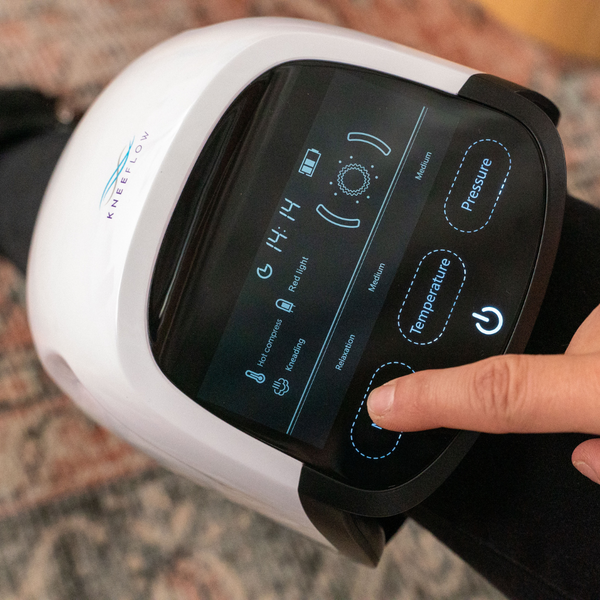
People ask how often to use a knee massager expecting a number. A number isn't wrong to want; it just isn't the right starting point. The honest answer depends on what's happening in the knee right now, what kind of day it's had, and whether the tissue needs warming up or settling down. Get that context wrong, and you're not just wasting a session; you're potentially applying heat to a joint that would be better served by ice and rest.
This guide maps out how often to use a knee massager by condition, because that's the only framing that actually holds. At KneeFlow, we'd rather people use the device correctly half as often than use it carelessly every day.
The Part Most Usage Guides Skip
Knee tissue isn't uniform, and neither is the logic behind how often to use a knee massager depending on what's going on inside it. The joint sits inside a layered structure: muscles that can tighten or weaken, ligaments and tendons that handle load, bursae that can swell when irritated, and cartilage that communicates its state through pain and stiffness rather than clear instructions.
Heat and compression from a massager improve circulation, relax surrounding musculature, and make movement easier in some of those states. In others, the same heat makes the underlying problem worse.
A knee stiff from three hours at a standing desk is not the same as a knee inflamed from a Monday run on pavement. Same joint, same device, opposite responses. That gap is precisely why understanding how often to use a knee massager means starting with condition rather than frequency.
Everyday Stiffness and General Maintenance
For people without any active injury, diagnosed condition, or recent surgery, the answer to how often to use a knee massager lands at once daily and rarely needs to go higher. This is the broadest group: anyone who works at a desk, spends long hours on their feet, walks regularly, or simply notices the knee tightens up after inactivity.
Morning sessions before you start moving work particularly well for people who wake up stiff. Evening sessions fit better for people whose knee fatigue builds through the day.
Fifteen to twenty minutes is the sweet spot for session length in this category. Enough time for the heat to reach the tissue and for circulation to respond meaningfully. Not so long that you're extending exposure past the point of diminishing return. If once daily starts feeling like more than the knee needs, if you notice the area feels heavy or overstimulated the next morning, every other day is a perfectly sensible cadence.
The first two weeks tell you a lot about knowing how often to use a knee massager for maintenance. Consistent improvement in morning mobility and daytime comfort means the frequency is working. A slow accumulation of soreness, especially one that persists into the next day, means pulling back rather than pushing through.
Osteoarthritis and Chronic Discomfort
Consistency changes the picture when osteoarthritis is part of the equation. People managing OA tend to get more out of regular daily use than from sessions scattered across the week whenever they remember. The stiffness that comes with OA is most pronounced in the morning and after rest, which makes a brief session before planned movement particularly effective.
Beyond the baseline frequency, how often to use a knee massager in an OA context carries a timing dimension that doesn't apply in general maintenance. Using the device before activity improves initial mobility. Using it after activity helps ease the fatigue that builds up around an arthritic joint under load. Both have a role. Morning and evening sessions, each running eight to ten minutes rather than the full maintenance length, is a pattern that fits naturally into most routines.
The protocol for how often to use a knee massager shifts completely in one situation. When the knee is noticeably warmer than usual, visibly more swollen, or in an active flare, heat is not the right tool. Warmth drives vasodilation, and vasodilation in an already inflamed joint adds fuel to the problem rather than dampening it.
Cold and rest during a flare. The massager comes back once things have settled. If flares are recurring, that pattern belongs in a conversation with a physician or physiotherapist rather than a device protocol.
After Exercise and Physical Activity
Post-exercise use shifts the question of how often to use a knee massager away from daily maintenance and toward targeted recovery instead. The device functions differently here: less about managing ongoing stiffness and more about helping tissue that's been under sustained mechanical load decompress and settle.
Two to four sessions per week, timed to training days rather than run on a fixed daily schedule, is the practical answer to how often to use a knee massager in an active context.
Wait fifteen to thirty minutes after finishing exercise before applying heat. The joint needs to come down from its post-activity temperature before warmth helps rather than compounds it. Once that window has passed, ten to fifteen minutes at a moderate heat level is usually enough.
A 2022 randomized study in the European Journal of Sport Science found that combined heat and compression post-exercise improved perceived recovery and reduced next-day muscle soreness compared to passive rest, which supports the logic of using a combined-modality device in this window specifically.
If the knee took an unusual hit during training (an impact, a sharp twist, swelling that wasn't there at the start of the session), don't apply heat. Ice and elevation. The heat-friendly post-exercise window assumes a joint that worked hard but stayed intact.
Post-Surgery: A Category Entirely Its Own
How often to use a knee massager after surgery has one answer during the acute phase. You don't. Heat on a recently operated knee can increase local bleeding, worsen post-operative swelling, and disrupt the body's inflammatory cascade at exactly the moment that cascade is doing necessary repair work. This applies across the board in the first weeks after any knee procedure, not just for certain types of surgery or certain patients.
What changes later in rehabilitation is determined by the clinical team, not by reading usage guides. When swelling has substantively reduced, when the patient has moved into a structured rehabilitation phase, and when the physiotherapist or surgeon has specifically cleared heat and compression for the affected joint. That's when the device re-enters the picture. Cautiously. At that point how often to use a knee massager resets to the same conservatism as a first-time user: short sessions, lower heat setting, close attention to how the knee responds.
Build from there based on what the tissue actually tolerates, not based on a target timeline. There is no universal week at which this becomes safe; the individual healing trajectory is what governs it.
Session Duration and How It Connects to Frequency
Duration and frequency are two parts of the same decision, and both shape the answer to how often to use a knee massager across any given week. Session length and weekly count move in opposite directions, and the two variables need to balance against each other. Longer daily sessions mean more accumulated heat exposure over time. Shorter sessions open up more room to add frequency if needed.
Fifteen to twenty minutes per session covers general maintenance and most chronic stiffness scenarios. Ten to fifteen minutes works for post-exercise use where the joint is already warm. Eight to ten minutes is the right entry point for anyone reintroducing use after a flare, which also affects how often to use a knee massager in that early period.
Most devices, ours at KneeFlow included, have auto-shutoff timers built in around these ranges. That's not accidental. Use the shutoff as the natural end of the session rather than resetting it to extend exposure. If the timer feels too short, the right adjustment is frequency across the week, not longer single sessions. To see how our heat settings and timer options are structured, explore the KneeFlow product page.
When the Protocol Pauses Entirely
Certain responses mean the question of how often to use a knee massager becomes temporarily irrelevant until a healthcare provider has assessed what's happening. Pain that increases during a session rather than easing is one. Skin that turns markedly red, feels hot to the touch at the contact site, or shows any sign of irritation is another. Swelling that's measurably worse after use than before it. Numbness. A burning sensation that wasn't there at the start.
Beyond those in-session signals, some presentations mean that asking how often to use a knee massager is the wrong question entirely. A knee that locks, gives way, or feels mechanically unstable. Significant swelling following a fall or a sudden twisting motion. Any joint that sustained visible impact. These are clinical presentations, not usage protocol problems. They need a professional assessment before heat and compression enter the picture.
A Routine That Holds
The most reliable answer to how often to use a knee massager isn't the most ambitious one. It's the one you'll actually stick to.
Once daily, fifteen minutes, at the same time each day, done for four weeks straight, produces more tangible change than an ambitious three-times-daily schedule that falls apart after ten days. The tissue adapts to consistent input, not occasional concentrated effort. Starting conservatively and adjusting upward based on feedback is almost always a better strategy than starting aggressive and dialing back when things go wrong.
For someone working out how often to use a knee massager from scratch, one daily session for the first week is enough. Pay attention to how the knee feels the morning after. If it's better, stay the course. If it's roughly the same, give it another week before changing anything. If it's worse, reduce it to every other day and reassess. That pattern of observation is more useful than any table of suggested frequencies, because it puts the decision where it belongs: with you and what your body is telling you.
For help building a protocol specific to your situation, contact the KneeFlow team, and we'll help you figure out what makes sense.
FAQ
How many times a day can I use a knee massager?
Once is the right starting point for most people, most of the time. Two shorter sessions, morning and evening around ten minutes each, can work well when you've already established how often to use a knee massager at the daily baseline and want to add a second window or post-activity fatigue, provided the knee responds well to the first week of daily use. Going beyond two sessions daily rarely adds benefit and starts increasing cumulative heat exposure to the same tissue area in ways that can cause irritation. The real driver of results isn't session count; it's whether you're doing it consistently over weeks, not whether you're squeezing in an extra round on days when the knee feels particularly stiff.
How long should each session be?
Fifteen to twenty minutes per session is the general range for daily maintenance and chronic discomfort management. Post-exercise sessions work well at ten to fifteen minutes. Reintroduction after a flare or post-surgical clearance should start at eight to ten minutes with a lower heat setting. The auto-shutoff on most devices is calibrated around these ranges; use it rather than overriding it. If you find yourself consistently wanting to extend sessions, the better adjustment is adding a second shorter session on particularly symptomatic days rather than running single sessions past twenty minutes.
Is daily use actually safe?
For most adults without acute injury, active inflammation, recent surgery, circulatory conditions, neuropathy, diabetes, or implanted cardiac devices: yes, once daily at appropriate session lengths is safe. The qualifier matters: how often to use a knee massager safely depends on which of those categories you're in. Someone managing mild chronic stiffness from a sedentary job is in a very different position from someone two weeks out of a partial meniscectomy. If there's any ambiguity about how often to use a knee massager in your specific situation, a short conversation with a physician or physiotherapist before establishing a daily routine is always worth the time.
Can I use it before exercise?
Yes, and it's one of the more practical applications for people whose knees feel particularly reluctant first thing in the morning. A ten-minute session before a walk or a training session warms the surrounding musculature and improves initial range of motion, which makes those first few minutes of movement noticeably more comfortable. Keep pre-exercise sessions shorter than maintenance sessions so the joint is warm but not fatigued. Avoid this application if the knee is already showing signs of inflammation or unusual swelling. Pre-activity heat on an inflamed joint compounds the problem rather than solving it.
What's the right protocol for osteoarthritis?
Once daily as a baseline, with a second short evening session if the stiffness tends to build in the afternoon. Timing matters more than frequency in OA management: using the device before planned movement (a morning session before a walk) tends to make the first several minutes of activity significantly more comfortable. Using it afterward helps the tissue recover from load. The exception is any active flare period with increased warmth or swelling in the joint: heat is contraindicated during those windows. Once the flare settles, return to the usual pattern and mention it to the clinician managing your care.
What about after knee surgery?
No use during the acute post-operative phase, which typically spans several weeks after any knee procedure. The body's healing response in that period involves a carefully regulated inflammatory process, and heat disrupts it. The appropriate time to reintroduce a heated massager is determined by the surgical team or physiotherapist, not by any external timeline. When clearance comes, start with short sessions at the lowest heat setting and build based on tolerance and clinical guidance. There is no fixed week at which how often to use a knee massager post-surgically becomes safe across the board; individual healing varies too much for that kind of generalization.
What if I've been using it too often?
Skin irritation, surface redness, a burning sensation that persists after the session, or a knee that consistently feels worse the morning after are the clearest signals. Any of those means pulling back: reduce session length first, and if that doesn't help, reduce frequency to every other day. For joints that are already inflamed, overuse with a heated device can compound the inflammation rather than settle it. The pattern to watch is whether the knee improves across the week or whether the baseline shifts slowly in the wrong direction. The second outcome means the current protocol isn't right. It doesn't mean the device is wrong, just that the timing or duration needs adjusting.
How long until I notice a difference?
The warmth and pressure from the first session usually feel good right away, but that immediate effect is short-lived. The changes that matter (reduced morning stiffness, better tolerance for sustained activity, a baseline that feels lower than it did before) tend to emerge across two to four weeks of consistent use. That timeline shifts depending on what's being managed, how well the rest of the person's routine supports joint health, and whether the protocol is actually being followed consistently. Knowing how often to use a knee massager matters less than knowing what surrounds the sessions. Using it alongside regular exercise and professional care when relevant produces more durable change than relying on the device alone.