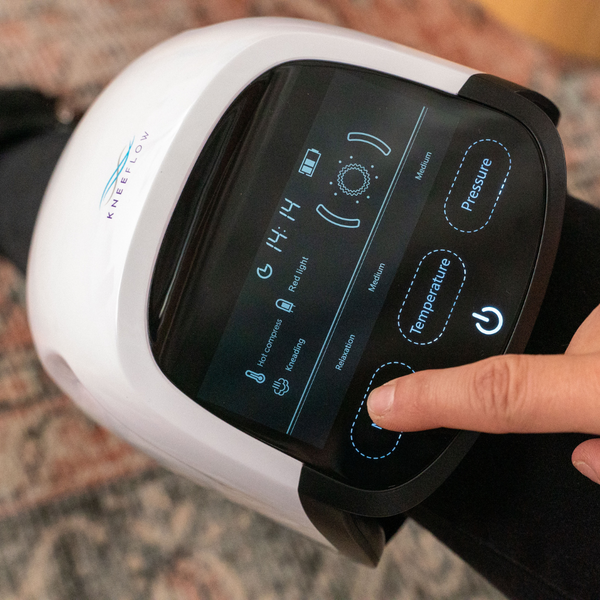
People search how does a knee massager work for two different reasons. Some have already bought one and want to understand what it's actually doing during a session. Others are still deciding, trying to separate the mechanism from the marketing before committing. Both groups deserve the same answer: a clear explanation of what the device physically does, what the research says about each component, and where the evidence holds up against where it gets murkier.
At KneeFlow, we think that kind of transparency belongs in the conversation before someone clicks buy, not after.
How Heat Affects the Knee
Anyone asking how does a knee massager work should start here: heat is the most well-documented component, and the one with the clearest mechanistic evidence. When a massager applies controlled warmth to the knee, several things happen in the surrounding tissue simultaneously. Blood vessels dilate through a process called vasodilation.
Local circulation increases as a result, bringing oxygen and nutrients to the area and supporting the removal of metabolic byproducts. The surrounding musculature relaxes as elevated tissue temperature reduces the resistance of the muscle fibers. And the nociceptors, the sensory nerve endings that register pain signals, are modulated by the thermal input in ways that reduce the intensity of pain perception.
A 2024 expert opinion paper published in Frontiers in Rehabilitation Sciences reviewed the literature on heat therapy specifically for knee pathologies and characterized it as a well-established treatment option for its capacity to promote muscle relaxation, enhance blood circulation, and modulate nociceptors with a good safety profile.
That combination of effects is what physically explains the comfort people feel, and it's at the core of how does a knee massager work from a biological standpoint: the joint feels looser, movement becomes easier, and the background ache that was present before the session is quieter afterward.
Research on thermotherapy for knee osteoarthritis, published through PubMed Central, confirms that heat helps to relax muscles and increase circulation to the affected area, thus reducing pain and stiffness, with the important caveat that it may in some cases worsen inflammation and edema.
How Compression Works on Joint Tissue
Pressure around the joint does something different from heat, and understanding how does a knee massager work fully requires separating the two. Compression acts on the tissue through mechanical rather than thermal pathways.
The most straightforward effect is proprioceptive. The skin and the mechanoreceptors beneath it are sensitive to pressure and contact. When consistent compression is applied around the knee, those receptors fire more actively, sending the brain richer spatial information about where the joint is in space and how it's moving.
Research has suggested that compression around joints stimulates mechanoreceptors, leading to improvement in proprioception and balance. A systematic review and meta-analysis in Physical Therapy in Sport found that joint stabilizers enhanced knee proprioception, with the pooled evidence suggesting that the effects come not merely from altered mechanical stability but also from subtle changes in musculoskeletal activation.
The second effect of compression is competitive inhibition of pain signals. When tactile and painful stimuli compete for simultaneous processing, there is a modulation of the conduction of nociceptive impulses and a reduction in the central perception of pain, a mechanism that aligns with the gate control theory of pain.
The pressure creates competing sensory input that the nervous system prioritizes over the pain signal, and this is one of the most practically useful aspects of how does a knee massager work to understand. This is why people often describe the compression component of a knee massager as grounding: it doesn't eliminate the discomfort so much as it crowds it out.
The Role of Vibration and Kneading
The vibration component is the third layer in understanding how does a knee massager work, and it's where the evidence requires the most nuance. The mechanism here draws on the same proprioceptive and neuromuscular pathways, with the addition of rhythmic mechanical stimulation that has its own effects on tissue state.
Vibration applied locally can help loosen tight connective tissue, improve local circulation beyond what heat alone produces, and contribute to sensory stimulation of the area in a way that some people find meaningfully reduces perceived stiffness.
The evidence base for vibration specifically in knee conditions is more variable than it is for heat or compression. A 2025 umbrella review of systematic reviews on vibration therapy for knee osteoarthritis, published through PubMed, found inconsistent findings across studies, with benefits more reliably documented when vibration is combined with strengthening exercise than when used passively in isolation.
Consumer-grade wearable vibration operates at lower intensities than the clinical-grade equipment used in most studies, so extrapolating directly from clinical literature to device performance requires caution.
What remains consistent across the different study contexts: vibration adds a sensory input that many users find helpful for reducing the sense of joint tightness, which is a genuine part of the answer to how does a knee massager work even if the magnitude is harder to pin down. The mechanism is plausible. The magnitude of the effect in a wearable consumer device is an honest question.
What Happens During an Actual Session
Putting the three mechanisms together answers how does a knee massager work in practical terms. When someone puts on a knee massager and starts a session, the heat begins warming the surrounding tissue within the first few minutes. Muscle tension in the quadriceps and hamstrings starts releasing.
The compression simultaneously engages the mechanoreceptors, which shifts the proprioceptive picture and begins the competitive inhibition of pain signals. If vibration is part of the session, it adds an additional layer of sensory stimulation on top of both.
Over fifteen to twenty minutes, these effects accumulate. By the end of a session, the joint is sitting in tissue that's warmer, better perfused, and less mechanically tense than it was before. The subjective result is usually a reduction in stiffness and a sense of greater ease of movement. That effect is documented and physiologically grounded.
It is also temporary: the tissue doesn't retain the warmth, the pain gate closes again once compression is removed, and nothing about the underlying joint structure has changed.
That's the honest answer to how does a knee massager work: it creates a favorable tissue environment that makes movement more comfortable during and shortly after each session. Accumulated over consistent use, many people find this translates into meaningfully better daily function. Whether it does depends on the specific condition, the consistency of use, and what else is happening in the person's overall approach to knee health.
Where a Knee Massager Fits and Where It Doesn't
Once you understand how does a knee massager work at a mechanistic level, the situations where the device belongs and where it doesn't become much clearer.
Heat and compression are most appropriate for chronic stiffness, everyday tension after prolonged activity, or the kind of joint fatigue that builds through a long day. That's the core use case that how does a knee massager work explanations should center on. For people managing osteoarthritis, the tissue environment created by a good session can make a meaningful difference in daily mobility. For active people whose knees tighten after training, post-exercise use supports the tissue settling process.
Heat is contraindicated on an acutely inflamed knee. If the joint is warmer than usual, visibly swollen, or in an active flare, warmth drives vasodilation into an area that's already dealing with excess fluid and inflammatory activity. The effect compounds the problem. This is also why heat and compression devices are not appropriate in the acute phase following any knee surgery or significant injury: the biological processes underway in that window do not benefit from additional thermal input.
Anyone with circulatory conditions, diabetes, neuropathy, implanted cardiac devices, or reduced skin sensitivity should consult a healthcare provider before using a heated knee massager. The reduced feedback from numbed or poorly perfused tissue means it's harder to gauge whether the heat is at a safe level.
The Difference Between Comfort and Treatment
This is the distinction that matters most in any honest answer to how does a knee massager work. The device produces physiological effects that have genuine documentation behind them. What it doesn't do is treat the underlying condition causing the discomfort.
Osteoarthritis involves cartilage degradation. A knee massager doesn't reverse that. Muscle weakness around the joint leads to instability and increased load on the joint surface. Heat and compression don't build strength. If there's a structural cause for knee pain, the path to addressing it runs through professional care: physical therapy, appropriate exercise, medical management, and in some cases surgery. A massager is a complementary tool in that picture, not a replacement for any part of it.
Wellbeing support and clinical treatment are different things. A device that reliably creates a comfortable tissue environment, improves daily quality of life, and reduces the background presence of stiffness is genuinely valuable. Just not in the way that a diagnosis, a structured rehabilitation program, or a physician's guidance are valuable.
Keeping those distinctions clear is what allows people to use devices like this intelligently. That's the complete answer to how does a knee massager work: it does something real, within specific limits, and those limits matter. For questions about whether a KneeFlow device fits your specific situation, contact the KneeFlow team, and we'll give you a straight answer.
FAQ
How does a knee massager work differently for osteoarthritis vs. general stiffness?
For general everyday stiffness, the main effects are muscular relaxation and improved local circulation, both of which respond well to heat and compression over a fifteen to twenty minute session. For osteoarthritis, the same mechanisms are in play, but the context matters more. OA involves structural changes in the joint that the device doesn't influence. What it does influence is the tissue environment around a joint that's already compromised, reducing the muscle guarding and circulatory stagnation that build up over time. For OA, consistent daily use tends to produce more meaningful benefit than occasional sessions, and timing relative to planned activity matters: a session before a walk is often more useful than one mid-afternoon with no particular trigger.
Does heat from a knee massager reduce inflammation?
Not in the structural sense that word usually implies, and this is one of the most important clarifications in any honest answer to how does a knee massager work. Heat supports comfort and circulation. It promotes muscle relaxation and modulates pain perception through effects on nociceptors. What it doesn't do is reduce the underlying inflammatory process in the joint. In fact, applying heat during an active inflammatory flare (when the joint is already warm, swollen, or in the middle of an OA exacerbation) can worsen the condition by adding vasodilation to an area already dealing with excess fluid. Heat works for chronic stiffness and muscle tension. It's contraindicated during active inflammation. That's a meaningful distinction worth understanding before using any heated device on a symptomatic knee.
What does the compression component of a knee massager actually do?
The compression element of how does a knee massager work acts through two main pathways. The first is proprioceptive: the mechanoreceptors in the skin and underlying tissue respond to consistent pressure by firing more actively, which sends richer spatial information to the brain about joint position and movement. This can improve the sense of stability and coordination around the knee. The second is competitive inhibition of pain signals: tactile input from the compression competes with pain signals for processing, which can reduce the perceived intensity of discomfort. Neither effect is permanent; both require the compression to be present to remain active.
How does a knee massager work compared to a TENS unit?
Understanding how does a knee massager work versus how a TENS unit works starts with recognizing they address different biological systems entirely. A knee massager uses heat, compression, and sometimes vibration to influence the physical and thermal state of the tissue around the joint. A TENS unit uses low-voltage electrical impulses through adhesive electrode pads to modulate the nervous system's processing of pain signals, drawing on the gate control theory at a neurological level. The massager targets tissue environment; the TENS unit targets pain perception through the nervous system. Neither treats underlying structural conditions. For people whose primary issue is chronic pain perception, TENS has documented short-term analgesic effects.
Can I use a knee massager after a knee injury?
Part of understanding how does a knee massager work is knowing when the device doesn't belong. It depends entirely on when the injury occurred and what kind it is. In the acute phase of any knee injury (typically the first 48 to 72 hours, or any period with active swelling and increased joint warmth), heat is not appropriate and can make the condition worse. Cold therapy, rest, compression, and elevation apply in that window. Once the acute phase has passed, once swelling has meaningfully reduced and the injury has been assessed by a healthcare provider, gentle heat and compression may have a role in supporting the return of comfortable movement.
How long does the effect of a knee massager session last?
The immediate effects (reduced stiffness, improved ease of movement, quieter background discomfort) are temporary. The warmth dissipates within thirty to sixty minutes of removing the device. The proprioceptive and competitive inhibition effects of compression fade as the pressure is removed. Over consistent use across weeks and months, many people find their baseline improves: the knee starts the morning with less stiffness, recovers from activity more readily, and requires less coaxing before movement feels accessible. That longer-term shift is part of the real-world answer to how does a knee massager work: accumulated tissue effect from regular sessions, not from any single one.
Is there real science behind how knee massagers work?
Yes, and understanding how does a knee massager work means understanding what that science actually covers. Heat therapy has a well-documented evidence base for knee applications specifically. A 2024 expert opinion paper in Frontiers in Rehabilitation Sciences, reviewing literature on heat therapy for knee pathologies, confirmed its established role in promoting muscle relaxation, enhancing circulation, and modulating pain-sensing nerve endings. Compression and proprioception have supporting evidence through joint stabilizer research. Vibration's evidence base is more mixed, with better support for combined therapeutic protocols than for passive consumer device use alone.