The surgery itself takes one to two hours. What comes after it takes closer to a year, and for older adults, the path looks different enough from what younger patients experience that most general recovery guides miss the point entirely. Knee replacement recovery time for elderly patients isn't just a longer version of the same story.
The starting conditions are different, the variables that shape the outcome carry more weight, and the margin for expectation gaps between what patients anticipate and what actually happens tends to be wider.
This isn't a guide about staying positive or following your surgeon's orders. What most people searching knee replacement recovery time for elderly actually want is a clearer picture of the road ahead. Those things matter, but they're not what people are actually trying to figure out when they search this topic. What most patients and families want to know is: what is coming, when does it get easier, and what can make the difference between a recovery that goes well and one that stalls.
At KneeFlow, helping people understand that territory honestly is something we think belongs in the conversation from the start.
What Makes Recovery Different in Older Adults
At 72, the body doesn't approach post-surgical healing the way it does at 52. The biological timeline for muscle repair runs roughly six to eight weeks across most age groups, and it's one of the most misleading numbers in the knee replacement recovery time for elderly conversation when taken without context. What it doesn't account for is the baseline.
Older adults who undergo total knee arthroplasty typically arrive at the operating table with quadriceps muscles that have been working around a painful joint for years. Those muscles are already weakened before the first incision. A 2023 systematic review in the Journal of Clinical Medicine, examining patient-reported outcomes following total knee replacement in adults aged 65 and over, found that TKR produces genuine improvements in pain, function, and life quality across this population.
Its findings speak directly to what shapes knee replacement recovery time for elderly patients: the benefits are real and consistent, but patients aged 75 and older showed smaller average gains than those aged 65 to 74. That gap matters for goal-setting. Progress in the older cohort doesn't look the same as progress in a 58-year-old, and comparing the two sets people up to feel like they're falling behind when they aren't.
A 2024 study published through the World Journal of Orthopedics on rehabilitation care for post-surgical knee patients in older adults confirmed something else worth naming: accelerated rehabilitation protocols, often called enhanced recovery after surgery programs, can improve outcomes in elderly patients, but only under close clinical supervision.
The Recovery Timeline: What Each Phase Looks Like
The first two to six weeks after surgery are the most physically demanding of the entire process. Swelling is significant, pain is managed with medication, and movement is carefully structured by the surgical team and hospital physiotherapist. Most patients start gentle range-of-motion exercises within the first 24 hours.
Six weeks to three months is often the most pivotal window in knee replacement recovery time for elderly patients. The sharpest pain begins to ease, and structured physical therapy takes over as the main driver. Gait retraining, stair work, strength exercises, and gradual endurance-building replace the early focus on basic mobility.
A prospective cohort study published through PubMed in 2025, assessing outcomes via the Knee Society Score, documented meaningful improvements in both pain and function by the three-month mark, one of the clearest benchmarks in knee replacement recovery time for elderly to share with patients who are struggling to see progress in weeks two or four.
Between three and six months, daily life starts to reconstitute itself. Driving comes back, carefully. Getting up from a chair without the full concentration it required at six weeks becomes routine again. The knee still fatigues, especially after anything sustained, and swelling lingers after longer days. That's not a sign something is wrong.
It's the joint and the surrounding tissue still negotiating a new normal. Knee replacement recovery time for elderly adults shifts in focus from pain control to capacity building: the stamina and confidence that come back slowly when the pre-surgical baseline was already compromised.
knee replacement recovery time for elderly: What Slows Recovery Down
Several factors have consistent evidence behind them as predictors of longer or more difficult knee replacement recovery time for elderly. Understanding them before surgery helps patients and families set expectations and plan support accordingly.
Comorbidity burden carries the most weight in the research. A 2022 study published in the Journals of Gerontology, drawing from the FORCE-TJR cohort, found that each step up in comorbidity severity using the Charlson Comorbidity Index corresponded to a statistically significant increase in the likelihood of a non-resilient outcome after total knee replacement.
Cardiovascular disease, diabetes, chronic respiratory conditions: none of them bar the door to surgery, but all of them ask more of a body that's already managing multiple demands. The healing resources have to be shared.
BMI is one of the more modifiable factors shaping knee replacement recovery time for elderly outcomes for patients with time to address it before the procedure. That same FORCE-TJR analysis found higher BMI independently associated with smaller functional gains. A 2024 predictive model published in Frontiers in Medicine identified BMI, sleep quality, and bone mineral density as significant predictors of poor recovery after total knee arthroplasty.
Programs that worked on the fear response alongside the physical exercises produced better results than those that addressed only the physical side. Pain teaches avoidance. Avoidance delays the very movements that are supposed to restore function. Breaking that cycle is part of the clinical work.
The Role of Physical Therapy and Clinical Supervision
No variable in the recovery picture matters more than what happens in physical therapy, and specifically how consistently and fully the patient engages with it. Quadriceps strength is what makes the new joint actually function in daily life: sitting, standing, walking with stability. The surgical implant creates the mechanical possibility. Physical therapy builds the muscle capacity that realizes it.
This fear response is one of the underappreciated forces extending knee replacement recovery time for elderly patients beyond what clinical timelines would otherwise suggest. Patients who hold back from exercises because movement feels threatening don't just recover more slowly; they often develop compensatory patterns that create secondary problems down the road.
A 2024 randomized study of elderly post-TKA patients found that structured education addressing kinesiophobia, layered on top of standard physical therapy, produced meaningfully better rehabilitation outcomes at every assessment point from one month through six months compared to physical therapy alone.
Showing up is not the same as working through it, and this is the part of knee replacement recovery time for elderly that resists being put on a calendar. The patients who come out of this process with the best functional outcomes tend to share a specific quality: they treat the home exercise program with the same seriousness as the clinic visits.
Between sessions is where most of the progress either happens or doesn't. The physiotherapist can calibrate the plan, but only with the information the patient brings back about what felt right and what didn't.
Sleep, Nutrition, and the Factors That Support Healing
The nutritional and sleep dimensions of knee replacement recovery time for elderly are less visible than physical therapy but equally grounded in biology. Surgery places massive metabolic demand on a system that, in older adults, is already operating with less reserve than it had at 50.
This is one of the aspects of knee replacement recovery time for elderly that families are best positioned to actively influence, because the practical support they provide shapes the conditions under which healing happens.
Protein is the raw material for tissue repair. Not just general good eating, but specifically enough protein and enough total calories to fund the rebuilding of muscle around the new joint. A registered dietitian can advise on individual targets, which vary with body weight, existing nutritional status, and what medications are on board. The point is not dietary perfection. It's providing the building blocks the body can't source on its own when they aren't coming in through food.
Practical adjustments help: keeping the limb positioned correctly to reduce nocturnal throbbing, cutting stimulants in the evenings, and flagging persistent sleep disruption to the care team rather than accepting it as an inevitability, because chronic sleep debt impairs immune function and slows tissue repair in measurable ways.
Fluid intake is another variable in knee replacement recovery time for elderly that consistently gets underestimated. Circulation depends on hydration. Some post-operative medications are harder on the kidneys when intake is low. The care team can advise on what's appropriate given cardiac or renal considerations.
Managing Swelling and Discomfort in the Later Stages
Managing swelling is an underappreciated part of knee replacement recovery time for elderly that catches families off guard months into the process. It doesn't always go away cleanly at six weeks, and in older adults whose lymphatic return is less efficient, it can be a companion well into the fourth and fifth month.
One of the most common misunderstandings in knee replacement recovery time for elderly involves heat timing. Heat on an actively inflamed knee does not soothe it. It vasodilates an area already dealing with inflammation and can compound the swelling rather than ease it. Cold therapy is appropriate in the acute window. The transition to warmth, if it becomes appropriate at all, is a clinical decision based on how the knee is actually healing. Not a number of weeks on a calendar.
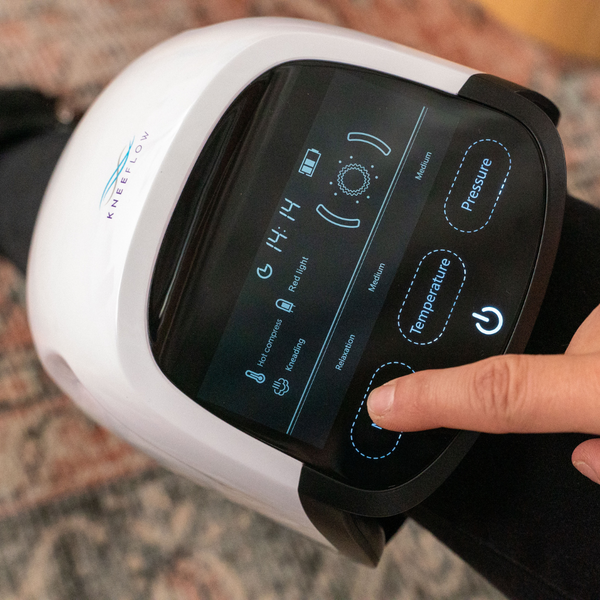
At KneeFlow, we hear from people in various stages of recovery who want to know whether our device belongs in their plan. The honest answer is that it depends entirely on where they are and what their surgeon or physiotherapist has cleared. Our device uses heat, compression, and massage.
None of those belong near a post-surgical knee in its acute phase. If someone is further along, inflammation has settled, and a healthcare provider has explicitly authorized gentle heat and compression for the affected area, we're glad to help them think through whether the device fits that context.
When to Contact a Healthcare Provider
Certain situations during knee replacement recovery time for elderly require same-day medical attention rather than a wait-and-see approach. Knowing them before they happen is what allows families to act decisively when they matter. A calf that becomes painful, swollen, or tight should be evaluated the same day; it may indicate a deep vein thrombosis. Redness spreading from the surgical site, warmth that seems to be increasing rather than decreasing, or swelling that surges without obvious cause can signal infection. Fever outside the range the surgical team defined as acceptable needs a call.
This distinction matters throughout knee replacement recovery time for elderly: a knee that feels mechanically unreliable (like it might give way, or like something is moving that shouldn't be) is not the same as a knee that aches from activity. The second one is expected. The first one should be reported. Pain that has a different character from the expected post-surgical soreness, particularly anything shooting or suddenly much more intense than the established pattern, belongs in front of a clinician, not on the wait list.
Setting Realistic Expectations Before the Day of Surgery
What may be the most overlooked dimension of knee replacement recovery time for elderly is the conversation that should happen weeks before surgery, not in the car on the way home from the hospital. The research on patient satisfaction after total knee replacement consistently finds that expectations set before the procedure shape how people interpret outcomes afterward. Patients who went in expecting a difficult process and a long road tend to report higher satisfaction with the same clinical results than patients who expected to feel normal in a month.
Knowing that knee replacement recovery time for elderly spans the better part of a year for most people, that the early weeks involve substantial pain and dependency, that swelling and fatigue can persist well past the three-month point, and that the implant keeps settling and adapting for the full twelve months. All of that reframes the experience from falling behind to being exactly on track.
Surgery delivers on that promise for most people who need it, and the evidence for meaningful gains from knee replacement recovery time for elderly in older adults is consistent enough to build confidence on. For questions about where at-home knee wellness tools fit into a later stage of that journey, communicate with us and we will help you think through what makes sense for where you actually are.
FAQ
How long does knee replacement recovery take for elderly patients?
Knee replacement recovery time for elderly patients generally runs six to twelve months before most people reach the functional plateau the procedure is designed to produce. The first three months cover the sharpest pain and the most intensive rehabilitation work. Daily independence for most activities returns somewhere between three and six months for patients who engage consistently with physical therapy. The twelve-month mark is when clinical teams typically assess final outcomes, though the implant continues to feel more natural beyond that window.
Why does recovery take longer for older adults than for younger patients?
Several things converge to extend knee replacement recovery time for elderly individuals beyond what younger patients experience. The most significant is the starting point for rehabilitation. Years of compensating for a painful knee erode quadriceps strength before the surgery even happens, which means post-operative strengthening begins from a lower baseline. Tissue regeneration slows with age as a biological fact. Comorbid conditions (cardiovascular disease, diabetes, chronic lung conditions) require the body to allocate healing resources across competing demands. Research from the Journals of Gerontology tied increasing comorbidity burden directly to poorer recovery trajectories after total knee replacement.
What matters most during recovery?
Physical therapy is the most powerful variable in knee replacement recovery time for elderly patients, and consistent engagement with both the clinic visits and the home program between them is what drives the outcome. Beyond that: sleep supports the biological repair process and disrupting it consistently slows recovery in documented ways. Adequate protein intake gives the body the material it needs to rebuild the muscle the implant depends on. Reporting problems to the care team early, rather than hoping they resolve, allows the clinical team to intervene before small complications become larger ones.
What makes recovery harder for some elderly patients than others?
The research points clearly to a set of factors that predict more difficult knee replacement recovery time for elderly patients. Higher BMI is independently associated with lower functional gains, as documented in multiple cohort studies including the FORCE-TJR analysis. Greater comorbidity burden carries the most consistent evidence across the literature. Sleep quality and bone mineral density emerged as significant predictors in a 2024 Frontiers in Medicine model. Sarcopenic obesity (reduced muscle mass combined with excess body fat) carries the highest individual risk for limited range-of-motion recovery post-surgery.
When is it safe to use heat or a massage device after knee replacement?
Not during the acute phase, which is when most people think to ask. Heat applied to a knee that is still actively inflamed after surgery does not provide comfort; it promotes vasodilation in an already swollen area and can worsen the problem. Cold therapy, used as the surgical team directs, is appropriate in the early weeks. The shift to heat, if it becomes appropriate at all, is determined by the clinical team based on how the specific knee is healing, not by a standard number of days post-procedure.
What symptoms require immediate medical attention?
Several symptoms during knee replacement recovery require same-day evaluation rather than the next available appointment. A calf that becomes painful, swollen, or hard warrants urgent assessment for deep vein thrombosis. Fever outside the range the surgical team defined as acceptable, redness or warmth spreading from the surgical site, or swelling that suddenly increases without a clear mechanical cause can all indicate infection. A wound that reopens or fails to close needs to be seen promptly. Pain that changes character dramatically from the expected post-surgical ache, particularly anything shooting, neurological, or suddenly much more intense, should not be attributed to normal healing without clinical evaluation.
How much does physical therapy matter for elderly recovery outcomes?
More than most patients realize going in, and the evidence is consistent. Physical therapy rebuilds the quadriceps strength that determines how functional the new joint actually becomes in everyday use. A 2024 randomized study of elderly post-TKA patients found that adding structured kinesiophobia education to standard PT produced significantly better outcomes at every follow-up point from one through six months, compared to standard PT alone. The ceiling on outcomes isn't set by the surgery. It's set by how much strength and confidence the patient builds afterward. Attendance is necessary but not sufficient.
What do families and caregivers need to prepare for?
Knee replacement recovery time for elderly patients is a household experience, not just an individual one. The first six to eight weeks usually require substantial hands-on help with basic daily tasks: transportation, meal preparation, household management, and the kind of steady presence that makes it easier for a patient to rest and rehabilitate without added stress. Planning that support before surgery, not the morning of discharge, makes a meaningful difference. Families who understand what the early weeks look like and who know the warning signs that require prompt medical contact are better equipped to be an active part of the recovery rather than bystanders trying to interpret what they're seeing.