An extremely painful knee has a way of taking over your whole life. You feel it when you get out of bed, when you climb stairs. When you try to squat, sit cross-legged, or even just stand at the sink for more than a few minutes. It’s not “just a small ache” anymore. It’s sharp, heavy, and exhausting.
If that’s where you are right now, you’re not alone. Knee pain is one of the most common joint problems in adults. And no, it’s not always “just age” or “just overuse.” There are real reasons your knee is screaming and also real ways to calm it down.
In this blog, we’ll walk through:
- What actually causes an extremely painful knee
- When to worry and see a doctor
- Common treatments (from simple home steps to surgery)
- How tools like a knee massager for pain relief can fit into your plan
- Why do many people with arthritis look for the best knee massager for arthritis instead of relying only on pills
And yes, we’ll also talk about when a gadget helps and when it’s not enough on its own.
Inside the Knee: Why Each Structure Is Essential for Stability and Motion
The knee is far more complex than a simple hinge joint. It is a sophisticated biomechanical system made up of bones, cartilage, ligaments, tendons, and fluid-filled bursae, all functioning in unison to support both stability and smooth motion. Every step, bend, twist, or jump requires precise coordination between these structures.
A closer look at the key components:
-
Bones – The joint is formed by the femur (thigh bone), tibia (shin bone), and patella (kneecap), creating the primary framework of the knee.
-
Articular cartilage – A smooth, shock-absorbing layer that covers the ends of the bones, allowing low-friction movement.
-
Menisci – Two C-shaped fibrocartilage discs that act as stabilizers and distribute body weight evenly across the joint.
-
Ligaments – The ACL, PCL, MCL, and LCL provide structural support and prevent excessive movement by holding the bones in proper alignment.
-
Tendons – These attach the muscles to the bones and transfer muscular force to produce controlled motion.
-
Bursae – Small, fluid-filled sacs that reduce friction between tissues, especially during repetitive movement.
Because each component plays a crucial role, dysfunction in even one structure—whether from irritation, degeneration, overload, or a tear—can quickly lead to pain, instability, or impaired mobility. This interconnected design is what makes the knee incredibly strong yet highly vulnerable to injury.
Common causes of extremely painful knees
There are a lot of labels doctors use: arthritis, meniscus tear, patellar something, bursitis, and so on. But most really painful knees fall into a few main buckets.
1. Sudden injuries (you remember “the moment it went”)
This is usually obvious. One wrong step. A twist on the football field. A fall from a step. You hear or feel a “pop,” or your knee gives way, and pain hits hard.
These injuries often include:
- Ligament tears – ACL, MCL, LCL, PCL
- Meniscus tear – the shock-absorbing cartilage gets torn
- Fracture – broken kneecap or other bone
- Dislocation – kneecap slips out of place
Red flag signs after an injury:
- The knee swells quickly
- You can’t put weight on it
- It feels unstable, like it will buckle
- You can’t straighten or bend it fully
This is not a “wait and see for a month” situation. That’s a “get it checked properly” situation.
2. Overuse and strain (creeps up over time)
Not every painful knee has a big injury story behind it. For a lot of people, pain slowly builds from:
- Long days standing or walking
- Hard leg workouts without enough recovery
- Running on hard surfaces
- Regular squatting, kneeling, or climbing stairs
These can lead to:
- Tendonitis – inflamed tendons (often the patellar tendon just below the kneecap)
- Bursitis – irritated fluid sacs around the knee
- IT band friction – pain on the outer side of the knee
This type of pain is often:
- Worse with activity
- Better with rest
- Achy, sometimes sharp on certain movements
Overuse of stuff sounds “mild,” but when it gets angry, it can be extremely painful too. Especially when you ignore early warning signs and keep pushing.
3. Arthritis (when the joint itself is wearing out or is inflamed)
If your knee:
- Feels stiff in the morning
- Clicks or grinds
- Swells on and off
- Hurts after sitting too long, then “warms up” as you move
…you might be dealing with arthritis.
The big ones:
- Osteoarthritis: Cartilage wears down over time. Bones start to rub more. Very common after 40, but it can show up earlier if you’ve had injuries, surgery, or heavy physical work.
- Rheumatoid arthritis/inflammatory arthritis: Autoimmune. Your immune system attacks your joint lining. Knees get swollen, hot, and very painful, often on both sides.
This is where a lot of people start searching for the best knee massager for arthritis to add to their routine. Why? Constant stiffness and dull, grinding pain are draining, and people want something they can use at home instead of living on pills all day.
A good knee massager for pain relief can’t reverse arthritis, but it can:
- Warm up the joint
- Improve local circulation
- Relax the tight muscles around the knee
- Temporarily ease stiffness
We’ll get into that more in a bit.
4. Other reasons your knee may scream
Less talked about, but still important:
- Gout: sharp, sudden pain, often with redness and swelling
- Infection in the joint: intense pain, warmth, fever, medical emergency
- Referred pain from hip/back: knee hurts, but the real problem is elsewhere
- Excess body weight: more load on your knee with every step
If your knee is extremely painful and you also feel sick or feverish, or if your skin is very hot and red, don’t mess around. You need urgent medical care.
When knee pain is an emergency
Get immediate help (ER/emergency services) if:
- You can’t put weight on the leg at all
- The knee looks badly deformed
- You heard a loud pop and had instant swelling
- The knee is hot, red, very swollen, and you feel feverish
- You’ve had a big fall, a car accident, or a sports injury
These are not times to try a home remedy or a knee massager. The first step is a proper medical evaluation.
How doctors figure out what’s wrong
If your knee pain is severe and doesn’t calm down in a few days, you really do want a professional to look at it. Usually they will:
- Ask what happened and how the pain started
- Examine your knee, pressing, bending, and checking stability
- Maybe order tests:
- X-ray (to see bones)
- MRI (to see ligaments, meniscus, cartilage)
- Blood tests (for infection or inflammatory arthritis)
It may feel like overkill, but getting the right diagnosis means you get the right treatment instead of just randomly trying things.

How can you treat an extremely painful knee?
Treatment depends on the cause, but in real life, people usually use a mix:
1. Basic home care (especially for mild injuries or flare-ups)
For many people, the first 3–7 days look like this:
- Rest: backing off heavy impact, deep squats, stairs
- Ice or heat:
- Ice right after a fresh injury
- Heat for chronic stiffness and arthritis
- Compression: elastic bandage or knee sleeve
- Elevation: keep the leg raised when possible
Pain Killers: Many use over-the-counter options like paracetamol or NSAIDs after speaking to a doctor or pharmacist. Don’t overdo them or mix randomly. They’re not candy.
2. Physiotherapy and exercises
When the worst pain settles, a good physio can change everything:
- Strengthening the muscles around your knee (quads, hamstrings, glutes)
- Improving your movement patterns and posture
- Stretching tight structures that pull on the joint
- Teaching you safe ways to squat, sit, climb, and train
If your knee always hurts after the same moves, chances are your mechanics or muscle balance need work. That’s exactly what physio addresses.
3. Braces, supports, and lifestyle tweaks
Depending on what’s going on:
- Knee brace or strap
- Better shoes with proper cushioning
- Losing a bit of weight if there’s extra strain on the joint
- Swapping high-impact exercise (jumping, running) for lower-impact ones (cycling, swimming, walking on softer surfaces)
None of this is glamorous, but it adds up.
4. Injections and surgery (for more serious problems)
In some cases, doctors may suggest:
- Steroid injections to calm inflammation
- Viscosupplementation (gel injections) in some arthritis cases
- Arthroscopic surgery for certain tears
- Knee replacement is performed when the joint is heavily damaged and nothing else is helping
These are big steps. Most people try conservative options first, and many do get enough relief without major surgery.
Where a knee massager fits into all this
Now let’s talk about something more practical and immediate: using a knee massager for pain relief at home.
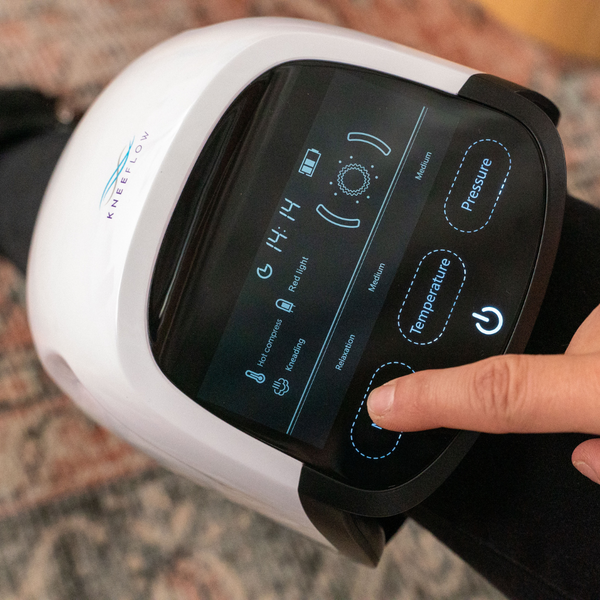
Devices like the Kneeflow Massager are built for exactly this, helping with ongoing knee pain from:
- Osteoarthritis
- Old sports injuries
- Overuse from training
- Post-surgery stiffness (when your doctor says it’s okay)
Kneeflow is designed as a 3-in-1 therapy tool:
- Infrared light to support blood flow and reduce local inflammation
- Heat therapy to relax stiff muscles and soothe the joint
- Airbag massage, gentle compression that wraps around the whole knee
You strap it on, pick a mode on the touchscreen, and in around 15 minutes, you’ve given your knee a proper focused session without going anywhere.
For many users, that’s the difference between “dragging the leg through the day” and “okay, I can move again.”
Why people with arthritis reach for a knee massager
If you have arthritis, you already know the pattern:
- Morning stiffness
- Pain after sitting too long
- Knees are complaining when the weather changes
- Deep ache after a bit of walking or climbing stairs
The best knee massager for arthritis is not magic, but it can:
- Warm up the joint before you start your day
- Make it easier to do your physio exercises
- Calm the knee down after activity
- Give you a non-drug option for bad days
Kneeflow is built exactly with this crowd in mind:
- Adjustable heat (45°C to 55°C), so you control how warm it gets
- Three preset modes: Relax, Recover, Repair
- 19 infrared lights targeting the joint area
- Soft airbags that hug the whole knee, not just one spot
- Cordless, lightweight design (about 790 g) with rechargeable battery
So instead of just swallowing another pill, you’ve got a physical, targeted way to tell your knee, “Okay, time to calm down.”
Using a knee massager for pain relief the smart way
A few practical tips if you’re considering a device like Kneeflow:
-
Start with shorter sessions: Even if it’s designed for 15 minutes, you can start with 5–10 minutes to see how your knee responds.
-
Pick the right mode for your situation
- Trouble starting the day? Use the Relax mode for gentle warmth and circulation.
- Post-workout stiffness? Recover mode can help your muscles settle down.
- Arthritis flare or long-term pain? Repair mode is made for deeper work on stiffness and inflammation.
-
Don’t crank everything to max right away: More heat and more pressure aren’t always better. Find the lowest level that feels genuinely soothing, not overwhelming.
-
Use it consistently: The people who rave about their knee massager usually use it regularly: once or twice a day, not just once a week.
-
Combine it with movement: Warm the knee with Kneeflow, then do your simple stretches and strengthening exercises. The combo works better than either one alone.
So… what’s the best way to move forward?
If your knee pain is:
- New and severe → get it checked.
- Ongoing and draining your energy → don’t just put up with it.
- Clearly linked to arthritis or old injuries → build a routine that includes movement, basic strength work, and smart tools.
That “smart tools” part is where a device like the Kneeflow can shine. It gives you:
- Heat
- Infrared light
- Gentle compression massage
All in one, in 15-minute sessions, anywhere at home, at work, or after a workout.
If you’re ready to take your knee pain seriously instead of endlessly complaining about it, you can explore Kneeflow.
FAQs
1. Can a knee massager really help with arthritis pain?
Yes, for many people it does help. Arthritis won’t completely disappear, but using a knee massager for pain relief can:
- Ease stiffness
- Improve circulation
- Relax the tight muscles around the joint
This often means less “rusty” mornings and better comfort during the day. The best knee massager for arthritis is one that combines heat, massage, and light therapy, like Kneeflow, and that you can use regularly without hassle.
2. Can a knee massager replace physiotherapy or medical treatment?
No, it shouldn’t replace proper medical care. Think of it as a support tool, not the whole solution.
You still need:
- A good diagnosis
- Exercises to strengthen and stabilize your knee
- Advice on activity, weight, and movement patterns
A device like Kneeflow fits in alongside these things. It can make exercises easier to do (because you’re less stiff and sore) and help calm the knee after a long day.
3. How often can I use a knee massager?
Most people safely use their knee massager once or twice a day, especially during painful phases. For example:
- 15 minutes in the morning to loosen up
- 15 minutes in the evening after work or training
If you have specific medical conditions (like severe vascular disease, infections, or recent surgery), ask your doctor how often you should use it and when it’s best to wait.
4. Is Kneeflow only for arthritis, or can athletes use it too?
Athletes actually love this kind of device. Kneeflow is useful for:
- Post-training recovery
- Reducing soreness after running, squats, or jumps
- Warm up before the activity to get blood flowing into the joint
- Managing old injuries that flare when training volume goes up