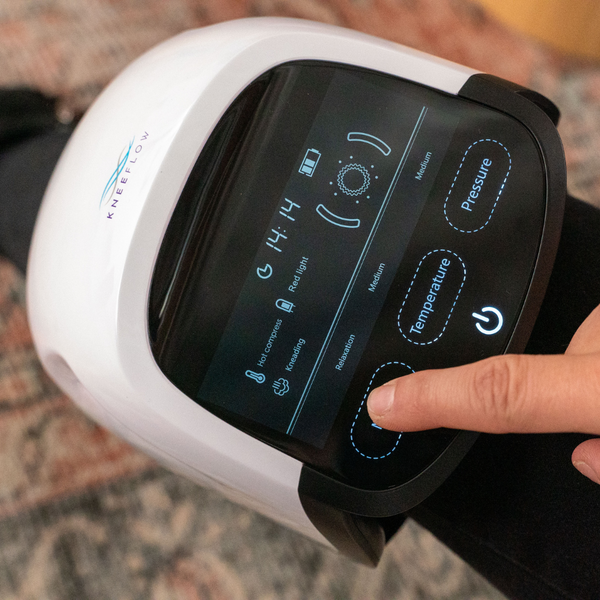
The Kneeflow vs Comfier question comes up often because both products sit in the same shelf category, heated wearable knee massagers, but are built around different assumptions about who the user is and what they actually need. One of those assumptions treats knee discomfort as a comfort problem. The other treats it as a tissue problem.
Walk into any online marketplace and search for knee massagers. Comfier appears immediately. Hundreds of reviews, accessible prices, a product page designed to reassure. On the next search result, Kneeflow. Fewer reviews but a different level of specificity about what the device is doing to the tissue it wraps around.
That distinction changes everything about how each device is designed. The Kneeflow heated knee massager is built around the tissue problem framework. Heat, compression, and near-infrared photobiomodulation working simultaneously on the joint and the structures around it.
Kneeflow vs Comfier: What Comfier Is Selling
Accessibility. And it delivers on that.
Comfier's knee massager lineup ranges from around $45 to $79. The core offering is a rechargeable wearable brace that heats the tissue and vibrates. Some models include basic 660nm red LEDs marketed as red light therapy. The controls are simple. The setup takes seconds. The result is a warm, lightly vibrating knee that feels better than a cold, stiff one.
That is a real benefit. Heat relaxes tight surrounding musculature. Warmth increases surface circulation. Vibration provides a sensory input that many people find genuinely soothing after a long day. None of this is fake or fabricated benefit. It is comfort, delivered at a price point that makes it accessible to a wide audience.
The ceiling on that benefit is where the honest Kneeflow vs Comfier conversation begins.
Vibration works at the surface. It stimulates the skin and the layers just beneath it without any documented mechanism for reaching the synovial membrane, the joint capsule, or the cellular environment where chronic knee conditions like osteoarthritis actually operate.
Heat penetrates further but is limited in what it can change at the biological level without a modality working alongside it at greater depth. The 660nm LEDs in the models that include them are absorbed primarily in superficial tissue. Near-infrared, the wavelength that reaches joint structures at therapeutic depth, is a different technology with different penetration characteristics.
Comfier is a comfort device. That is a legitimate thing to be. It is not the same thing as a clinical-grade joint recovery tool.
Kneeflow vs Comfier: What Kneeflow Is Doing Instead
Three mechanisms. Simultaneously. All three directed at the knee joint.
A dedicated heating element is part of a complete system. It produces heat that not only heats up tissues but also optimizes the distribution of synovial fluid within a joint and releases muscular tension. The quadriceps, hamstring and calf muscles acquire tension during the day while you are active. The morning stiffness that remains for hours after is caused by fluid that has pooled and thickened during hours of immobility. Heat, applied consistently before activity begins, shortens the time that stiffness lasts.
Compression is the second mechanism, and it is entirely absent from Comfier's design. A purposeful feature to reduce post-activity swelling and manage fluid in the joint space, as well as provide appropriate proprioception to better enable the joint to track during activities. These features are not cosmetic differences. Swelling management and proprioception are clinically documented contributors to how well arthritic and overloaded knees function day to day.
The third mechanism of action for near-infrared red light therapy that distinguishes Kneeflow from Comfier is the depth of penetration into the biological tissues. Near-infrared light between 800-850nm penetrates several centimeters into biological tissue, reaching the joint capsule and synovial structures where the biology of knee pain originates.
Inside those cells, the light is absorbed by cytochrome c oxidase in the mitochondria. ATP production increases. Nitric oxide releases into surrounding vasculature. Pro-inflammatory cytokines including IL-1β and TNF-α decrease in expression. These are documented cellular-level changes with a body of controlled research behind them across multiple knee conditions.
That is what separates warmth and vibration from something built on a different foundation entirely.
The 660nm vs Near-Infrared Problem
Some Comfier models include what they describe as red light therapy.
Worth examining what that means. The LEDs on those models emit at 660nm, visible red light. It gets strongly absorbed in the upper layers of skin so that by the time it gets down to your joints several cm below the surface of your skin at typical power for consumer outputs. It provides some surface-level photobiomodulation benefit and contributes to the warm glow visible through the device.
Near-infrared, around 850nm, behaves differently in tissue. It scatters less. It penetrates further. It reaches the structures inside and immediately surrounding the joint where conditions like osteoarthritis, patellar tendinopathy, and chronic synovial inflammation live. Both can be called red light therapy. Only one of them reaches the depth where it matters for joint-level treatment.
This is not a technicality. It is the difference between surface comfort and cellular-level intervention and Kneeflow vs Comfier.
Kneeflow vs Comfier: Price, Honestly Framed
Comfier: $45 to $79. Kneeflow: $119.
That $40 to $74 gap is real. For someone evaluating these devices as equivalent products at different prices, the cheaper option looks obviously correct. The problem is that they are not equivalent products.
Buying a comfort device to manage a clinical condition is not a bargain. It is a misallocation. Someone with knee osteoarthritis using a Comfier device daily is paying for surface relief while the inflammatory biology of their condition continues without being meaningfully addressed. Someone using Kneeflow daily is investing $119, once, in a rechargeable device that delivers photobiomodulation, compression, and heat simultaneously for every session indefinitely.
The right question is not which costs less. It is which one addresses what is actually happening in the joint. For mild discomfort and post-activity warmth, Comfier's price is appropriate for its function. For daily clinical management of a specific knee condition, $119 is a different calculation entirely.
Who Uses Comfier Well
Someone who wants to feel better after a long day. That is specific and honest.
Evening relaxation after hours on their feet. Post-workout warmth around a knee that is tired but not pathologically compromised. A gift for someone whose knee is sore in the way that most people's knees get sore without a specific diagnosis. These are the use cases where Comfier's combination of affordability, simplicity, and genuine comfort benefit makes it a sensible choice.
The device does not require clinical reasoning to use. It does not require a diagnosis. It provides warmth, vibration, and some surface-level red light stimulus, and many people find real relief within those parameters.
Who Uses Kneeflow Well
Someone whose knee has a specific, ongoing problem that affects daily life.
Stiffness that is still present an hour after getting out of bed. Swelling that is visible after a walk and has not fully resolved by the following morning. The ache of arthritis that worsens with cold, with inactivity, with weather changes. Tendon pain that responds temporarily to rest but returns predictably with any increase in activity. Post-surgical recovery that needs targeted joint support between physical therapy appointments.
These are the situations where the thermal, mechanical, and photobiological approach of Kneeflow produces outcomes that Comfier cannot. Not because Comfier is poorly designed. Because Comfier was not designed for this. If this is your case, and you didn’t know which device Kneeflow vs Comfier pick, but feel more identified with our Knee massager, you are free to contact us and know more about it.