Nobody sits down to research a knee device because things are going well. You're reading this because something is off: maybe it's that grinding stiffness after an hour at your desk, maybe it's the kind of morning soreness that makes the first few steps feel like a negotiation. And now you're somewhere in the middle of a search result comparing two gadgets that look nothing alike and supposedly do similar things. They don't. That's the first thing worth saying out loud.
The debate around TENS unit for knee pain vs massage keeps circulating because nobody stops to explain the actual difference in mechanism. Most comparisons frame it as a competition. It isn't. Both show up in the same shopping searches. Both get positioned as "pain relief." Both have research behind them. But they work on completely different parts of your body's response to discomfort, which means the question isn't which one wins.
It's which one speaks to what's actually happening in your knee. At KneeFlow, sorting that out clearly is something we think every buyer deserves before opening their wallet.
What a TENS Unit Actually Does
Anyone working through the TENS unit for knee pain vs massage question needs to start here, because this is where the two paths diverge. TENS is short for transcutaneous electrical nerve stimulation, and the name describes the mechanism precisely: electrical current, applied through the skin, targeting nerves. Adhesive electrode pads go onto the skin near the painful area, and the device sends low-voltage pulses through them. What happens next is where it gets interesting.
The dominant explanation comes from what's called the gate control theory of pain, developed by Melzack and Wall. Large nerve fibers, when stimulated electrically, compete with the smaller pain-signal fibers at the spinal cord level.
That competition narrows the pathway through which pain information reaches the brain, and the "gate" closes a little. Low-frequency TENS may also nudge the body toward releasing endorphins, though that effect is frequency-dependent and not guaranteed across devices or settings.
Clinically, TENS has built a track record as a complement to supervised exercise and physical therapy, not as a standalone fix. A systematic review and meta-analysis registered on PROSPERO in November 2024 and published in 2026 examined dose-response patterns of TENS specifically for knee osteoarthritis pain.
The finding: short-term analgesia is achievable, but the evidence positions TENS as an adjunct to active care, not a substitute. Set alongside that: a 2019 guideline from the American College of Rheumatology went further and explicitly recommended against TENS as a primary intervention for osteoarthritis pain.
What a Knee Massager Actually Does
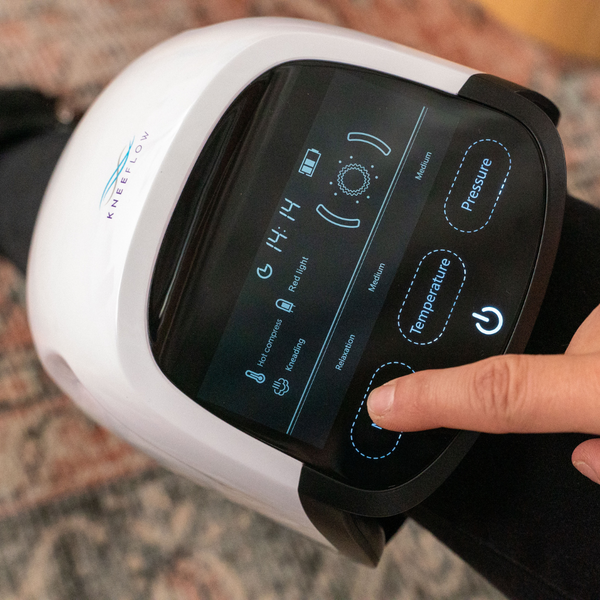
Nothing about a knee massager touches your nervous system the way TENS does. The physics are different from the start. Heat penetrates soft tissue, dilates local blood vessels, and relaxes the surrounding musculature.
Vibration, when it's part of the device, operates through mechanical stimulation of the tissue. A 2025 umbrella review published through PubMed covering multiple systematic reviews on vibration therapy for knee osteoarthritis lands on a measured conclusion: findings are mixed, benefits are modest. Vibration is safe in the right context. It is not magic.
Compression rounds things out, and this is the point that deserves attention for anyone who has been mentally filing the TENS unit for knee pain vs massage choice as a question of intensity rather than mechanism. Consistent pressure around the joint creates a sense of support and stability, dampens the loose feeling that can accompany a sore or stiff knee, and provides proprioceptive input that many people find genuinely grounding during activity or rest.
Put all three together, and you have a device that works on the physical environment around the joint (circulation, muscle state, pressure), not on the neural signal that tells you the joint hurts. That distinction is what separates the massager side of the TENS unit for knee pain vs massage equation from the electrical stimulation side. Same shelf in the pharmacy.
When TENS Is the Better Fit
The TENS unit for knee pain vs massage comparison starts to clarify when you separate stiffness from chronic pain perception. Stiffness is one thing. The sustained experience of pain itself is another, and TENS is built for the second category. If you're someone whose knee discomfort has become the main thing standing between you and moving through your day.
Not tightness, not fatigue, but the sustained experience of pain itself. That's when the neurological interference mechanism of TENS has something concrete to offer. The 2022 randomized controlled study published in the European Journal of Pain found that active TENS produced lower knee pain scores meaningfully during functional activities, compared to a sham unit.
TENS devices for consumer use carry FDA Class II clearance, which means they've cleared a regulatory threshold. That matters, but so do the contraindications, and they're worth reading carefully before anything else. People with implanted cardiac devices (pacemakers, defibrillators, neurostimulators) should not use TENS.
None of that makes TENS a dangerous device for the right user. On the TENS unit for knee pain vs massage spectrum, the electrical stimulation option carries more conditions. It makes it a device with a profile. You need to match that profile honestly before treating it as a general-purpose solution.
When a Knee Massager Is the Better Fit
Shifting the TENS unit for knee pain vs massage question toward the massager side starts with one practical observation. Pay attention to how your knee actually feels in the moments that bother you most. Is it pain, sharp and persistent, something that makes you wince? Or is it more like your joint just hasn't woken up yet, like it needs coaxing before it cooperates? That second description: the morning lock, the post-desk creakiness, the fatigue that settles in after a long walk.
A massager also has a consistency advantage in the TENS unit for knee pain vs massage comparison that often goes unmentioned. No pad placement strategy, no skin prep, no matching frequency settings to your specific nerve fiber profile.
You put it on, choose your heat level, and it runs. For someone building a daily knee wellness routine they'll actually follow before bed or after a morning walk without thinking twice about it, that low friction matters enormously. Behavior change research is pretty clear: the easier something is to do, the more often it gets done.
That's where the TENS unit for knee pain vs massage choice becomes straightforward for a significant portion of people. At KneeFlow, we built our device around exactly that use case. The daily maintenance scenario, not the acute pain management scenario.
The Honest Limitations of Both
Buy either device expecting a cure and you'll be disappointed. That applies to both ends of the TENS unit for knee pain vs massage choice equally. TENS unit for knee pain vs massage is ultimately a question about two support tools, and the clinical literature treats both of them as exactly that.
On the TENS side: the electrical stimulation closes the pain gate while the device is active. Turn it off, and the gate reopens. The endorphin effect fades. Nothing about the underlying structural situation in your knee has changed. TENS does not repair cartilage, does not reduce inflammation in any structural sense, and does not rehabilitate muscle imbalances. It makes pain more manageable in the moment. For some people, that's enormously valuable. It is not the same as treatment.
A knee massager operates under a similar ceiling, approached from a different direction. Warmth and compression ease the feeling of tightness and get circulation moving through a sluggish joint. But if tightness is rooted in a degenerating joint surface, a significant muscle imbalance, or a structural problem that physical therapy hasn't addressed yet, the massager is treating a symptom, not its source. It still has a role. That role just has limits.
When symptoms are new, worsening, or following some kind of injury (a fall, a sudden twist, a pop you felt), neither of these devices belongs in the picture until you've had a professional evaluation. Swelling, inability to bear weight, joint instability, locking, a knee that feels warm or looks visibly deformed: those are clinical presentations, not wellness device presentations. Get them looked at first.
Combining the Two of them
The TENS unit for knee pain vs massage framing quietly pressures people into thinking they need to pick one and commit. Many people use both over time, and there's a logical case for it. TENS during activity can make movement accessible by dulling the pain threshold enough to get you moving. Heat and compression afterward can ease the tension that built up and help the area settle. Different moments, different tools, different jobs.
Anyone using both in sequence needs to stay clear on which TENS unit for knee pain vs massage rules apply to each separately. The timing has to be deliberate. Heat on a knee that's acutely inflamed is counterproductive regardless of what preceded it. TENS during any activity that demands monitoring your body's physical feedback (driving, operating machinery, sleeping) is not appropriate.
Using both simultaneously is not recommended; each has a safety profile, and overlapping them without understanding each one creates unnecessary variables. For anyone managing a diagnosed condition, bringing a second modality into the routine is a conversation worth having with whoever's managing your care, not a solo decision.
Making the Decision That Fits Your Life
Here's the practical split. If the dominant thing you're managing is chronic pain perception, something that's been evaluated, diagnosed, and is now being managed alongside exercise and professional care, TENS offers a documented short-term analgesic tool that may make that management meaningfully easier.
Use it with attention to the contraindications, use it with professional guidance if you're managing a diagnosed condition, and don't expect it to do more than it's built to do.
If what you're managing looks more like daily stiffness, fatigue after activity, the kind of knee discomfort that accumulates quietly rather than demanding your attention: a massager is the simpler, lower-risk place to start. It costs less cognitive overhead to use consistently, and consistency is most of what separates a wellness routine that works from one that collects dust on a shelf.
Stripped of the marketing noise from both sides, the TENS unit for knee pain vs massage question doesn't have a universal correct answer. What it has is a framework for thinking about your own knee clearly enough to make the TENS unit for knee pain vs massage decision on your own terms, for your specific situation.
When in doubt about which one that is, a healthcare provider is the right starting point, not a product comparison article. For questions about how heat, compression, and massage fit into a daily knee wellness routine, contact KneeFlow now; we're happy to help you think through what makes sense.
FAQ
What is the main difference between a TENS unit and a knee massager?
A TENS unit works by sending low-voltage electrical pulses through adhesive pads placed on the skin, targeting nerve pathways to interrupt how pain signals reach the brain. That's a neurological mechanism. A knee massager operates through physical inputs: heat to loosen surrounding muscle tissue and draw circulation to the area, vibration to add mechanical stimulation, and compression to provide steady pressure around the joint. The two tools don't do the same thing at different intensities. They engage completely separate biological systems.
Does a TENS unit actually work for knee pain?
It can, under specific conditions, and the distinction matters. A 2024-registered systematic review and meta-analysis on TENS for knee osteoarthritis pain, published in 2026, found evidence for short-term analgesia, particularly when TENS supports an active care program rather than replacing one. A 2022 randomized controlled trial in the European Journal of Pain confirmed that active TENS produced lower pain scores during functional activities compared to a sham device. The other side of that picture: a network meta-analysis comparing electrical stimulation modalities found standard TENS is not among the most effective options for sustained pain relief.
Who should not use a TENS unit on the knee?
The contraindication list is specific and serious enough to read carefully before purchasing. Anyone with an implanted cardiac device (pacemaker, defibrillator, neurostimulator) should not use TENS because the current can interfere with those devices at a cardiac level. Pregnancy is a firm contraindication, especially near the lower back or abdomen. Skin that's broken, infected, or has significantly reduced sensation should not have electrodes placed on it; without accurate feedback, tissue damage is possible before you'd notice. Metal implants near the knee, including joint replacement hardware, can distort how the current travels and need professional evaluation before TENS is used in that region.
Is a knee massager safe for everyone?
Not without qualifications. Heat should never be applied during the acute phase of a knee injury (roughly the first 48 to 72 hours after impact, strain, or the onset of significant swelling), because it adds vasodilation to an area that is already inflamed and can compound the problem. People with diabetes, peripheral neuropathy, or circulatory conditions may have reduced sensation that makes it difficult to gauge whether heat is at a safe level, which is why a physician's guidance matters for those groups. Anyone with implanted cardiac hardware, a bleeding disorder, or a skin condition that affects surface integrity should check in with their doctor before using a heated wearable device.
Can I use both a TENS unit and a knee massager together?
Sequential use (massager before or after a TENS session) is generally reasonable for healthy adults who have no contraindications to either device. Using both at the same time is not appropriate; they need to be used separately so you can monitor your body's response to each. A few timing principles to hold onto: heat should stay off a knee that's acutely inflamed, regardless of what else is in the routine. TENS shouldn't be active during any task requiring you to monitor physical sensation carefully.
How many times a day can I use a TENS unit for knee pain?
Most consumer TENS units are considered safe for multiple sessions daily in healthy adults without contraindications. Standard guidance suggests sessions of 20 to 60 minutes with rest periods between them, partly to let the skin recover and partly because prolonged continuous use can lead to habituation, where the nervous system adapts to the signal and the analgesic effect diminishes. Using TENS while sleeping is not recommended; if pads shift during the night, you lose the ability to monitor the sensation and respond to any discomfort at the placement site.
What type of knee pain is a massager most suited for?
The situations where a massager tends to deliver the most tangible benefit share a common feature: stiffness or tension rather than acute pain. Waking up with a knee that feels locked or slow, standing up after a long meeting to find the joint needs a few minutes before it cooperates, finishing a walk and feeling a heaviness that lingers: all of that points toward circulation and muscle tension as the core issue. Heat addresses both by relaxing the surrounding tissue and encouraging blood flow. Compression adds stability and proprioceptive input. Where a massager is less suited: fresh injuries with active swelling, severe pain from a diagnosed structural condition, or any symptoms that haven't been professionally evaluated yet.
Does the research favor TENS or massage for knee osteoarthritis?
Neither has a clear edge for all people across all stages of the condition. TENS has a larger body of randomized controlled trial data specifically targeting knee osteoarthritis, but the effect sizes are generally small to moderate, the findings are inconsistent across studies, and the leading clinical guidelines are divided on whether to recommend it. Thermotherapy has strong face validity for comfort and stiffness, but most vibration research uses clinical-grade equipment that isn't comparable to a consumer wearable. Both categories produce temporary, modest benefits rather than structural improvement.